Information retrieval

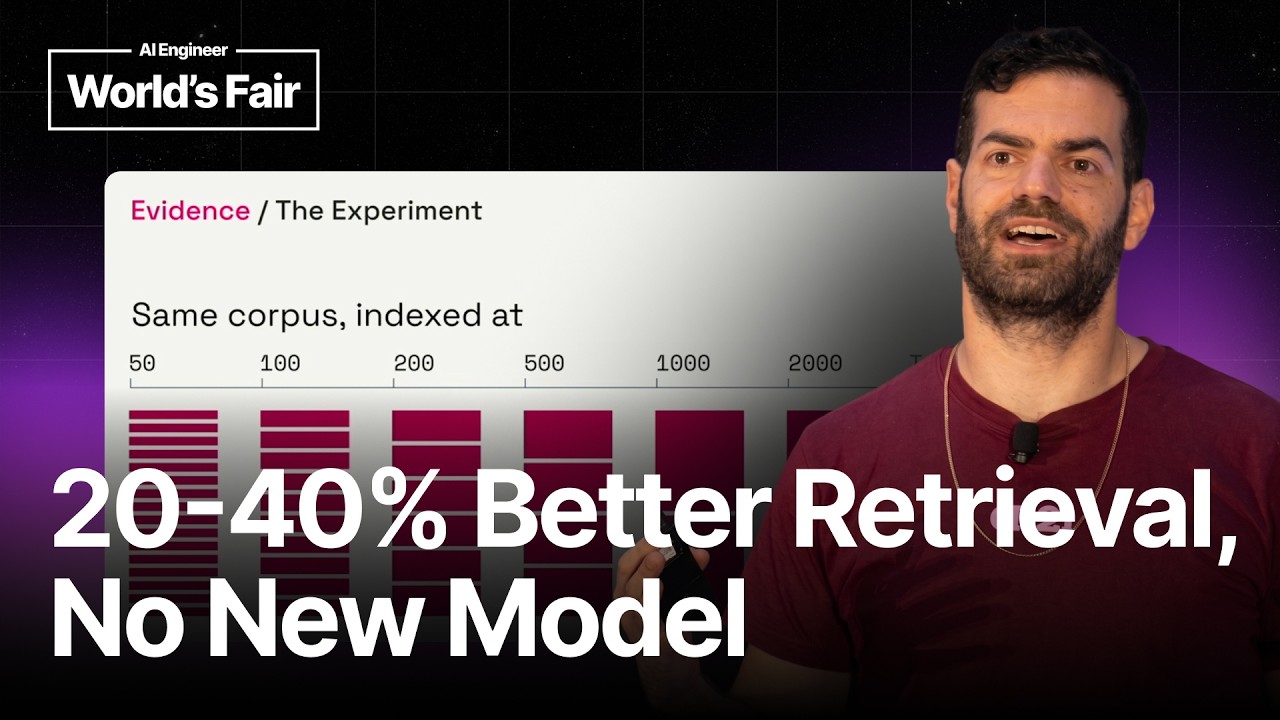
Stop Chunking Like It's 2022 — Yuval Belfer, AI21 Labs

Stop Chunking Like It's 2022 — Yuval Belfer, AI21 Labs

Yuval Belfer addresses the fundamental challenge in Retrieval Augmented Generation (RAG): the optimal chunk size is query-dependent, but chunking decisions are fixed during indexing. This "information problem" leads to significant recall loss, as shown by experiments demonstrating a 20-40% gap between fixed chunking and an oracle. His proposed solution, multiscale indexing, involves creating multiple document copies with different chunk sizes, querying all of them, retrieving whole documents, and merging results using Reciprocal Rank Fusion, yielding substantial recall improvements with minimal latency increase.


If we want them to do Knowledge Work, design them as Knowledge Agents — Benjamin Clavié, Mixedbread

If we want them to do Knowledge Work, design them as Knowledge Agents — Benjamin Clavié, Mixedbread

Benjamin Clavié argues that the industry has mistakenly generalized from the "easy case" of coding agents to the much harder domain of general knowledge work. He highlights that code offers durable, explicit cues and narrow tasks, while knowledge work involves implicit meaning, contextual understanding, and agents needing to reconstruct intent. Clavié traces human solutions through "tool loops" and "organization loops," demonstrating how optimized tools and hierarchical agentic structures (like searcher agents generating memos) are essential to overcome performance ceilings and significantly bridge the "oracle gap" between AI and human knowledge workers.

The Search Engine for the Agentic Web — Will Bryk, Exa

The Search Engine for the Agentic Web — Will Bryk, Exa

Exa's CEO, William Bryk, discusses the impending AI search boom, predicting machines will soon outpace human searches dramatically. He explains Exa's evolution from a consumer search engine to an API for AI agents, driven by the realization that LLMs need external, 'perfect' retrieval to overcome the limitations of traditional search and combat societal misinformation. Exa leverages neural networks, embeddings, and customized features to provide fast, accurate, and cost-efficient information, with plans for a private data marketplace, aiming to deliver 'a year of research in a second' for AI agents and foster a deeply informed society.

The unreasonable effectiveness of BM25 for agentic search — Jo Kristian Bergum, Hornet.dev

The unreasonable effectiveness of BM25 for agentic search — Jo Kristian Bergum, Hornet.dev

Jo Kristian Bergum argues that the 30-year-old lexical search function BM25 is making a powerful comeback, not because it has changed, but because LLM agents are fundamentally different and more capable users. He highlights how these agents, with their general knowledge and ability to formulate complex queries, leverage BM25's strengths. Using the Browsecom+ benchmark, he demonstrates that reasoning isn't the bottleneck for LLMs, but effective retrieval and query formulation are. He advocates for a "file system workspace" approach, allowing models to use their existing coding and bash skills to interact with retrieved documents, signaling a shift in how search systems are designed and evaluated for agentic applications.

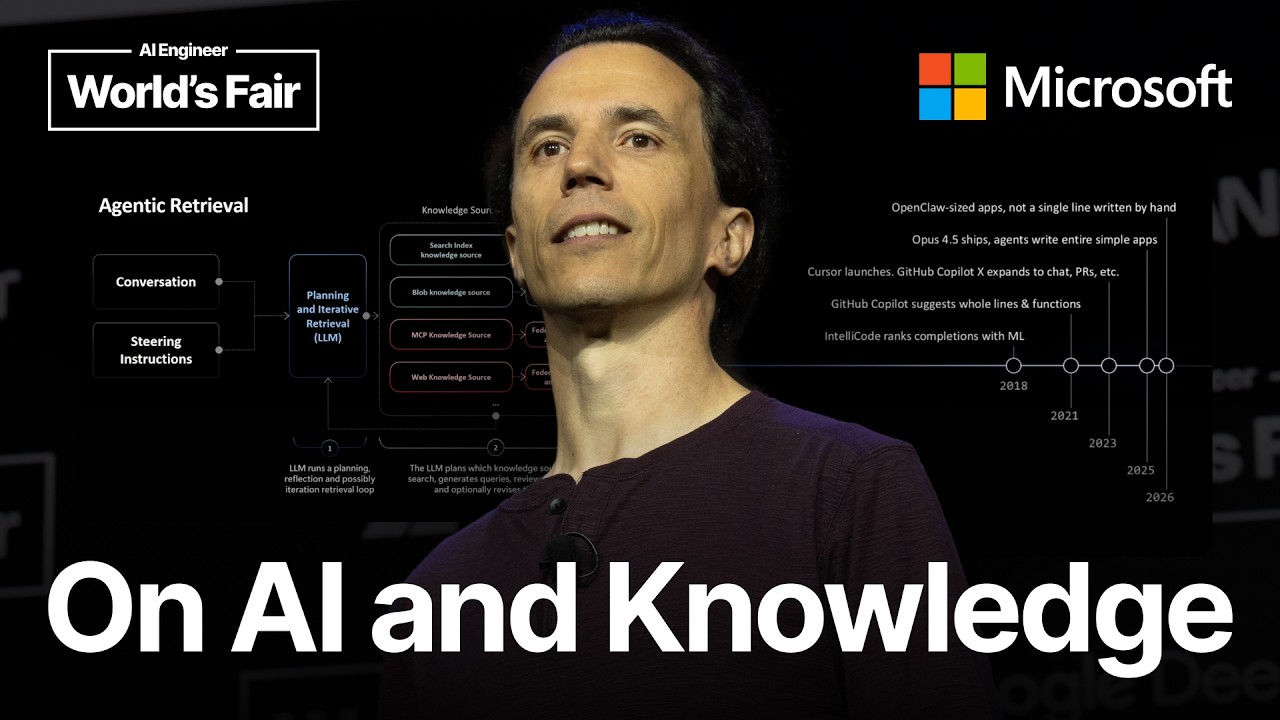
On AI and Knowledge — Pablo Castro, Distinguished Engineer & CVP for AI Knowledge, Microsoft

On AI and Knowledge — Pablo Castro, Distinguished Engineer & CVP for AI Knowledge, Microsoft

Pablo Castro explores the three pillars of AI knowledge—intrinsic, extrinsic, and learned—explaining how models leverage parametric memory, agents integrate with enterprise data through sophisticated RAG systems like Foundry IQ, and how continuous learning loops, facilitated by tools like the Agent Optimizer, enable self-improving agents, driving the next wave of AI applications.

How we taught agents to use good retrieval - Hanna Lichtenberg, Mixedbread AI

How we taught agents to use good retrieval - Hanna Lichtenberg, Mixedbread AI

Mixedbread AI addresses the "Oracle Gap" – the disparity between LLM reasoning and retrieval capabilities – by developing agents trained to use advanced search tools effectively. They demonstrate how current LLMs generate poor queries due to training biases and introduce a sophisticated agent harness with diverse search tools and a unique training regimen, including supervised fine-tuning and reinforcement learning with custom rewards, to teach agents to form precise semantic queries. This approach significantly improves performance on benchmarks like Oblique Congress and Snowflake's Match QA, closing the gap between theoretical perfect retrieval and real-world agent performance.