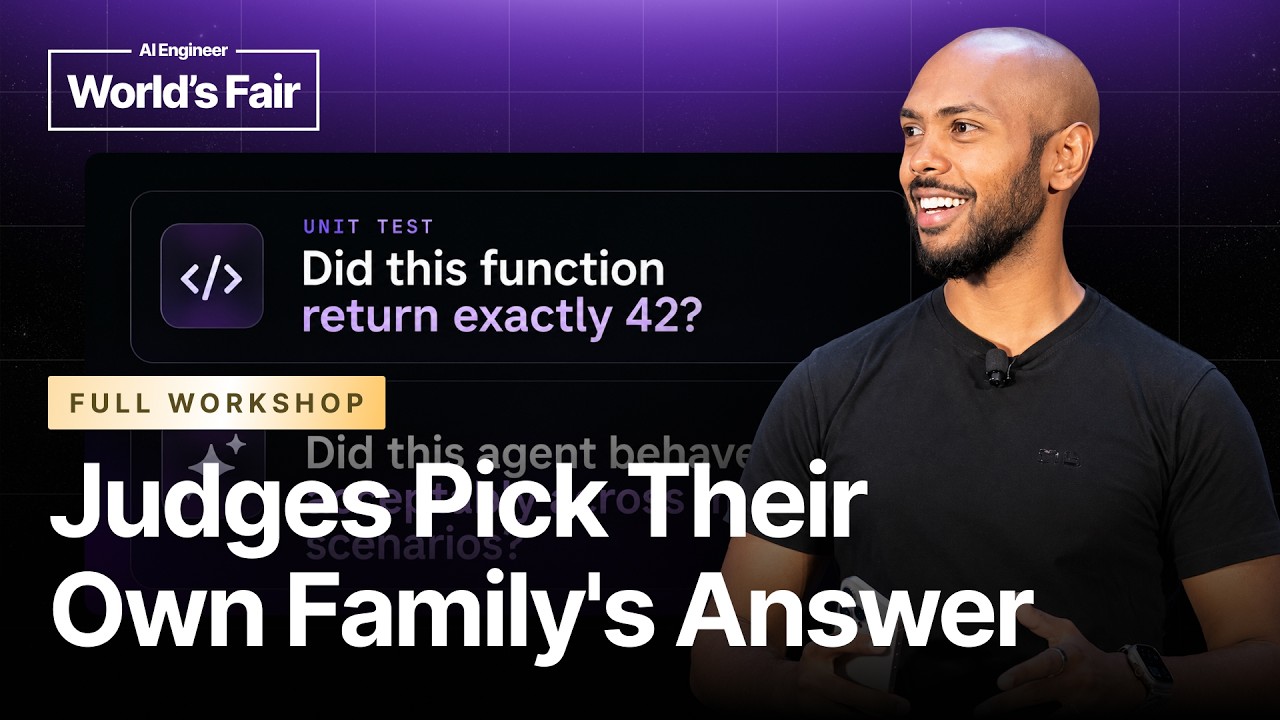
Evals in AI: A Deep Dive — Tejas Kumar, IBM
This deep dive into AI evaluation (evals) starts by clarifying their role in providing ahead-of-time reliability and security for non-deterministic systems, contrasted with just-in-time harnesses. Tejas Kumar defines evals as "fuzzy unit tests" and outlines their core components: test cases, expected behavior, a judge, and aggregation. He explores various evaluation techniques, emphasizing the challenges and biases of using LLMs as judges, such as position bias, sycophancy, self-preference, and verbosity. The presentation details a practical methodology for calibrating LLM judges against human verdicts using a "golden dataset" to achieve an 80-85% agreement threshold, which can then be enforced as a CI/CD gate. A live coding demonstration illustrates the evolution from simple string matching to a policy-aware LLM judge, showcasing how refining policy and incorporating RAG (Retrieval Augmented Generation) via OpenRAG dramatically improves decision-making. The discussion also covers strategies for maintaining living datasets in production and managing evaluation costs.