Gemma

Why Large? Tiny LMs & Agents on Edge/Robotics — Cormac Brick, Google

Why Large? Tiny LMs & Agents on Edge/Robotics — Cormac Brick, Google

Cormac Brick from Google AI Edge discusses how the increasing constraint of DRAM cost on edge devices necessitates the development and deployment of increasingly smaller AI models. He outlines the work of his team in optimizing models like Gemma, achieving 2.9 bits per weight for a 2 billion parameter model capable of running on a Raspberry Pi at 7.6 tokens/second, or on an NPU at 31 tokens/second decode for vision tasks. The talk delves into 'tiny models' (50M-500M parameters) that extend AI to older devices and enable features like robust voice-to-function calling via fine-tuning with synthetic data, exemplified by an offline voice dictation app.

Frontier results, on device - RL Nabors, Arize

Frontier results, on device - RL Nabors, Arize

RL Nabors discusses the significant costs associated with using frontier AI models, covering security, latency, and financial implications. She introduces a framework for right-sizing AI solutions by leveraging smaller, task-specific models and Small Language Models (SLMs). The framework details how to prove task feasibility, establish success criteria with golden datasets, conduct capability evaluations (using tools like Phoenix), and select the most appropriate "Small And Good Enough" (SAGE) model. Nabors further demonstrates how prompt engineering, particularly few-shot prompting, and post-processing can close performance gaps with larger models, while advocating for continuous regression evaluations to maintain performance integrity. The overarching message is to "prototype big, deploy small" to optimize AI deployments.

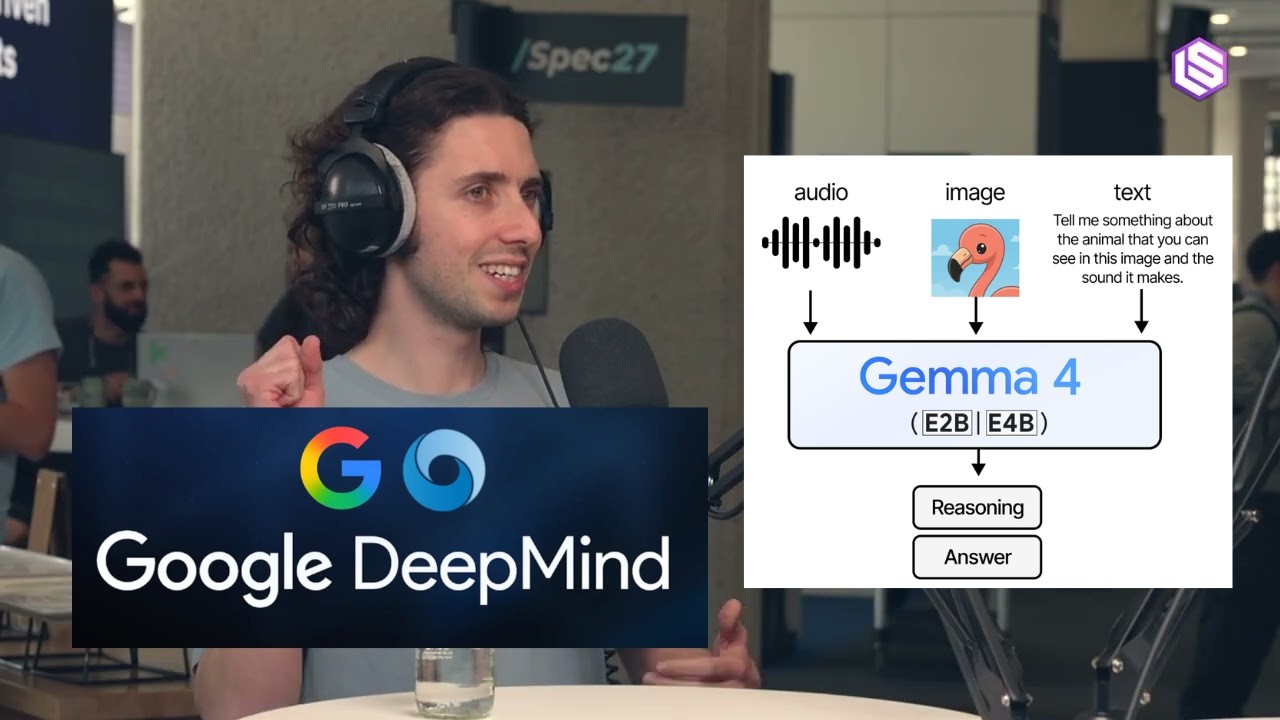
⚡️ Google's Open AI Strategy — Omar Sanseviero, Google DeepMind

⚡️ Google's Open AI Strategy — Omar Sanseviero, Google DeepMind

An in-depth look at Gemma 4's novel transformer architecture with per-layer embeddings, enabling efficient parameter offloading for on-device inference. The discussion also covers its native multimodality, the state of fine-tuning, text-based diffusion models, and the growing intersection of research and engineering.

Accelerating AI on Edge — Chintan Parikh and Weiyi Wang, Google DeepMind

Accelerating AI on Edge — Chintan Parikh and Weiyi Wang, Google DeepMind

A deep dive into Google's AI Edge stack for on-device AI, covering the new Gemma 4 models, the LiteRT framework for cross-platform deployment, and practical use cases in agent skills, tool calling, and hardware acceleration on CPUs, GPUs, and NPUs.

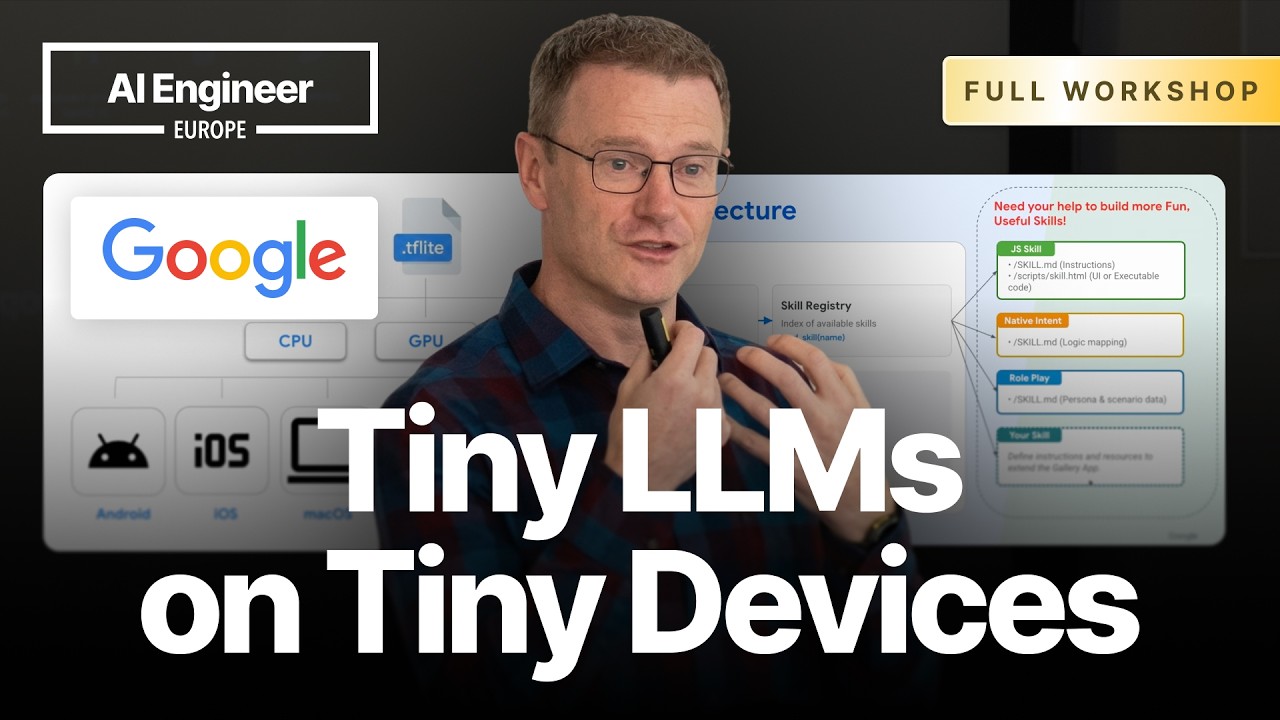
TLMs: Tiny LLMs and Agents on Edge Devices with LiteRT-LM — Cormac Brick, Google

TLMs: Tiny LLMs and Agents on Edge Devices with LiteRT-LM — Cormac Brick, Google

Cormac Brick from Google's AI Edge team details the dual trends of on-device AI: large, system-level models like Gemma 4 enabling complex agent skills, and fine-tuned tiny LLMs for high-performance, in-app tasks. The summary covers the architecture of on-device function calling, the engineering trade-offs for edge deployment, and the practical workflow for fine-tuning and deploying models under 1B parameters on platforms like Android and iOS.

Build & deploy AI-powered apps — Paige Bailey, Google DeepMind

Build & deploy AI-powered apps — Paige Bailey, Google DeepMind

A developer-focused, demo-heavy session on rapid AI prototyping using the Google DeepMind stack. It covers how to leverage the full capabilities of AI Studio, from video analysis and code execution with Gemini 3.1 Flash, to building full-stack applications with databases, and exploring the frontiers of generative media with Genie 3, Veo 3.1 Lite, and Lyria 3.