Foundation models

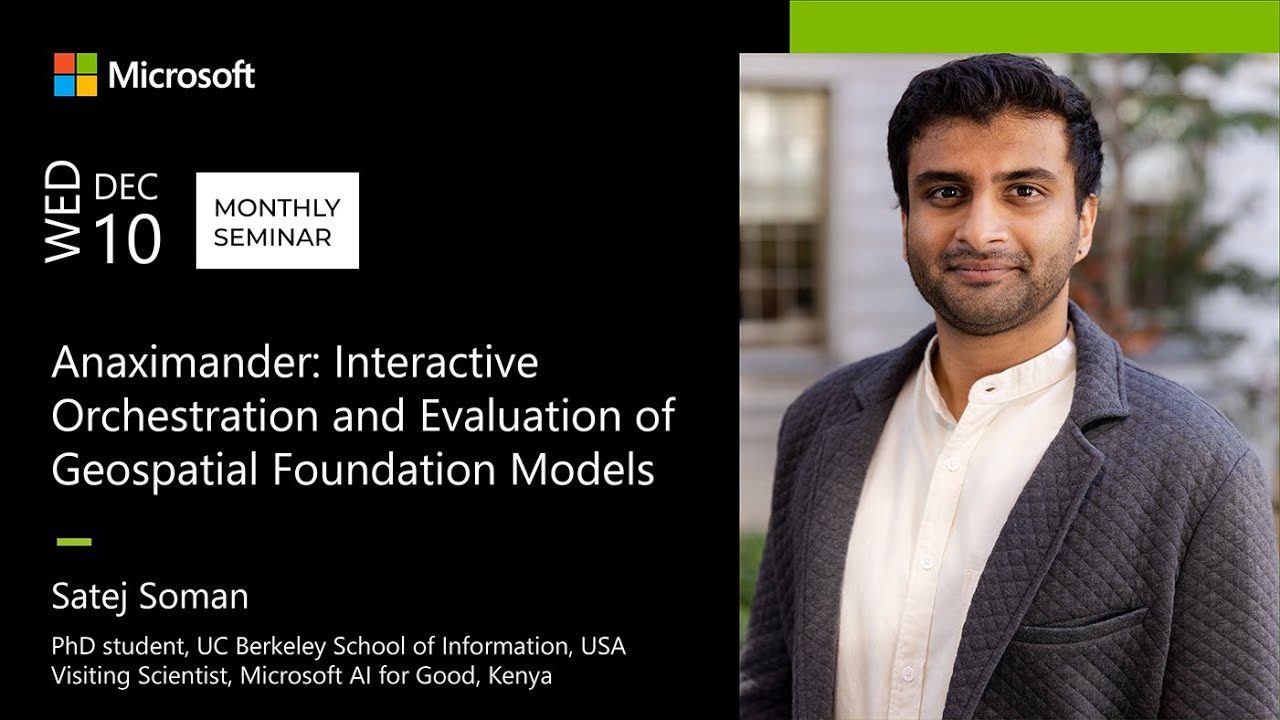
Anaximander: Interactive Orchestration and Evaluation of Geospatial Foundation Models

Anaximander: Interactive Orchestration and Evaluation of Geospatial Foundation Models

This talk introduces Anaximander, a system designed to bridge the gap between traditional, GUI-driven Geographic Information System (GIS) workflows and modern, code-heavy machine learning practices. Anaximander integrates geospatial foundation models directly into QGIS, allowing experts to interactively orchestrate, run, and evaluate models for tasks like semantic segmentation and object detection on satellite imagery.

No Priors Ep. 141 | With Sunday Robotics Co-Founders Tony Zhao and Cheng Chi

No Priors Ep. 141 | With Sunday Robotics Co-Founders Tony Zhao and Cheng Chi

Tony Zhao and Cheng Chi, co-founders of Sunday Robotics, discuss the state of AI robotics, framing it as being between a "GPT moment" (the core technology is known) and a "ChatGPT moment" (a scalable consumer product). They detail the key research, data collection innovations, and full-stack engineering required to build Memo, their general-purpose home robot designed to free humanity from chores.

How End-to-End Learning Created Autonomous Driving 2.0: Wayve CEO Alex Kendall

How End-to-End Learning Created Autonomous Driving 2.0: Wayve CEO Alex Kendall

Alex Kendall, CEO of Wayve, discusses the architectural shift from AV 1.0's hand-engineered robotics to AV 2.0's end-to-end deep learning. He explains how Wayve's generalization-first approach, powered by world models and diverse data, allows them to scale across hundreds of cities and multiple automotive OEMs, creating a path toward a general-purpose embodied AI foundation model.

Faster Science, Better Drugs

Faster Science, Better Drugs

Erik Torenberg, Patrick Hsu (Arc Institute), and Jorge Conde (a16z) discuss Arc's moonshot to create 'virtual cells' using foundation models to simulate biology. They cover why science is slow, how AI can accelerate drug discovery by predicting cellular perturbations, and the remaining bottlenecks in clinical trials and capital intensity that the biotech industry faces.

Fully autonomous robots are much closer than you think – Sergey Levine

Fully autonomous robots are much closer than you think – Sergey Levine

Sergey Levine, co-founder of Physical Intelligence, outlines the path to general-purpose robots, predicting a 'self-improvement flywheel' could lead to fully autonomous household robots by 2030. He discusses the architecture of vision-language-action models, the critical role of embodiment in solving the data problem, and how robotics will scale faster than self-driving cars.

Why China’s Engineering Culture Gives Them an AI Advantage

Why China’s Engineering Culture Gives Them an AI Advantage

Ben Lorica and Evangelos Simoudis explore the nuanced landscape of AI regulation, contrasting foundation model oversight with domain-specific rules and highlighting the critical issue of IP rights in training data. They also analyze China's engineering-led AI strategy and the challenges of enterprise AI adoption.