Feature

The Age Of The 40-Year-Old Solo Founder Is Here

The Age Of The 40-Year-Old Solo Founder Is Here

Bryant Chou, co-founder of Webflow, introduces his new AI-powered platform, Ploy. This episode delves into how Ploy transcends traditional website builders by integrating analytics, CRM, and SEO to autonomously optimize marketing. Chou discusses Ploy's 'anti-slop' approach, leveraging curated data and expertise to produce high-quality web designs, and reflects on building a startup in the AI era compared to Webflow's early days. He also explores the competitive moat of purpose-built AI, the concept of 'agents as customers,' and how experienced founders can leverage AI to 'clone themselves' and achieve unprecedented speed and scale.

Fable 5: The Full Story from Capabilities to Drama (Ep. 1002 with Jon Krohn)

Fable 5: The Full Story from Capabilities to Drama (Ep. 1002 with Jon Krohn)

Anthropic's highly anticipated Claude Fable 5 model, a public version of its advanced "Mythos class" AI with state-of-the-art capabilities in software, vision, and long-context tasks, was released and then swiftly pulled offline by the U.S. government after just three days. The removal, initiated as an export control action over national security concerns stemming from a disputed "jailbreak" claim, highlights the growing tension between frontier AI development, AI safety, and regulatory oversight.

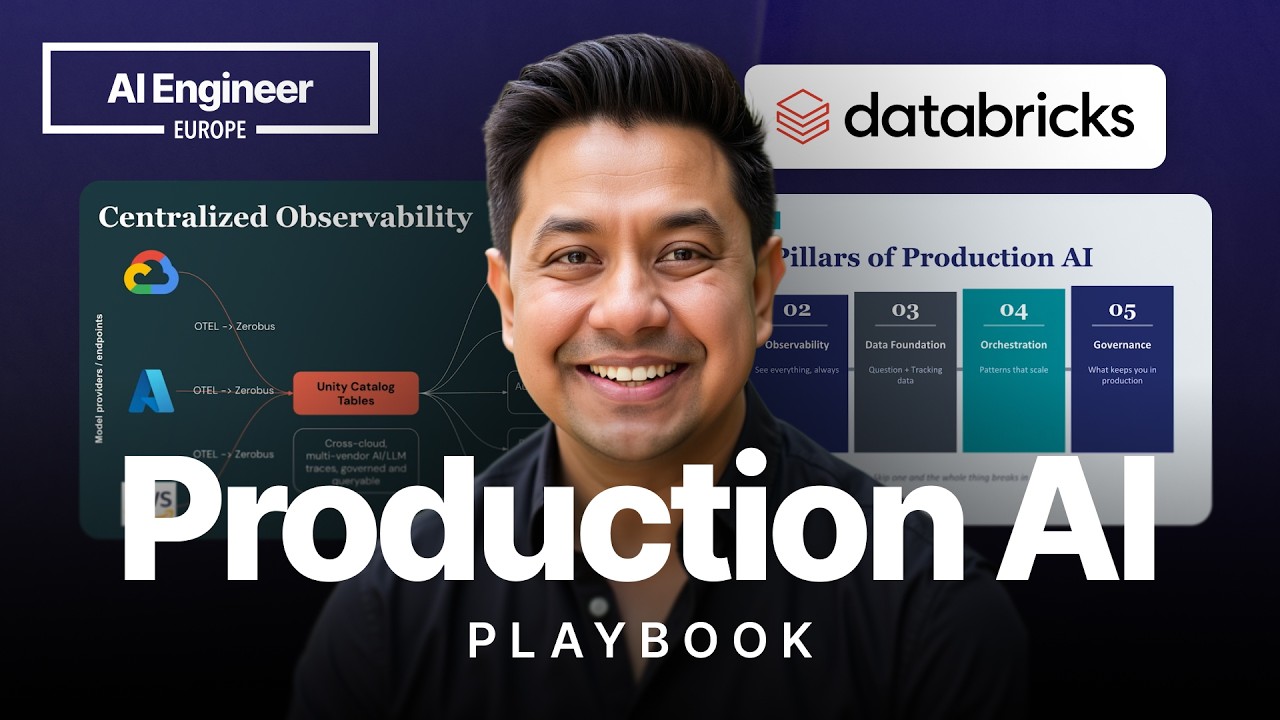
The Production AI Playbook: Deploying Agents at Enterprise Scale — Sandipan Bhaumik, Databricks

The Production AI Playbook: Deploying Agents at Enterprise Scale — Sandipan Bhaumik, Databricks

Sandipan Bhaumik presents a five-pillar framework for successfully moving AI systems from demos to production, inspired by a retail bank's failed chatbot PoC. The framework covers defining numerical success (Evaluation), tracing every AI decision (Observability), building robust data pipelines (Data Foundation), managing multiple AI interactions (Multi-agent Orchestration), and ensuring accountability and security (Governance). He illustrates these concepts with a banking chatbot case study, emphasizing continuous evaluation, data quality, and a proactive incident playbook.

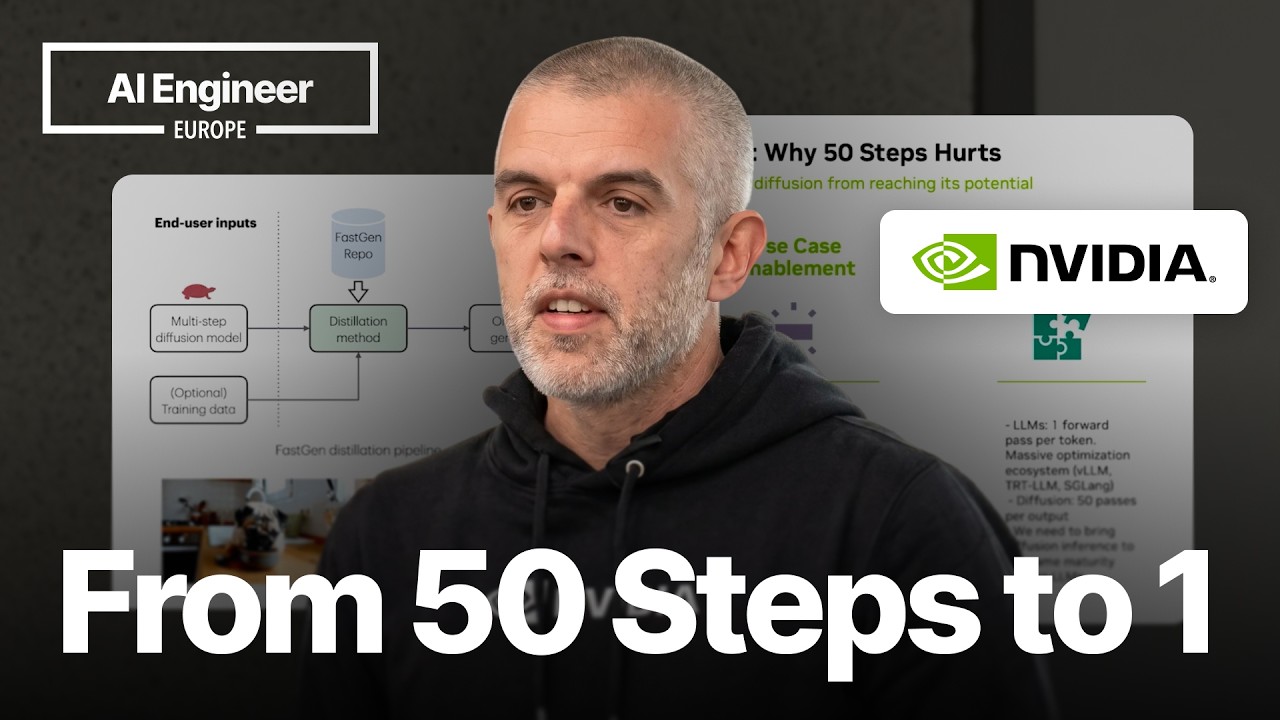
You Might Not Need 50 Diffusion Steps — Ziv Ilan, Nvidia

You Might Not Need 50 Diffusion Steps — Ziv Ilan, Nvidia

Ziv Ilan from NVIDIA details how latency in video diffusion models can be drastically reduced to achieve real-time generation. He presents a layered approach combining dynamic quantization for memory and speed, chunk-based caching to skip redundant denoising computations, and, most critically, step distillation—training models to achieve high-quality output in significantly fewer steps. These techniques, packaged in the open-source FastGen repository, offer additive performance gains, enabling real-time video on a single Blackwell B200 GPU.

Simulating Humans at Scale: Simile's Joon Sung Park

Simulating Humans at Scale: Simile's Joon Sung Park

Joon Sung Park, founder and CEO of Simile and creator of Stanford's "Smallville" generative agents study, explains how Simile is building the "GPU of intelligence" to simulate human society, diverging from frontier models that act as the "CPU of intelligence." He details Simile's approach of grounding simulations with real human behavioral data, its diverse corporate applications, and its long-term vision to create a "CERN of human society" to solve fundamental societal challenges.

Context Engineering for Coding Agents

Context Engineering for Coding Agents

A deep dive into advanced engineering techniques for coding agents, focusing on effective context management in LLMs like Claude. The talk introduces a practical framework using a brain-inspired analogy, proposing a Markdown-based 'wiki' as a long-term memory system to augment the agent's limited context window. This approach is demonstrated through a real-world challenge of extracting structured data from technical drawings.