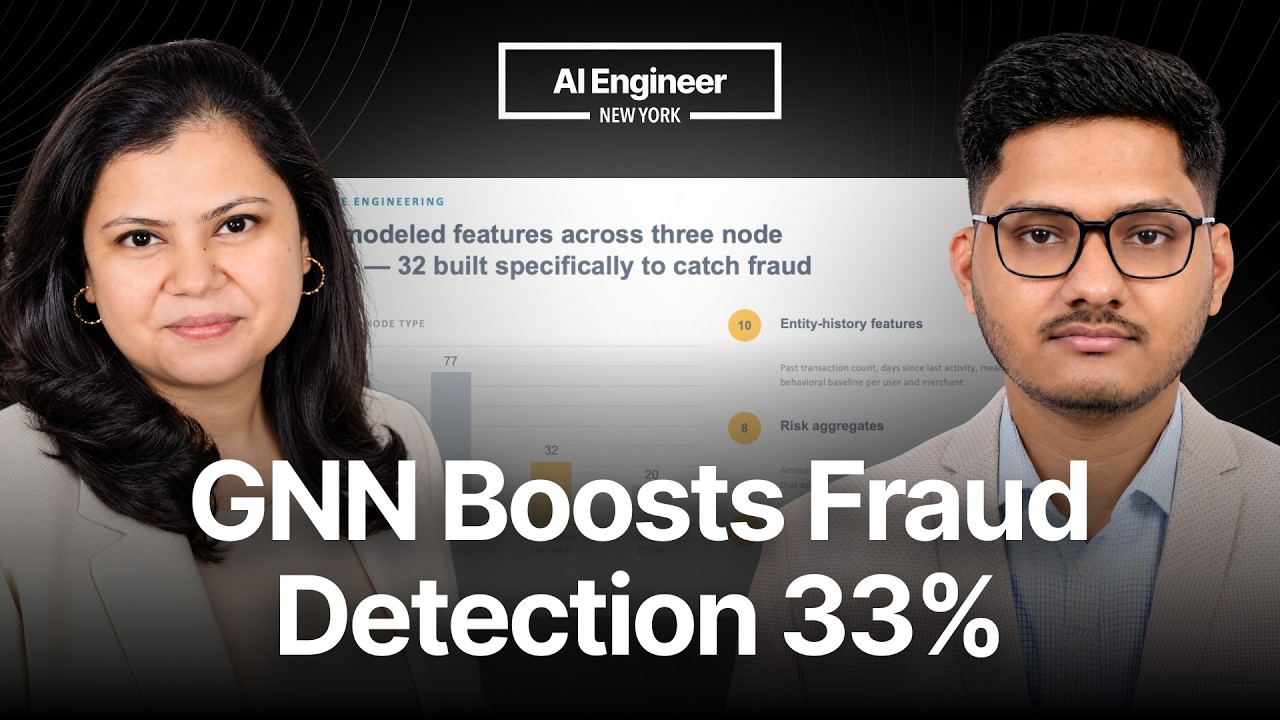
Feature engineering

Judge a Transaction by the Company It Keeps — Somya Rai & MD Sharique, EXL

Judge a Transaction by the Company It Keeps — Somya Rai & MD Sharique, EXL

EXL developed an advanced fraud detection system that augments XGBoost with Graph Neural Network (GNN) embeddings. Traditional tabular models struggle to capture fraud signals residing in transaction neighborhoods. The system's innovative design includes meticulous sampling strategies, disjoint monthly graph construction for leakage control, and a GraphSAGE architecture that aggregates mean, max, and standard deviation of neighbor features to detect subtle fraud patterns. Emphasizing explainability for regulatory compliance and analyst trust, it also features a highly optimized serving architecture achieving 3ms P99 latency, pivoting to edge prediction to reduce cache footprint from 60GB to 2-3GB. This led to a 27-33% relative lift in true positive rates and a projected $65 million incremental fraud capture.
Graph Neural Networks Just Solved Enterprise AI?

Graph Neural Networks Just Solved Enterprise AI?

Jure Leskovec introduces Relational Foundation Models (RFMs), a new class of models based on graph neural networks that learn directly from raw, multi-table enterprise data. This approach bypasses manual feature engineering, leading to more accurate, faster-to-deploy, and easier-to-maintain predictive models for tasks like churn prediction, fraud detection, and recommendation systems.

Traditional vs LLM Recommender Systems: Are They Worth It?

Traditional vs LLM Recommender Systems: Are They Worth It?

This summary explores Arpita Vats's insights on how Large Language Models (LLMs) are revolutionizing recommender systems. It contrasts the traditional feature-engineering-heavy approach with the contextual understanding of LLMs, which shifts the focus to prompt engineering. Key challenges like inference latency and cost are discussed, along with practical solutions such as lightweight models, knowledge distillation, and hybrid architectures. The conversation also touches on advanced applications like sequential recommendation and the future potential of agentic AI.