Distributed ai

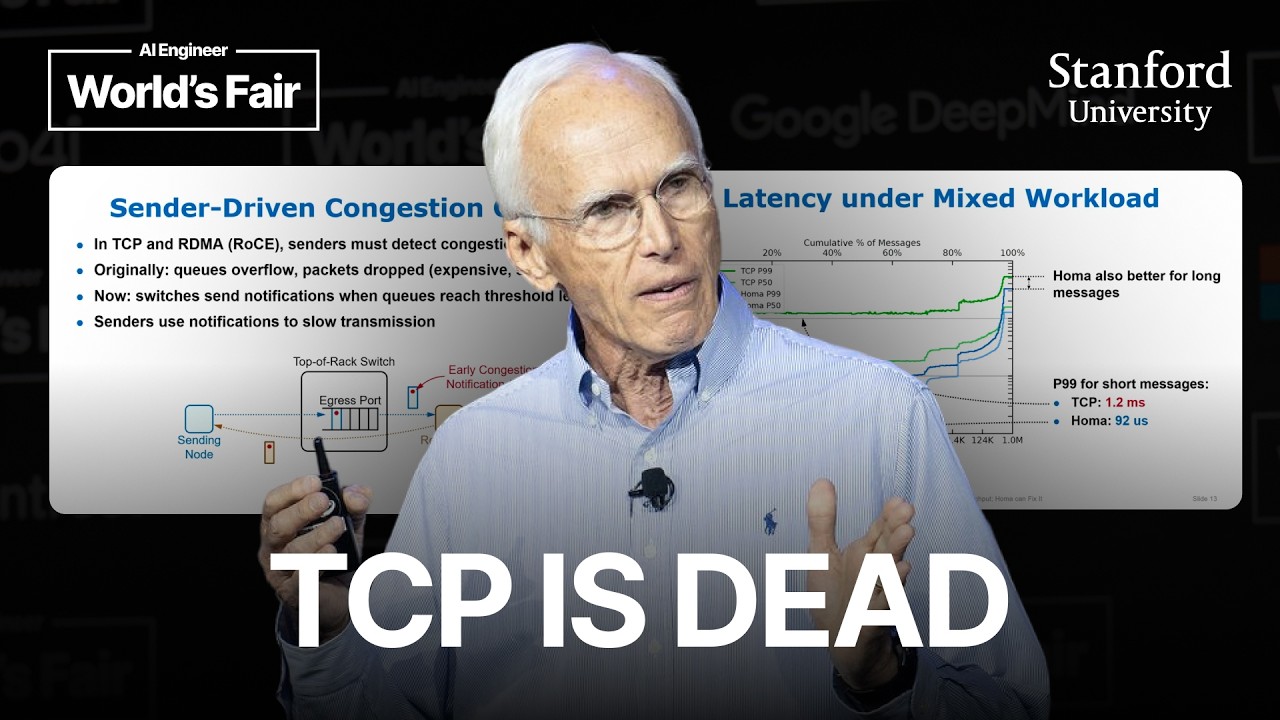
The End of TCP for AI Clusters — John Ousterhout, Stanford

The End of TCP for AI Clusters — John Ousterhout, Stanford

John Ousterhout argues that AI workloads are shifting from large data transfers to small, frequent coordination messages, making network latency (especially tail latency) a critical bottleneck. He explains why traditional protocols like TCP and RDMA are ill-suited due to sender-side congestion control and their byte-stream model. Ousterhout then introduces Homa, a new protocol designed from scratch with message-based communication, receiver-side congestion control, and switch priority queue utilization, demonstrating significant improvements in tail latency for AI applications.
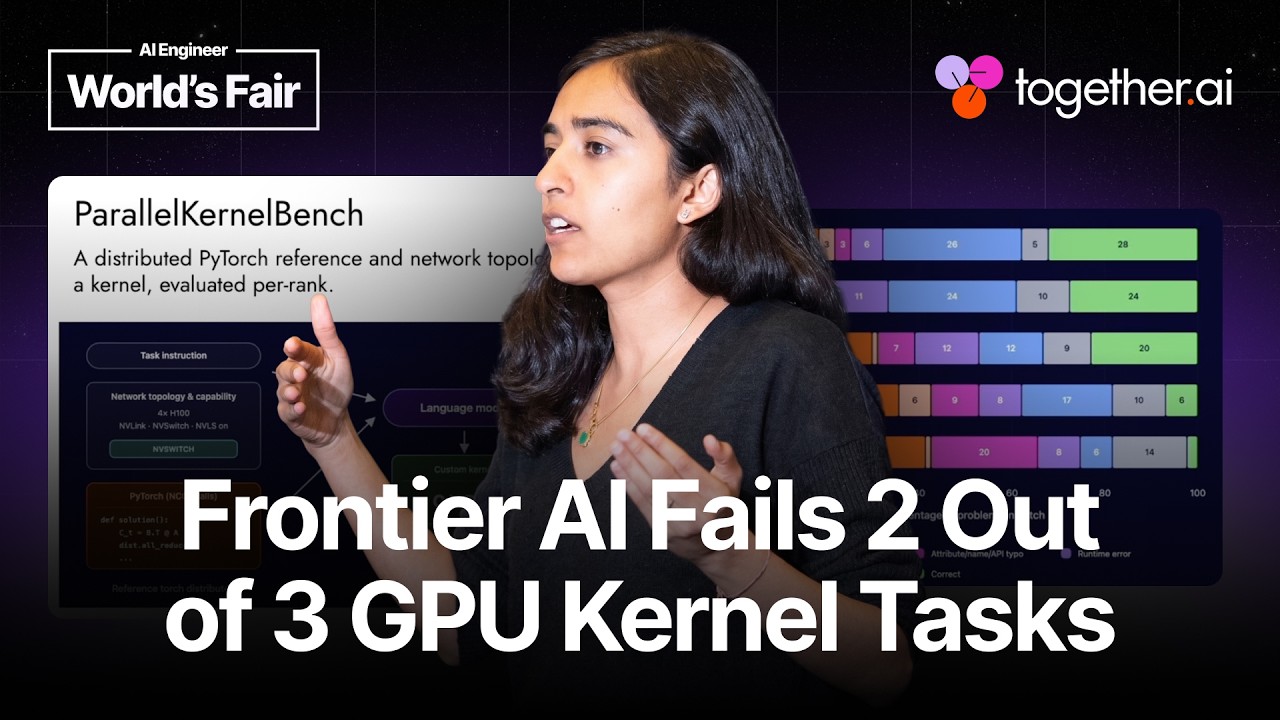
Can LLMs Write Fast Multi-GPU Kernels? — Simran Arora, Together AI

Can LLMs Write Fast Multi-GPU Kernels? — Simran Arora, Together AI

Simran Arora discusses the critical bottleneck shift in large AI workloads from GPU compute to inter-GPU communication. Her team's solution, ParallelKittens, offers a set of primitives to optimize multi-GPU kernels by leveraging fundamental transfer mechanisms and compute-communication overlapping. They introduce ParallelKernelBench, a benchmark to evaluate AI models' ability to generate such kernels, revealing that while models can handle syntax, they struggle with deeper reasoning about communication patterns and hardware trade-offs.

Why Old GPUs Keep Gaining Value

Why Old GPUs Keep Gaining Value

Steve Hou, Head of Research at Silicon Data, unpacks the data behind the AI compute market, revealing persistent tightness in GPU rentals and rising residual values, despite talk of oversupply. He discusses the methodologies behind their GPU price indices and forward curves, the evolving hardware landscape beyond Nvidia (including AMD, Cerebras, and TPUs), and trends in LLM token economics. The conversation also delves into the complex financial aspects of AI data center buildouts, the rise of specialized models, China's emerging AI hardware ecosystem, and the growing importance of power constraints and distributed AI infrastructure.