Database architecture

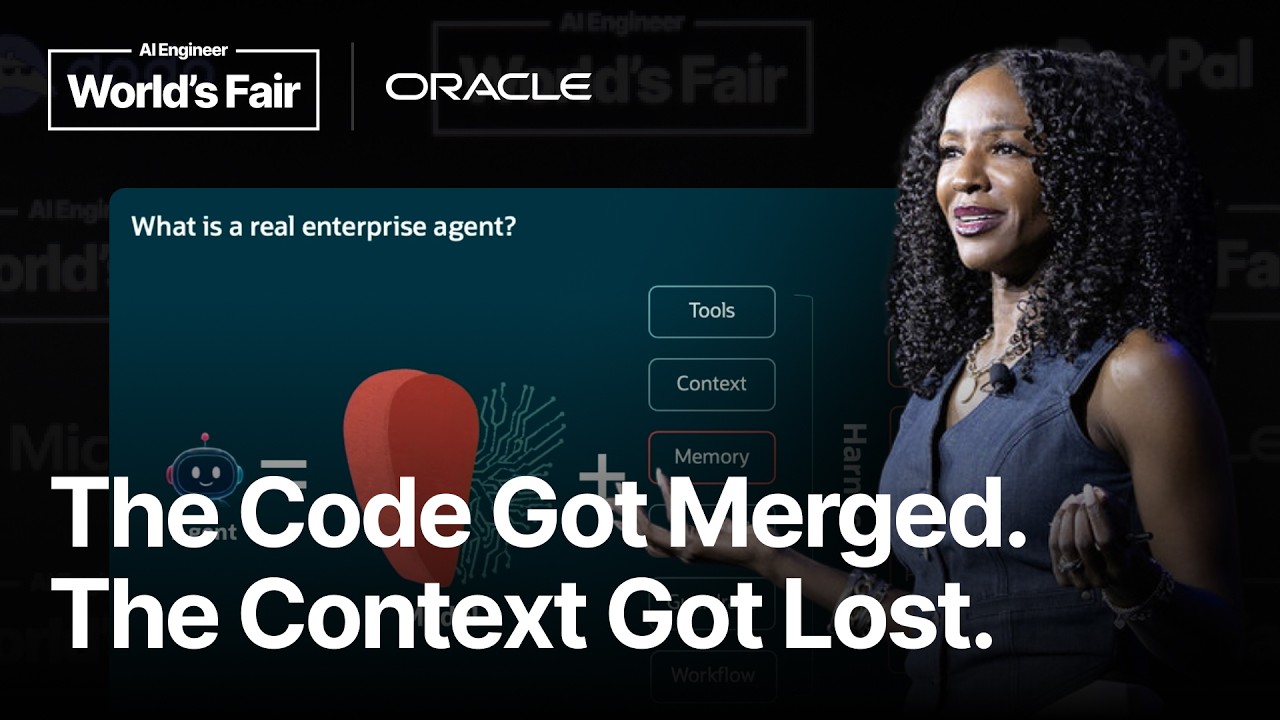
No Memory, No Harness: Why the Database Is the Last Line of Defense — Kay Malcolm, Oracle

No Memory, No Harness: Why the Database Is the Last Line of Defense — Kay Malcolm, Oracle

Kay Malcolm discusses how AI, while boosting individual performance, often hinders overall team productivity due to fragmented context. She introduces the concept of an "agent harness" with "memory" as its central nervous system, vital for sharing context. Drawing on personal experiences with database sprawl, she highlights the inefficiencies of storing diverse memory types across multiple data stores. Malcolm then presents Oracle's AI database (26AI) as a unified solution, capable of natively managing all memory types in a single platform, thereby enhancing team collaboration and solving the context problem for enterprise AI agents.

The Future of Search: Agents, RAG, and Why Retrieval Still Matters — Simon Eskildsen, Turbopuffer

The Future of Search: Agents, RAG, and Why Retrieval Still Matters — Simon Eskildsen, Turbopuffer

Simon Hørup Eskildsen, founder of turbopuffer, shares his journey from scaling Shopify's infrastructure to creating a new search engine for the AI era. He discusses how a prohibitively expensive experiment at Readwise inspired him to build a cost-effective vector search solution based on object storage and NVMe. Eskildsen breaks down turbopuffer's architecture, its role in cutting costs for companies like Cursor and Notion, his philosophy on building a 'P99' engineering team, and how agentic workloads are changing the future of retrieval.

Building Planetary-Scale Data Systems with Venice • Felix GV & Olimpiu Pop

Building Planetary-Scale Data Systems with Venice • Felix GV & Olimpiu Pop

Félix GV, architect of LinkedIn's Venice database, explains its unbundled, planetary-scale architecture. He covers their rigorous chaos engineering practices, the trade-offs between consistency and availability in a derived data system, and an experimental integration with DuckDB for advanced analytics and data exploration.