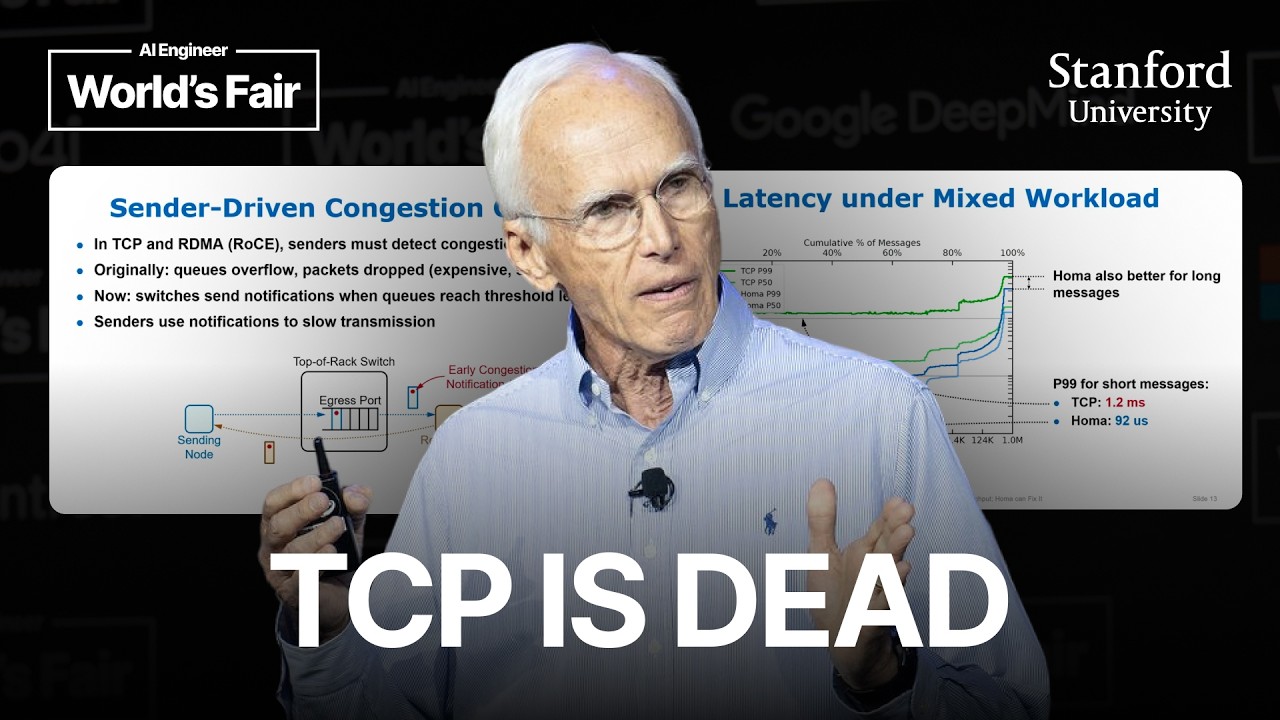
The End of TCP for AI Clusters — John Ousterhout, Stanford
John Ousterhout argues that AI workloads are shifting from large data transfers to small, frequent coordination messages, making network latency (especially tail latency) a critical bottleneck. He explains why traditional protocols like TCP and RDMA are ill-suited due to sender-side congestion control and their byte-stream model. Ousterhout then introduces Homa, a new protocol designed from scratch with message-based communication, receiver-side congestion control, and switch priority queue utilization, demonstrating significant improvements in tail latency for AI applications.