Code generation

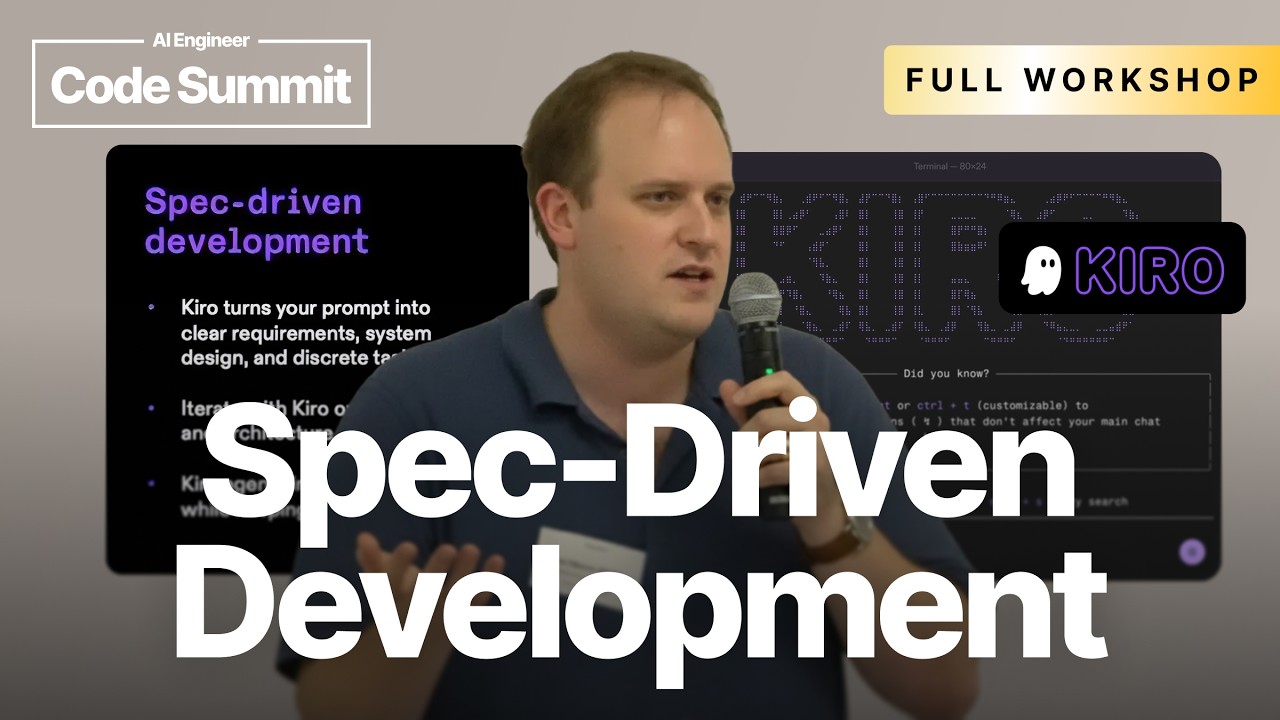
Spec-Driven Development: Sharpening your AI toolbox - Al Harris, Amazon Kiro

Spec-Driven Development: Sharpening your AI toolbox - Al Harris, Amazon Kiro

Spec-Driven Development offers a structured, reproducible, and reliable alternative to 'vibe coding' in the AI era. Al Harris from the Kiro team explains how to leverage specs as living documentation, integrate external tools via MCPs, and use property-based testing to create a tight feedback loop from natural language requirements to verified code.

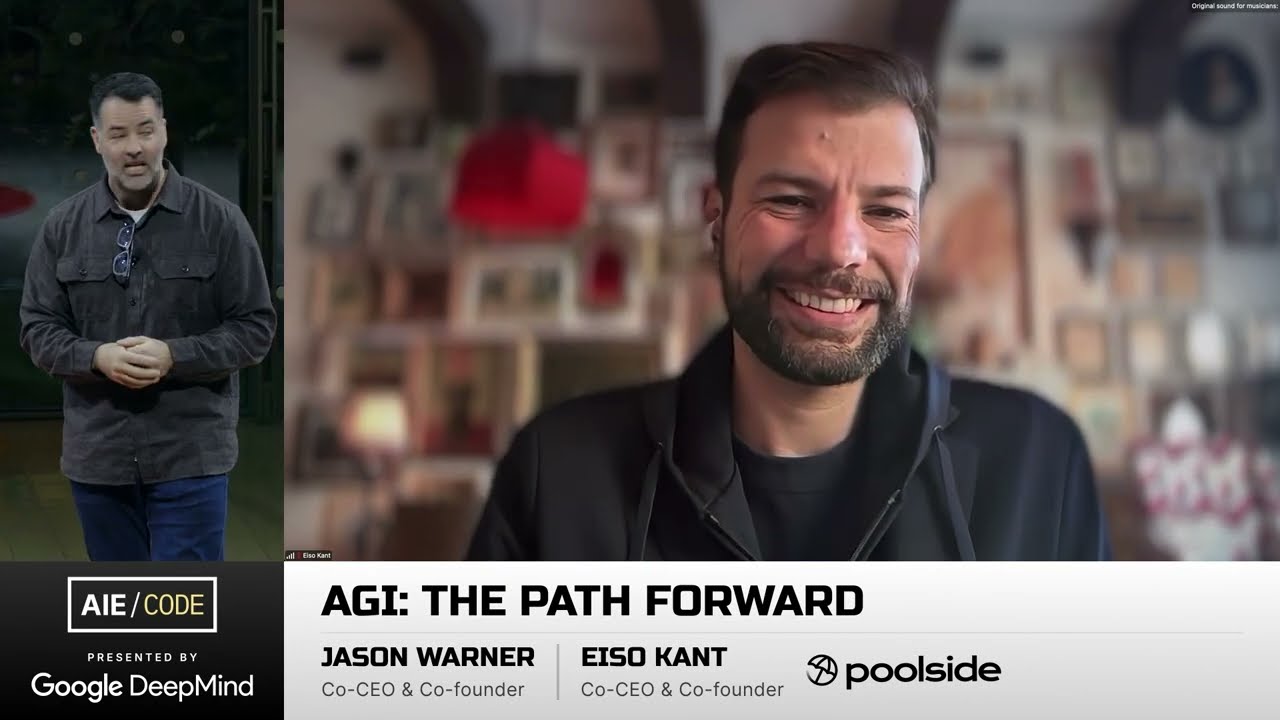
AGI: The Path Forward – Jason Warner & Eiso Kant, Poolside

AGI: The Path Forward – Jason Warner & Eiso Kant, Poolside

In a live demo, Poolside's CEOs showcase their second-generation model, the Malibu agent, by migrating a complex codebase from ADA to Rust, including automated testing and iterative feature development. They outline their vision for achieving AGI through a full-stack approach combining proprietary models, reinforcement learning, and massive-scale compute, with plans for a public model release in early 2025.

AI Code Generation: Wins, Fails and the Future

AI Code Generation: Wins, Fails and the Future

A panel of experts discusses the future of AI in software engineering, focusing on the "barbell effect" where AI excels at hyper-complex tasks but fails at simple ones. The conversation explores whether performance is driven by the model or the agent orchestration, the evolving role of the engineer as an architect, and the significant challenges open-source tools face against vertically integrated proprietary systems, particularly the high cost of inference.

The Infinite Software Crisis – Jake Nations, Netflix

The Infinite Software Crisis – Jake Nations, Netflix

In an era of the "Infinite Software Crisis" where AI-generated code outpaces human understanding, this talk argues for choosing "simple" design over "easy" generation. The speaker presents a three-phase methodology—Research, Planning, and Implementation—that forces developers to think critically before generating code. This approach leverages AI for mechanical tasks while ensuring that human judgment, context, and a deep understanding of the system remain the core of the software development process, turning human insight into the ultimate competitive advantage.

Code World Model: Building World Models for Computation – Jacob Kahn, FAIR Meta

Code World Model: Building World Models for Computation – Jacob Kahn, FAIR Meta

Jacob Kahn from FAIR, Meta, introduces the Code World Model (CWM), a new paradigm for AI models that learn from program execution rather than just code syntax. By training on detailed execution traces, CWM builds an internal world model of computation, enabling it to predict a program's behavior. This talk explores CWM's architecture, its highly scalable and asynchronous reinforcement learning setup, and groundbreaking applications like a 'neural debugger' that understands user intent from code structure and the potential to approximate undecidable problems like the halting problem.

Compilers in the Age of LLMs — Yusuf Olokoba, Muna

Compilers in the Age of LLMs — Yusuf Olokoba, Muna

Yusuf Olokoba, founder of Muna, details a compiler-based approach to transform Python AI functions into self-contained native binaries. This talk explores the technical pipeline, including custom AST-based tracing, type propagation, and the strategic use of LLMs for code generation, enabling a universal, OpenAI-style client for running any model on any platform.