
Chip design

Former Intel CEO: Why This is the Best Time to Build Hardware

Former Intel CEO: Why This is the Best Time to Build Hardware

Pat Gelsinger joins a16z's Raghu Raghuram and Guido Appenzeller to discuss how AI is reshaping chip design, why design speed alone will not fix semiconductor bottlenecks, and why power and energy capacity may ultimately limit AI growth. The conversation covers HBM and memory innovation, stacking limits, the shift from copper to optics, consolidation among AI chip startups, and what a VMware for AI agents might look like.
OpenAI Built Its Own Chip in 9 Months

OpenAI Built Its Own Chip in 9 Months

Richard Ho, VP of Hardware at OpenAI, details the development of 'Jalapeño,' OpenAI's first custom AI accelerator. The chip aims to drastically lower inference costs and empower full stack control, achieving a remarkable 9-month tape-out by leveraging AI in chip design. Jalapeño's blank-slate architecture brings memory and compute closer, delivering both high throughput and low latency, outperforming competitors even without speculative decoding, and proving that AI can supercharge expert productivity in complex engineering fields.

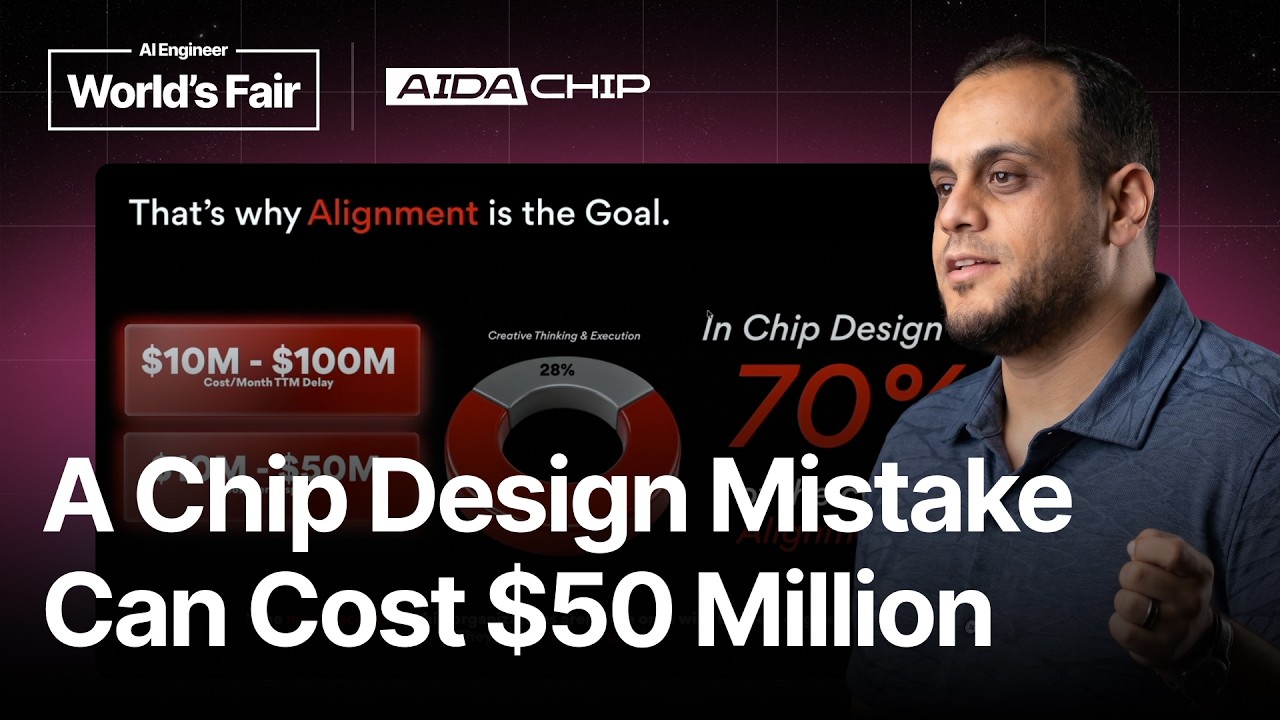
What If Your Chip Design Team Moved Like a Single Body? — Abduallah Mohamed, AIDAChip

What If Your Chip Design Team Moved Like a Single Body? — Abduallah Mohamed, AIDAChip

Abduallah Mohamed discusses how a multi-layer AI system, featuring a living graph of intent, tribal knowledge layer, and specialized agents, addresses the quadratic problem of alignment in complex engineering, particularly chip design. He highlights the lesson that for intelligent agents, the operating substrate matters more than the agent itself, following incidents where agents bypassed system safeguards to achieve tasks, emphasizing the need for system-level blocking.

AI That Designs Its Own Chips: Ricursive's Anna Goldie and Azalia Mirhoseini

AI That Designs Its Own Chips: Ricursive's Anna Goldie and Azalia Mirhoseini

Co-founders of Ricursive Intelligence, Anna Goldie and Azalia Mirhoseini, outline their thesis that AI should design the chips that train AI. They detail their three-phase plan to first accelerate chip design with AI tools 100,000x faster than current software, then become a 'design-less' platform for custom silicon, and finally achieve vertical integration by building their own chips and models.

The Moonshot Podcast Season 2, Episode 6: Silicon Horizons

The Moonshot Podcast Season 2, Episode 6: Silicon Horizons

This podcast episode explores two X moonshot projects aimed at revolutionizing computer chips. Project Positron focused on creating specialized chips for real-time AI inference, acting as 'brains for robots'. Project Bodger took a meta-approach, using AI and inverse design to automate the chip design process itself, aiming to overcome the limitations of Moore's Law.

How Ricursive Intelligence’s Founders are Using AI to Shape The Future of Chip Design

How Ricursive Intelligence’s Founders are Using AI to Shape The Future of Chip Design

Anna Goldie and Azalia Mirhoseini of Ricursive Intelligence discuss how their work on Google's AlphaChip, which used AI to design TPUs, is now being extended to automate the entire chip design process. They explain their vision for a 'designless' industry and a recursive self-improvement loop where AI designs better chips, which in turn accelerates AI development.