Change management

The Shadow AI Problem Nobody's Talking About

The Shadow AI Problem Nobody's Talking About

Euro Beinat (Prosus Group) and Mert Öztekin (Just Eat Takeaway.com) discuss the practical challenges of scaling AI, focusing on developer productivity, the role of AI agents in automating the 'long tail' of tasks, and the critical importance of change management and governance to foster an AI-native culture without stifling innovation.

The $700 Billion AI Productivity Problem No One's Talking About

The $700 Billion AI Productivity Problem No One's Talking About

Russ Fradin, founder of Larridin, draws parallels between the early days of ad tech and the current AI boom, arguing that a robust measurement infrastructure is the missing piece to unlock AI's true enterprise value. He discusses the challenges of measuring AI ROI, the gap between AI spending and actual usage, and how to overcome employee anxiety to foster productive adoption. The key is to move beyond simple surveys and marry behavioral data with real-world outcomes to understand if AI tools are actually making companies more productive.

How AbbVie accelerates drug discovery with Claude

How AbbVie accelerates drug discovery with Claude

Sarah Nam, VP of AI Strategy and Partnerships at AbbVie, and Anthropic’s Ivy Weng discuss how AbbVie is transforming pharmaceutical research and development with AI, from reimagining drug discovery and clinical trials to driving enterprise-wide adoption and evaluating strategic partnerships.

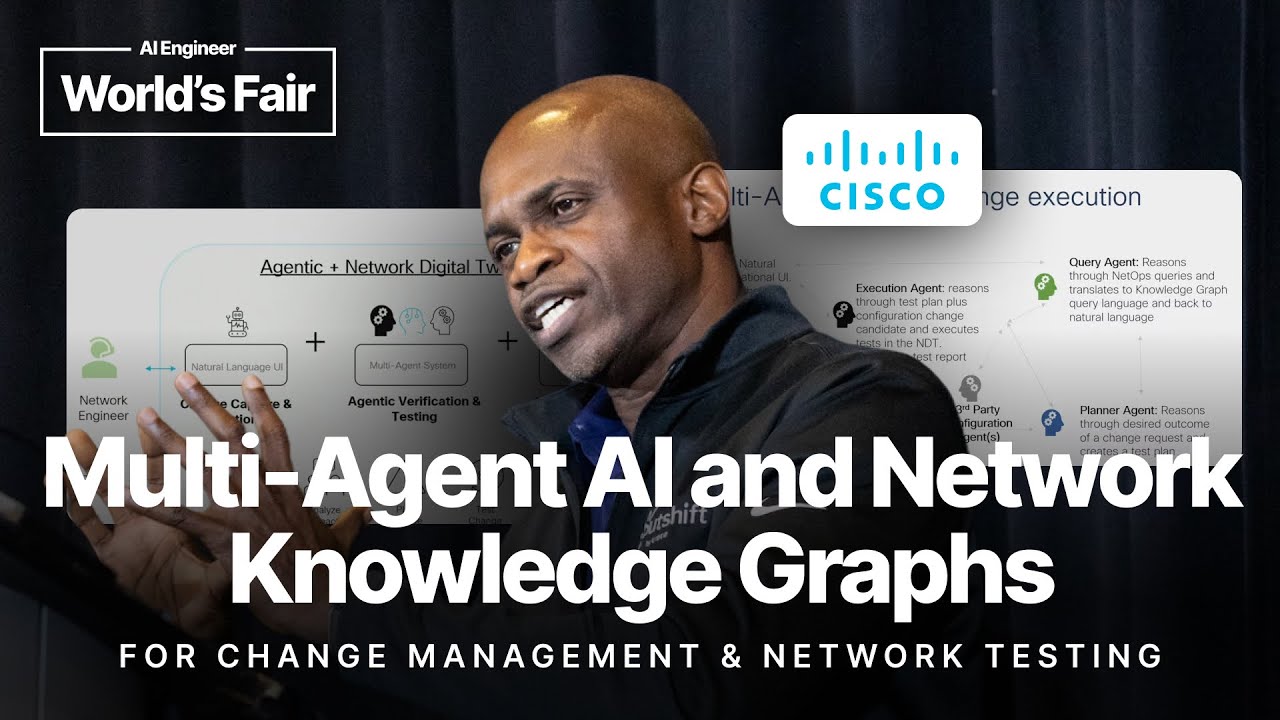
Multi Agent AI and Network Knowledge Graphs for Change — Ola Mabadeje, Cisco

Multi Agent AI and Network Knowledge Graphs for Change — Ola Mabadeje, Cisco

A product manager from Cisco's incubation group, Outshift, details a solution that uses a multi-agent AI system combined with a dynamic network knowledge graph to solve critical issues in IT change management. The system integrates with ITSM tools like ServiceNow to automate impact assessment, test plan generation, and pre-production validation in a "digital twin" environment, significantly reducing production failures.