Ai agents

How to Build the Future: Demis Hassabis

How to Build the Future: Demis Hassabis

Demis Hassabis, CEO of Google DeepMind, outlines the remaining challenges on the path to AGI, including memory, continual learning, and true reasoning. He discusses how learnings from AlphaGo are shaping agent development, the strategic importance of powerful small models like Gemma, and his vision for AI as the ultimate tool for scientific discovery, offering a framework for identifying breakthrough opportunities and advice for founders building in the age of AI.
Building your own software factory — Eric Zakariasson, Cursor

Building your own software factory — Eric Zakariasson, Cursor

Eric Zakariasson from Cursor explains the shift from single-agent pair programming to managing a multi-agent "software factory". He outlines the practical steps required, from establishing a well-structured codebase with guardrails to adopting a managerial mindset that focuses on automation, asynchronous work, and scaling agent fleets to increase software development throughput and consistency.

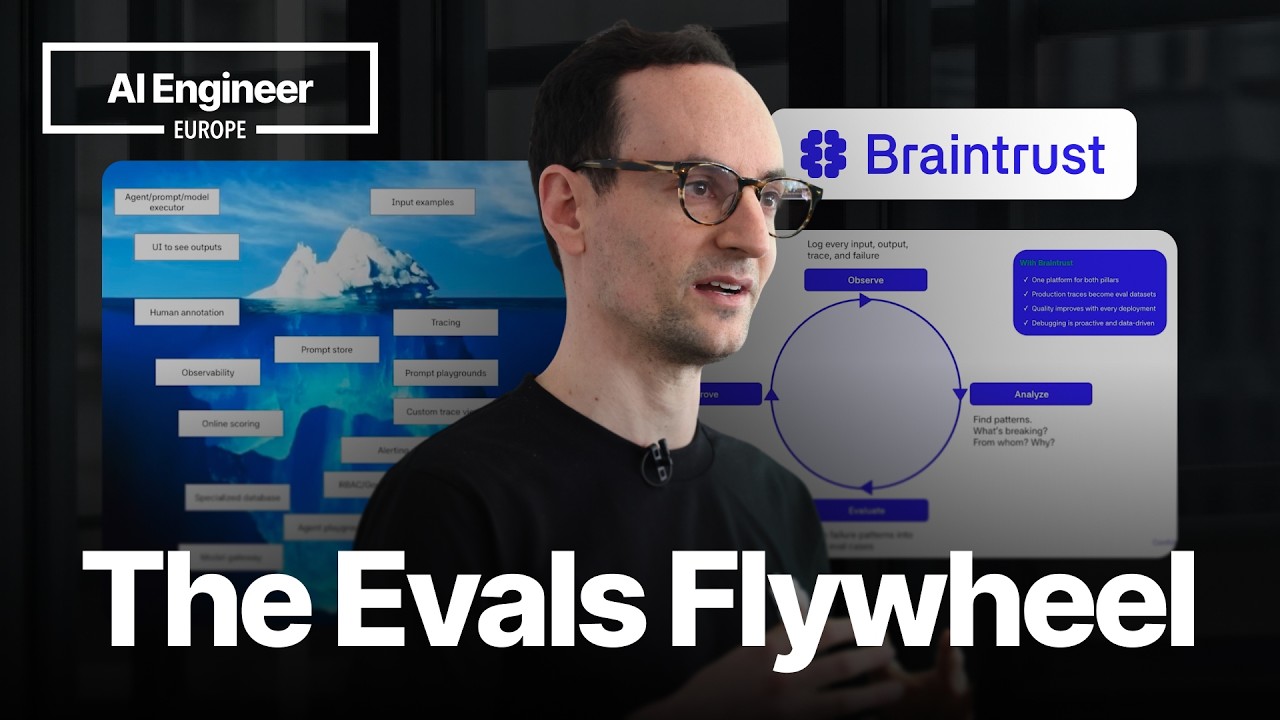
Why building eval platforms is hard — Phil Hetzel, Braintrust

Why building eval platforms is hard — Phil Hetzel, Braintrust

An evaluation platform is more than a simple test runner; it's a complex system for creating shared definitions of quality. This talk explores the evolution of eval platforms from basic spreadsheets to sophisticated, integrated systems, highlighting the hidden data and systems engineering challenges involved in making them credible, scalable, and usable for building trustworthy AI agents.

Box CEO: Why Big Companies Are Falling Behind on AI | a16z

Box CEO: Why Big Companies Are Falling Behind on AI | a16z

Steven Sinofsky, Aaron Levie, and Martin Casado of a16z dissect the reality of AI adoption within large enterprises. They explore the significant gap between Silicon Valley's developer-centric culture and the complex, legacy-driven world of established organizations, explaining why many top-down AI initiatives fail. The discussion introduces a key architectural shift—treating AI agents as users rather than integrated software—and analyzes the immense integration, security, and data challenges that agents face. Ultimately, they argue that AI, rather than eliminating jobs, will create new ones by increasing system complexity and enabling professionals to operate at a higher level of abstraction.

Why Agents are Driving Software Development to the Cloud

Why Agents are Driving Software Development to the Cloud

Zach Lloyd, CEO of Warp, explains why the future of software development is moving from local, interactive agents to cloud-native, collaborative systems. He discusses the flaws in the "dev box" sandbox model, the decline of traditional SaaS interfaces in favor of "just-in-time apps," and how platforms like Warp's Oz are providing the necessary orchestration, observability, and access control for teams to effectively deploy AI agents at scale.

What is OpenClaw? Inside AI Agents, LLMs and the Agentic Loop

What is OpenClaw? Inside AI Agents, LLMs and the Agentic Loop

AI agents represent a paradigm shift from conversational AI to autonomous systems that can perform actions. This is achieved through an 'agentic loop' combining Large Language Models (LLMs) with tools, as exemplified by the OpenClaw framework, which enables complex, automated workflows while also raising important security considerations.