Agi

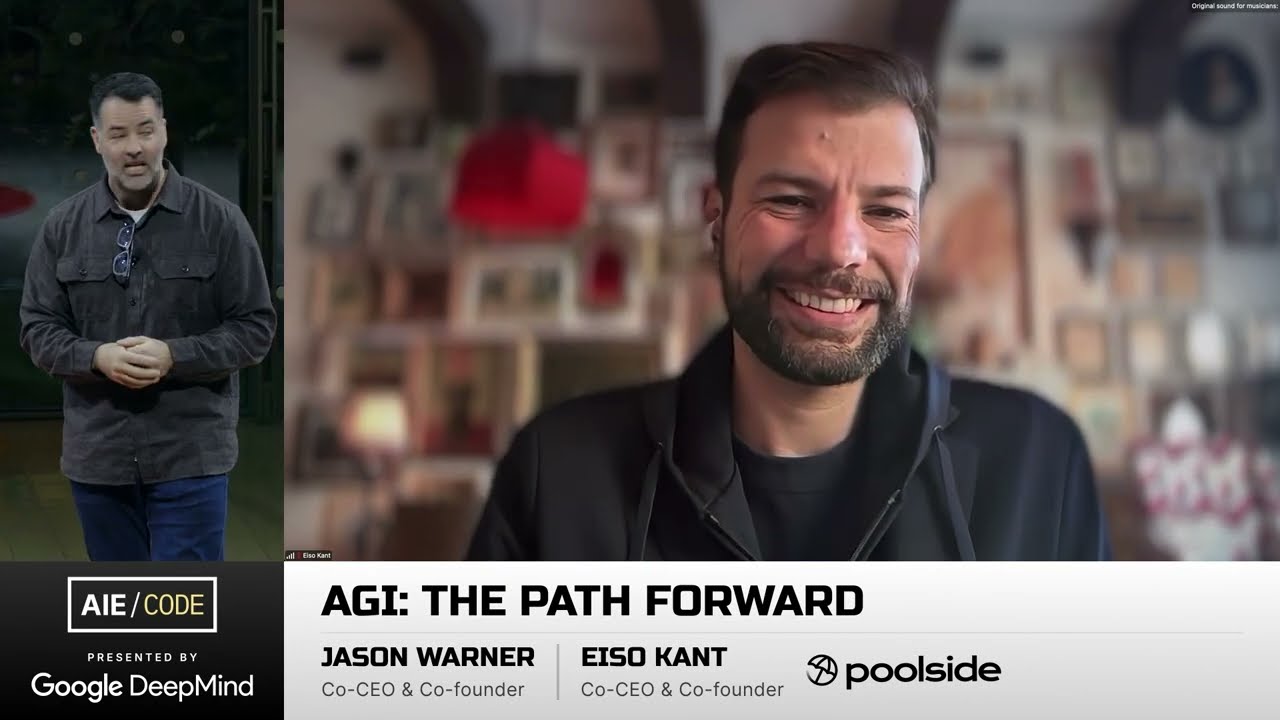
AGI: The Path Forward – Jason Warner & Eiso Kant, Poolside

AGI: The Path Forward – Jason Warner & Eiso Kant, Poolside

In a live demo, Poolside's CEOs showcase their second-generation model, the Malibu agent, by migrating a complex codebase from ADA to Rust, including automated testing and iterative feature development. They outline their vision for achieving AGI through a full-stack approach combining proprietary models, reinforcement learning, and massive-scale compute, with plans for a public model release in early 2025.

What are we scaling?

What are we scaling?

A critical analysis of AI progress, arguing that short AGI timelines are unlikely given the current reliance on pre-baking skills via reinforcement learning. The author contends that true AGI requires on-the-job, continual learning—a capability current models lack. The modest economic impact of AI is presented not as a diffusion lag but as direct evidence of this capability gap. The future of AI will be a gradual, competitive race to solve continual learning, not a sudden takeoff.

How Intelligent Is AI, Really?

How Intelligent Is AI, Really?

Greg Kamradt of the ARC Prize Foundation explains how the ARC-AGI benchmark is shifting the focus of AI evaluation from memorization to true intelligence, defined as the ability to generalize and learn new skills efficiently. He discusses the history of ARC-AGI, how it revealed the limits of early LLMs and highlighted the recent "reasoning breakthrough," and details the upcoming interactive ARC-AGI v3, which will measure AI performance against a human baseline with zero instructions.

The future of intelligence | Demis Hassabis (Co-founder and CEO of DeepMind)

The future of intelligence | Demis Hassabis (Co-founder and CEO of DeepMind)

Google DeepMind CEO Demis Hassabis discusses the path to AGI, focusing on the scientific frontiers of the next decade. He covers the importance of solving 'root node' problems like fusion energy, the challenge of 'jagged intelligence' in current models, and the promise of world models and simulations like Genie and SimA. The conversation also explores the balance between scientific rigor and commercial competition, and the profound societal and philosophical questions AGI will force us to confront.

Why humans are AI's biggest bottleneck (and what's coming in 2026) | Alexander Embiricos (OpenAI)

Why humans are AI's biggest bottleneck (and what's coming in 2026) | Alexander Embiricos (OpenAI)

Alexander Embiricos, product lead for OpenAI's Codex, discusses the vision of AI as a proactive software engineering teammate, the product decisions that led to its explosive 20x growth, and why the real bottleneck to AGI-level productivity is shifting from model capability to human review speed.

Why humans are AI's biggest bottleneck (and what's coming in 2026) | Alexander Embiricos (OpenAI)

Why humans are AI's biggest bottleneck (and what's coming in 2026) | Alexander Embiricos (OpenAI)

Alexander Embiricos, product lead for OpenAI's Codex, discusses the vision of AI as a proactive software engineering teammate, not just a tool. He covers the product decisions that led to Codex's 20x growth, how it enabled shipping the Sora Android app in 18 days, and why the real bottleneck to AGI-level productivity is shifting from model capability to human review speed and interaction.