Agentic search

How Bridgewater Turned 100 Million Documents Into an Edge - Sam Green & Aaron Linsky, Bridgewater

How Bridgewater Turned 100 Million Documents Into an Edge - Sam Green & Aaron Linsky, Bridgewater

Bridgewater Associates' Applied AI and product engineering leads explain how they built the Vault, a governed repository of more than 100 million unstructured documents, and why humans and agents need different things from the same search system. They cover a hand-built benchmark that lifted precision at 10 from about 60% to over 90%, the filtering and scaling choices behind it, and the shift toward proactive agents that bring investors the topics most deserving of their attention.
Grep or Embeddings? Agentic Search Over Company Documents — George He, LlamaIndex

Grep or Embeddings? Agentic Search Over Company Documents — George He, LlamaIndex

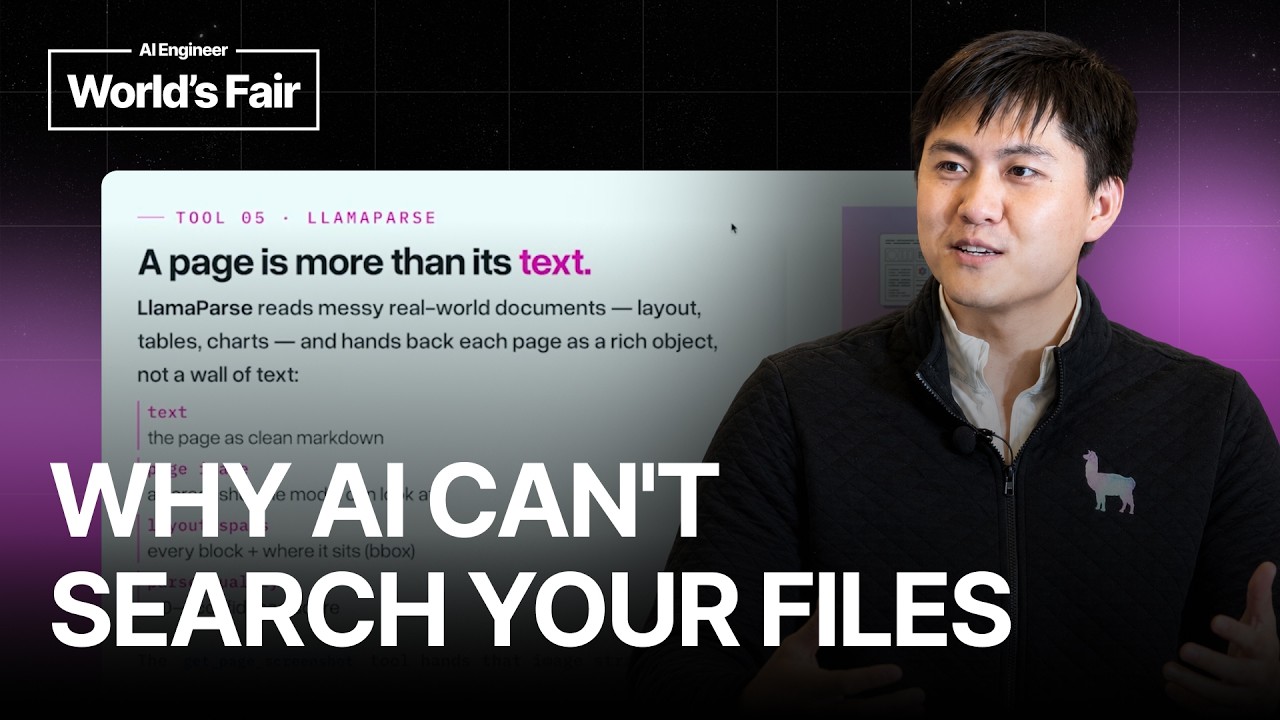
George He, head of engineering at LlamaIndex, explores when agents need pre-indexed vector search and when plain file traversal with grep is enough. He contrasts Claude Code's embedding-free approach on code with the harder reality of large, messy, multimodal, permissioned company documents, and proposes a harness of hybrid retrieval, metadata filtering, grep, and reading tools backed by LlamaParse and LiteParse. The talk closes with a live demo of an agent building a cash-flow table from 135 Alphabet filings, grounded in source files.

Agentic Search vs Vector Search for Coding Agents: We Ran the Eval — Braintrust

Agentic Search vs Vector Search for Coding Agents: We Ran the Eval — Braintrust

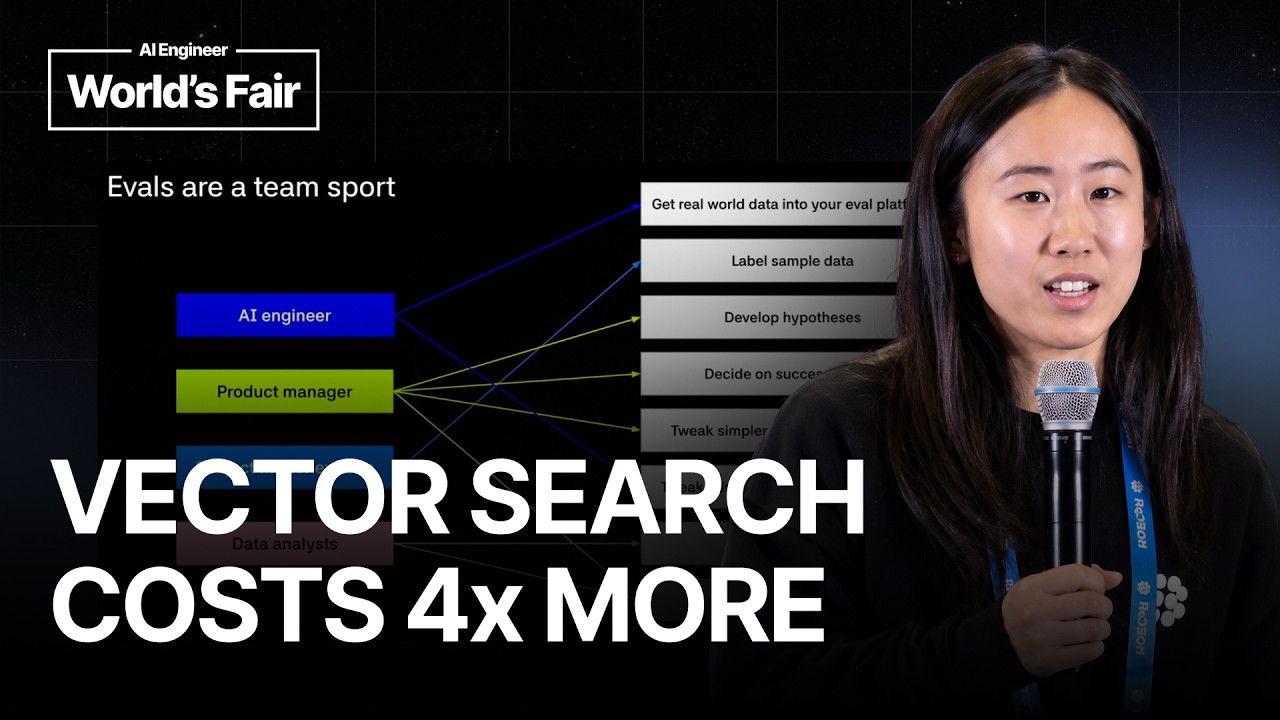
This talk by Jess Wang from Braintrust delves into the critical importance of evaluations (evals) in AI development, moving beyond subjective "vibes" to data-driven decision-making. She breaks down the four core components of an eval—dataset, task, scoring, and experiments—and illustrates the continuous improvement "eval flywheel" integrating observability. The central experiment compares agentic search against vector search for a coding agent tasked with finding buggy code in Microsoft's TypeScript Go repo. While both methods achieved identical accuracy, vector search proved four times more expensive due to its inability to capture surrounding context within code chunks, leading to excessive, inefficient searches. Wang concludes with practical caveats and best practices for conducting effective LLM evals.

How a Voice Agent Learns the Rhythm of Conversation — Shawn Wen

How a Voice Agent Learns the Rhythm of Conversation — Shawn Wen

Shawn, CTO of PolyAI, explains why voice agents are harder than text agents: voice adds time, and good conversation depends on adapting to the person on the line. He describes Dialog-RSN-1, an audio-native model that predicts turn-taking, replies in text with citations, and writes the transcript last for auditability, along with training on real noisy calls, latency and what agents should do while thinking, voice personality, benchmarking, harness ownership, and the shifting bottleneck from producing content to validating it.

The unreasonable effectiveness of BM25 for agentic search — Jo Kristian Bergum, Hornet.dev

The unreasonable effectiveness of BM25 for agentic search — Jo Kristian Bergum, Hornet.dev

Jo Kristian Bergum argues that the 30-year-old lexical search function BM25 is making a powerful comeback, not because it has changed, but because LLM agents are fundamentally different and more capable users. He highlights how these agents, with their general knowledge and ability to formulate complex queries, leverage BM25's strengths. Using the Browsecom+ benchmark, he demonstrates that reasoning isn't the bottleneck for LLMs, but effective retrieval and query formulation are. He advocates for a "file system workspace" approach, allowing models to use their existing coding and bash skills to interact with retrieved documents, signaling a shift in how search systems are designed and evaluated for agentic applications.

Parallel’s Parag Agrawal: Building a New Web for AI Agents

Parallel’s Parag Agrawal: Building a New Web for AI Agents

Parag Agrawal, CEO of Parallel Web Systems, outlines his vision for an agent-centric web where AI agents query the internet 1000x more than humans. He details how Parallel is reinventing search infrastructure, dismissing human click data as a "bug," and tackling the economic crisis of the ad-supported internet with a novel monetization model based on Shapley values to pay content creators.