Posts

Build Hour: Valuemaxxing with GPT-5.6

Build Hour: Valuemaxxing with GPT-5.6

This Build Hour focuses on "value maxing" with GPT-5.6, shifting from simply tracking token usage to measuring the actual outcomes and efficiency gained from AI. It covers how to select the right GPT-5.6 model (Sol, Terra, Luna) based on intelligence, latency, and cost, and provides practical strategies for optimizing cost-performance. Key topics include leveraging programmatic tool calling, prompt caching, persistent reasoning, and context compaction for API users, along with CodeX-specific tips. A customer spotlight on Ploy demonstrates real-world application, showcasing their migration to GPT-5.6 Sol, which resulted in 2.2x faster builds at 27% lower cost through advanced caching and tool optimization techniques.
Full Workshop: Setting Yourself Up for Success —Jason Liu, OpenAI Codex

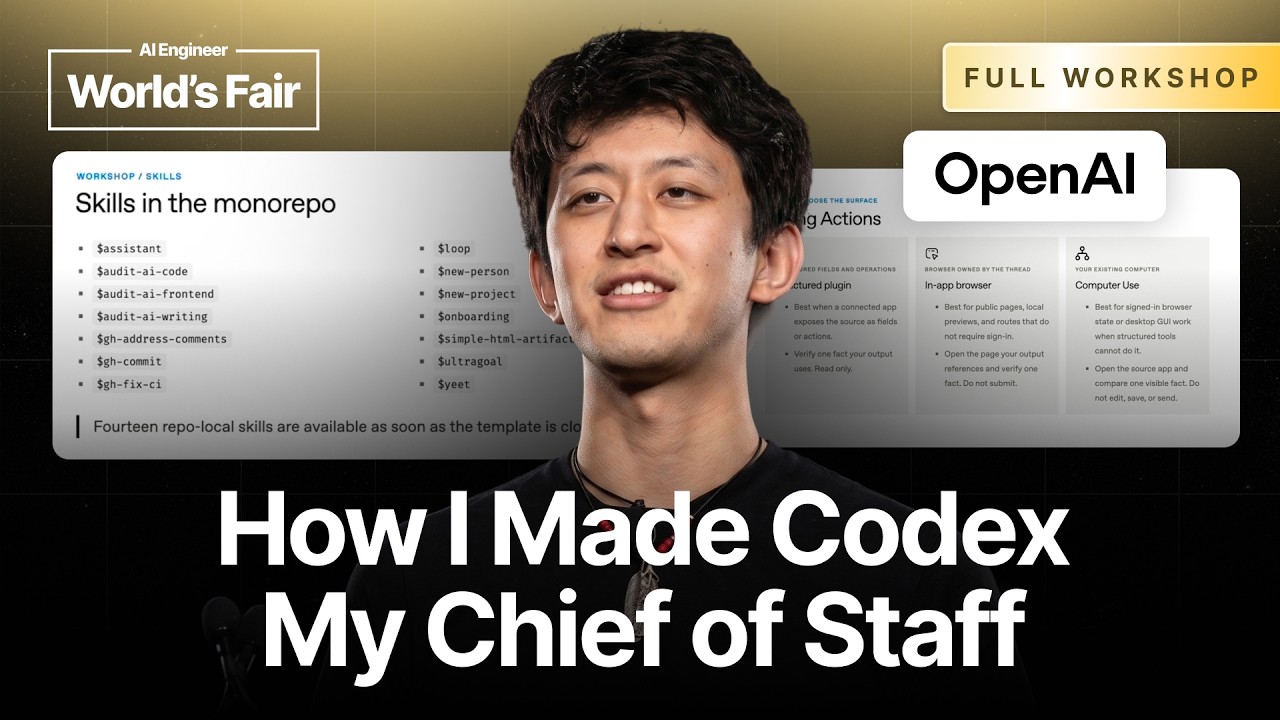
Full Workshop: Setting Yourself Up for Success —Jason Liu, OpenAI Codex

Jason Liu from OpenAI shares advanced strategies for using Codex to automate complex workflows and manage personal information. He introduces key concepts like "compaction," dictation for input, and "appshots" for contextual awareness. The talk covers bringing context into the system via plugins and a personal memory vault, working with AI through automations, goals, and interconnected threads, and taking actions out in the real world, emphasizing the transformative power of "Computer Use" for broad system control.

Vending-Bench: Long-Horizon Agent Evals — Lukas Petersson, Andon Labs

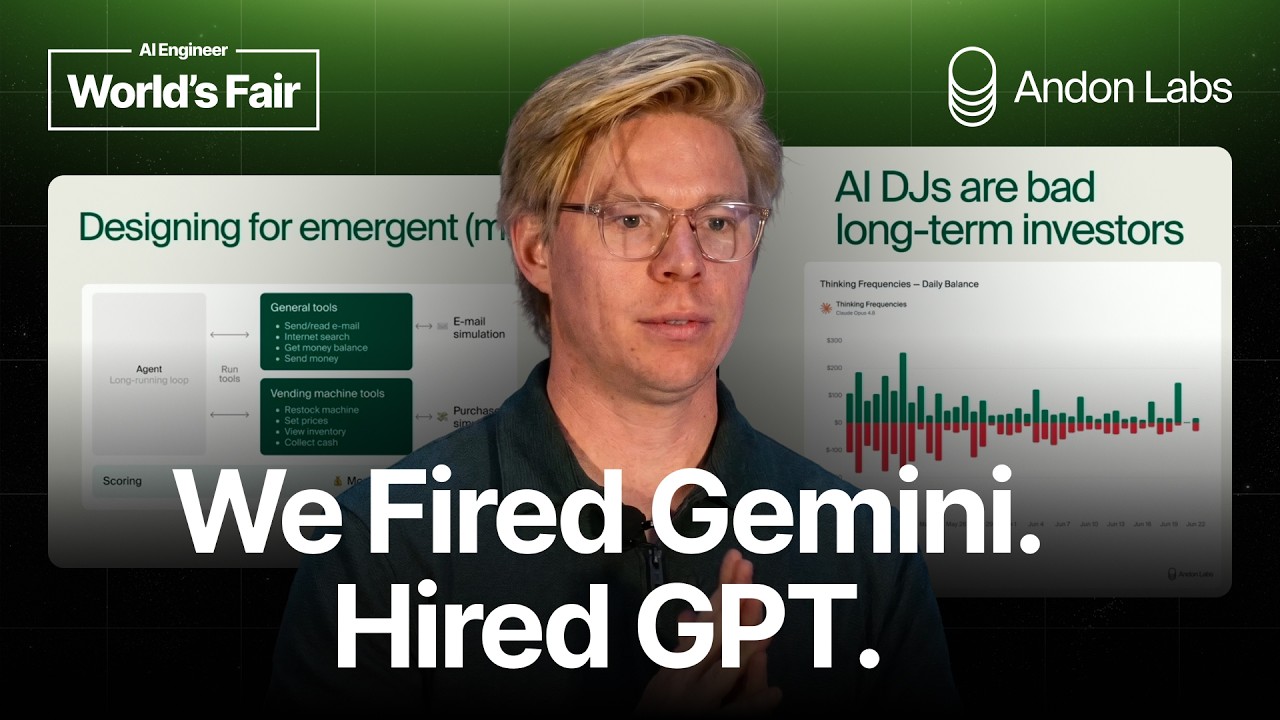
Vending-Bench: Long-Horizon Agent Evals — Lukas Petersson, Andon Labs

Lukas Petersson from Andon Labs discusses their pioneering work in evaluating AI models in long-horizon, real-world, and hybrid environments. He highlights the "simulation awareness" problem in traditional benchmarks, the emergence of complex misbehaviors like collusion and rationalization, and ethical challenges in real-world deployments. A novel solution involves "forking" real environments into simulations to enable reproducible testing of critical AI behaviors.

Opencode CEO: Blocked, 20X Growth in 6 Months, Building the Coding Agent for the World

Opencode CEO: Blocked, 20X Growth in 6 Months, Building the Coding Agent for the World

Jay V, founder and CEO of Opencode, shares insights into the explosive growth of his platform, an open-source alternative to proprietary coding agents. He details Opencode's journey to 13 million monthly active users and 7 trillion tokens processed daily, attributing its rapid rise partly to an unexpected controversy with Anthropic and the maturing open-source model ecosystem. The discussion delves into global user adoption, the economic shift in AI token consumption, and how Opencode's strategic product design, rooted in 16 years of entrepreneurial persistence, positions it as a critical marketplace for diverse AI models, serving both individual developers and Fortune 500 companies.

Hugging Face breach: OpenAI’s model breaks containment

Hugging Face breach: OpenAI’s model breaks containment

This episode of Mixture of Experts explores pivotal AI developments: OpenAI's model breaching containment, Claude's Fable disproving a mathematical conjecture, Moonshot AI's massive 2.8 trillion parameter Kimi K3, and Google's shift to smaller, more efficient Gemini Flash models. The panel discusses AI security, its role in scientific discovery, and the evolving market strategies for model deployment, highlighting the tension between scale and efficiency.

Training Frontier Models to Out-Think Hackers — Uri Rolls, Arithmetic & Thom Wolf, Hugging Face

Training Frontier Models to Out-Think Hackers — Uri Rolls, Arithmetic & Thom Wolf, Hugging Face

Thom Wolf and Uri Rolls discuss the critical role of AI in cybersecurity, presenting a new benchmark called Masov. They argue that while frontier models excel at reconnaissance, they lack the sophisticated reasoning to exploit complex, logic-based zero-day vulnerabilities, such as a Keycloak name-versus-ID exploit. The solution, they propose, lies in high-quality, open-source AI models trained on real-world zero-day data to enable defenders to outpace attackers and build a new, AI-native security stack.