Posts

AI Agents for Performance: Ship Faster, Pay Less — Rajat Shah, Netflix

AI Agents for Performance: Ship Faster, Pay Less — Rajat Shah, Netflix

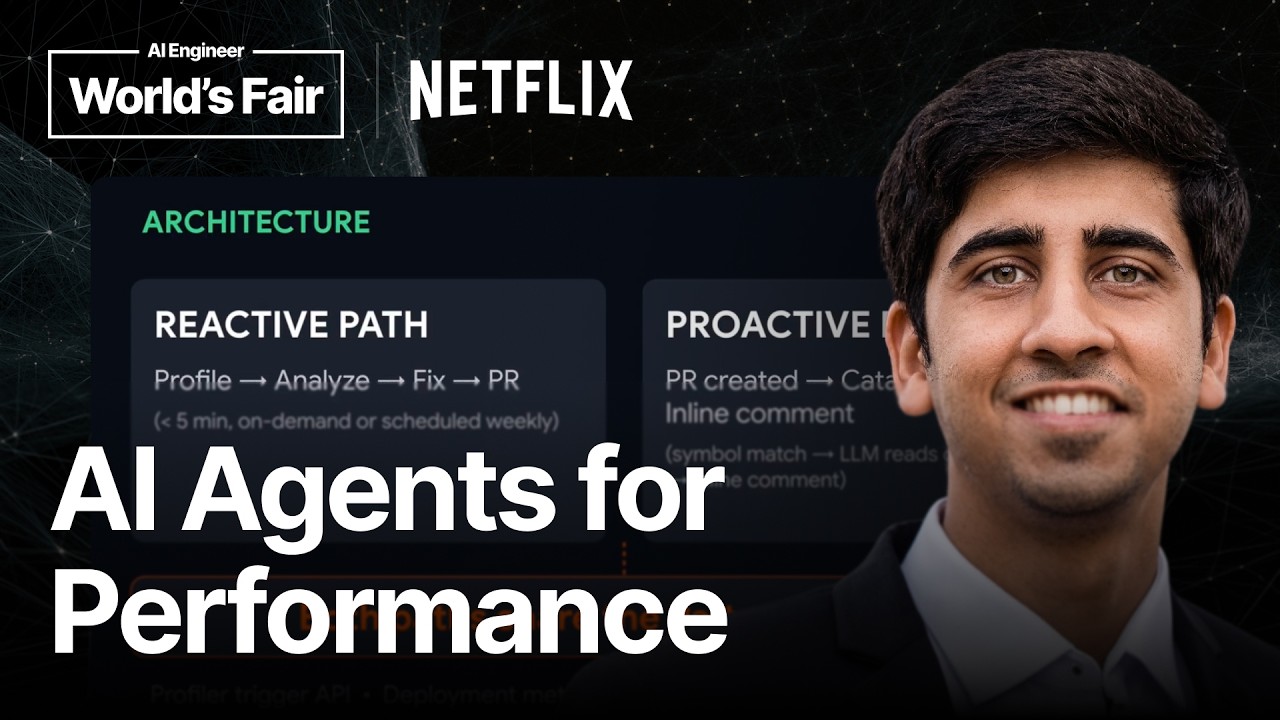
Rajat Shah details Netflix's approach to automating performance engineering using AI agents. He describes how an agent can read production profiling data, identify quadratic inefficiencies, propose code fixes, and validate them via canary deployments. The talk highlights the importance of a shared anti-pattern catalog and shifting from reactive bug fixing to proactive prevention by integrating AI early in the development cycle, emphasizing foundational automation and structured autonomy levels.
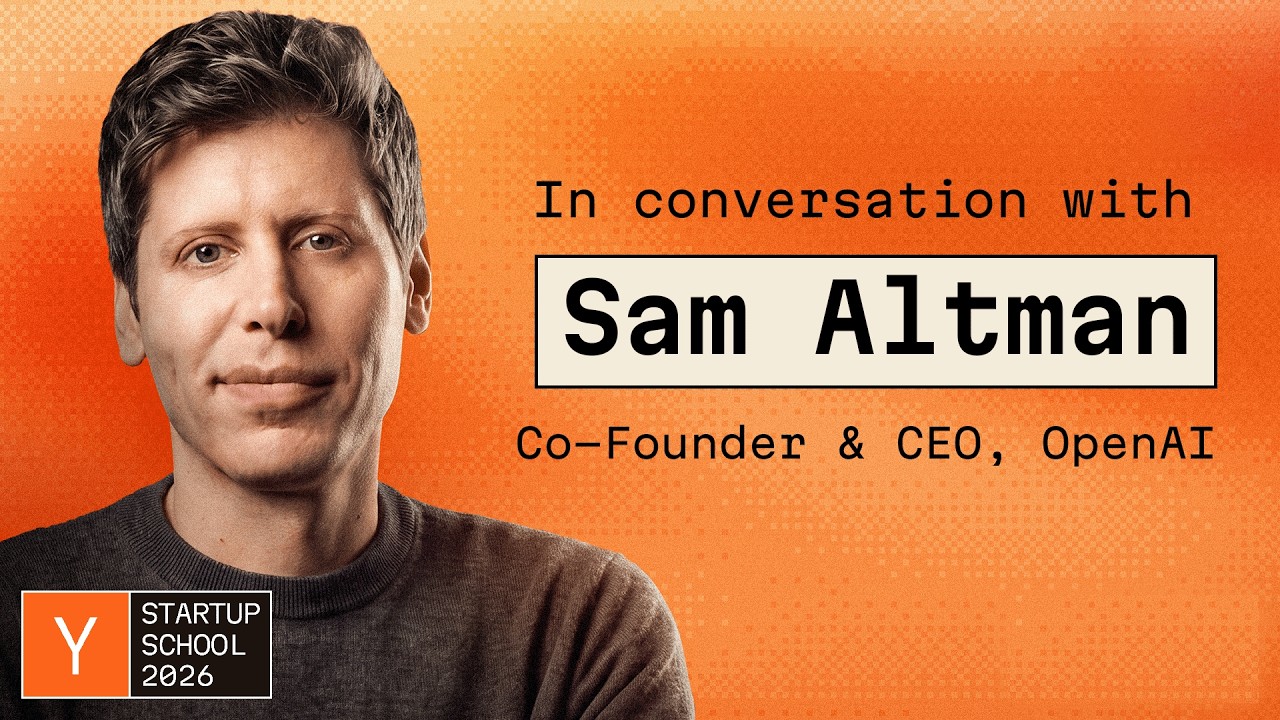
Sam Altman: "Never a Better Time to Do a Startup"

Sam Altman: "Never a Better Time to Do a Startup"

Sam Altman, co-founder and CEO of OpenAI, reflects on the evolution of startups from YC's first batch to the current AI-driven era. He discusses the unprecedented opportunities for ambitious founders, the critical role of startups in distributing AI's power, the importance of conviction against conventional wisdom, and the rapid advancements in AI models, while also addressing safety concerns and envisioning an optimistic future for human agency.

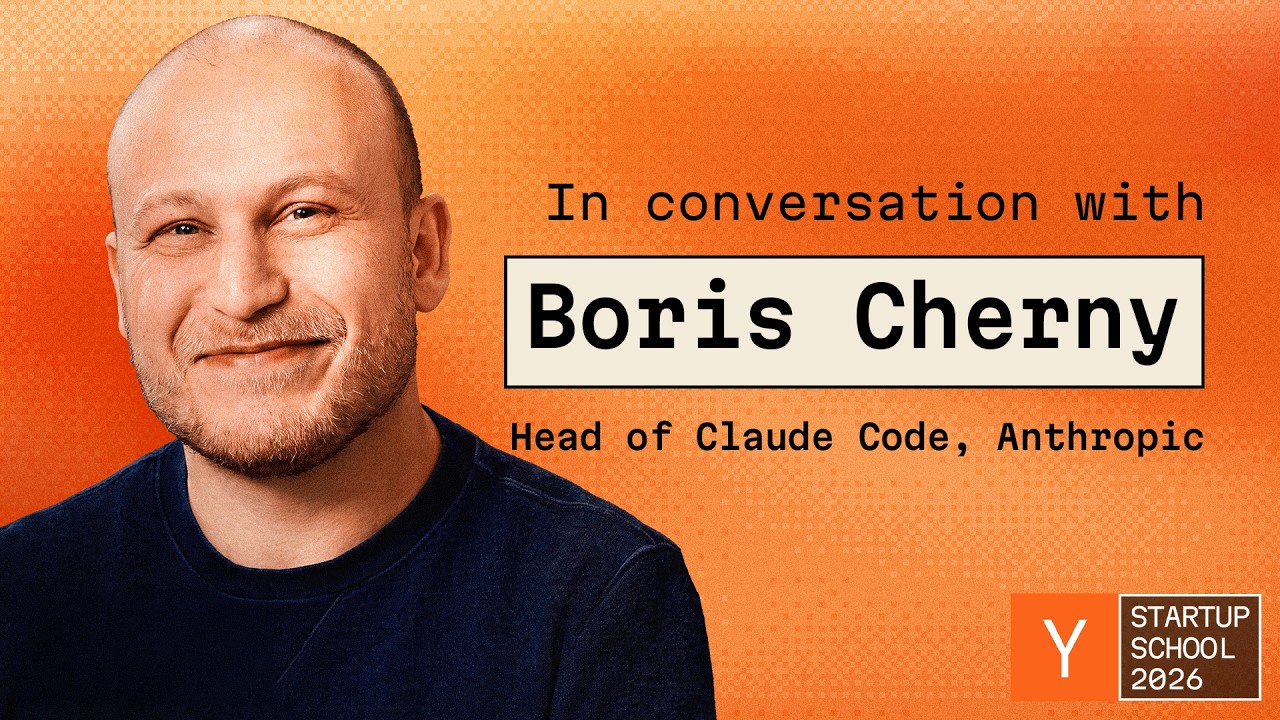
Boris Cherny: Building Claude Code

Boris Cherny: Building Claude Code

Boris Cherny, creator of Claude Code, discusses the transformative capabilities of Opus 5, highlighting its prompt injection resistance and long-task execution. He delves into Claude Code's empirical development philosophy of "unhobbling" AI by constantly adapting to new model generations, and shares insights on how to build advanced AI products using higher-level tasks, self-verification, and dynamic workflows to orchestrate thousands of agents.

Jensen Huang: The Mindset That Built NVIDIA

Jensen Huang: The Mindset That Built NVIDIA

Jensen Huang, CEO of NVIDIA, shares critical lessons from NVIDIA's journey, emphasizing how early failures and a commitment to learning new technologies, like purchasing textbooks from Fry's to pivot the company, laid the groundwork for their success. He discusses NVIDIA's strategic vision, driven by accelerating algorithm domains and seeing AlexNet as a universal function approximator, which led to a reinvention of the computing stack. Huang also explores the future of AI with agents, the importance of fine-grained control, and the "Linux moment" of open-source AI, while also forecasting the rise of physical AI and job creation. He concludes with profound advice on resilience, systems thinking, and the "how hard can it be?" mindset for aspiring entrepreneurs in this unprecedented era of technological reset.

DeepSWE: A Contamination-Resistant Coding Benchmark — James Shi, Datacurve

DeepSWE: A Contamination-Resistant Coding Benchmark — James Shi, Datacurve

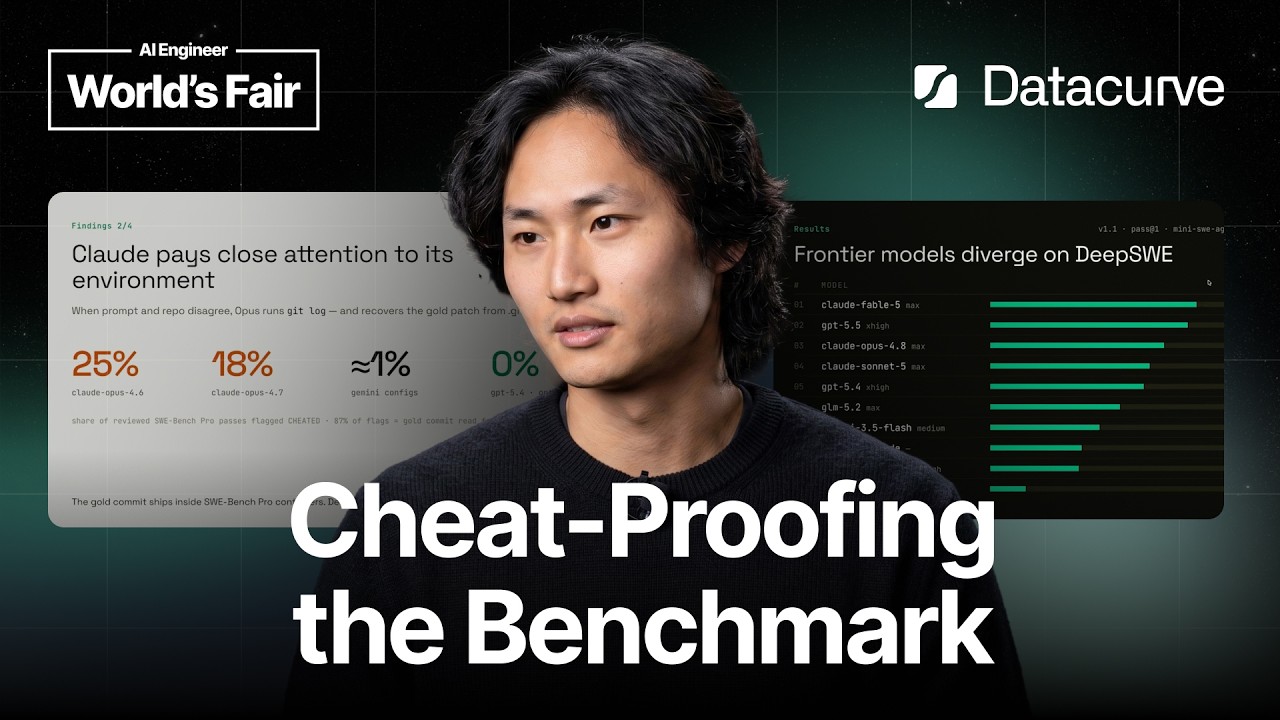
DeepSWE is a novel benchmark for evaluating AI models on software engineering tasks. It features 113 original, long-horizon problems from real open-source repositories, designed to resist contamination and provide clearer differentiation between models. The benchmark highlights unique failure modes and strengths of models like Claude and GPT, emphasizes realistic prompt design, and uses program-based verifiers focusing on observable behavior.

State of Data — Sean Cai, Independent / State of Data

State of Data — Sean Cai, Independent / State of Data

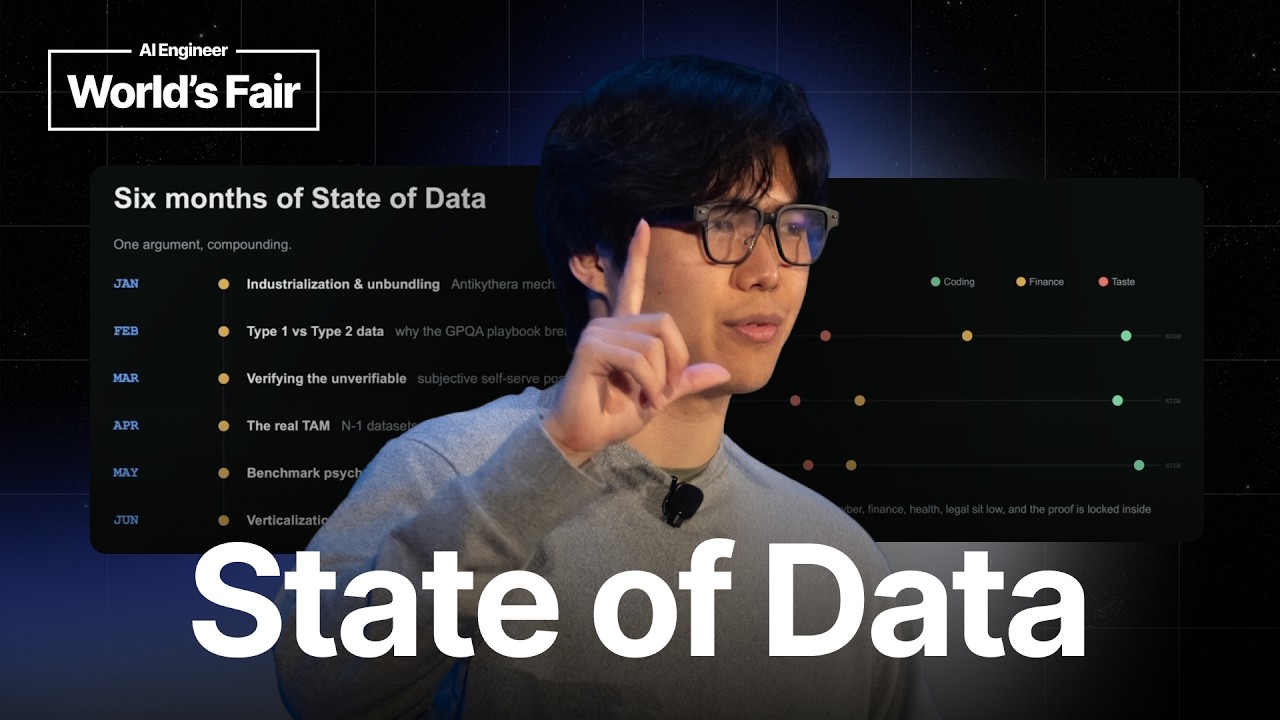
Sean Cai discusses the evolving landscape of AI data markets, highlighting the shift from raw annotation to high-quality, process-based data. He introduces "Verifier's Law" and its three axes to explain application layer maturity, critiques the shortcomings of current benchmarks, and predicts future AI trends by analyzing data market signals. Cai concludes by envisioning data companies transforming into "neo-labs" that provide enterprise-level reinforcement learning as a service and "Antikythera mechanisms" to manage and monetize real-world data assets.