Posts

What OpenAI & Google engineers learned deploying 50+ AI products in production

What OpenAI & Google engineers learned deploying 50+ AI products in production

Aishwarya Naresh Reganti and Kiriti Badam, with experience from OpenAI, Google, and Amazon, share a framework for building successful enterprise AI products. They detail why AI development differs from traditional software, emphasizing the challenges of non-determinism and the agency-control trade-off, and introduce their 'Continuous Calibration, Continuous Development' (CC/CD) lifecycle to build reliable, value-driven AI systems.
Humanoid Robots: Hype vs. Reality

Humanoid Robots: Hype vs. Reality

A deep dive into the key takeaways from CES 2026, covering the surge in humanoid robotics and the evolution of software-defined vehicles, followed by a nuanced analysis of the shifting US-China export controls on advanced AI chips.

Collaborative AI Agents At OpenAI

Collaborative AI Agents At OpenAI

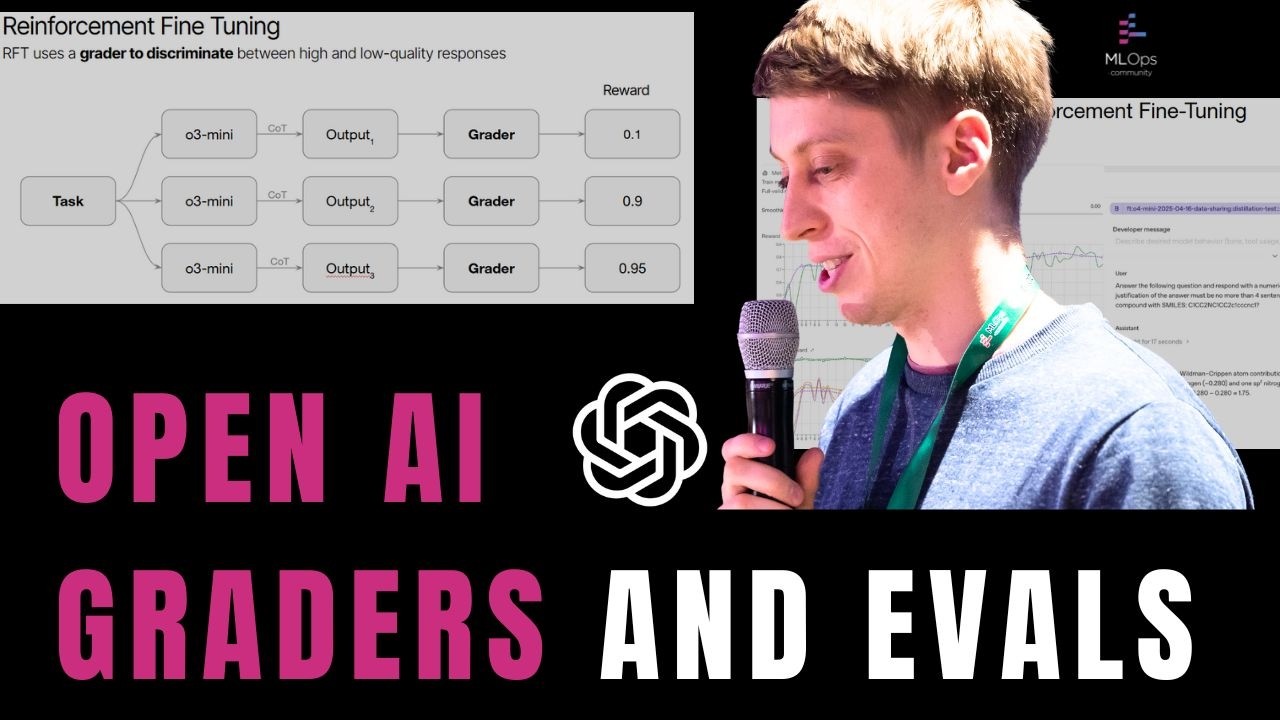
Robert from OpenAI discusses the critical role of structured evaluations (evals) and graders for developing advanced collaborative agents. He explores the limitations of 'vibe-based' assessments, introduces a maturity model for evals, and presents a comprehensive rubric for measuring agent performance beyond simple accuracy, connecting these concepts to the power of Reinforcement Fine-Tuning (RFT).

The Limits of Today’s AI Models

The Limits of Today’s AI Models

Karan Goel, CEO of Cartesia, discusses the fundamental limitations of Transformer architectures, arguing they behave more like retrieval systems than learning systems. He explains how State Space Models (SSMs) enable compression and abstraction, and why Cartesia is tackling multimodal intelligence by first solving for voice AI, aiming to develop a transferable 'recipe' for end-to-end representation learning.

Spec-Driven Development: Sharpening your AI toolbox - Al Harris, Amazon Kiro

Spec-Driven Development: Sharpening your AI toolbox - Al Harris, Amazon Kiro

Spec-Driven Development offers a structured, reproducible, and reliable alternative to 'vibe coding' in the AI era. Al Harris from the Kiro team explains how to leverage specs as living documentation, integrate external tools via MCPs, and use property-based testing to create a tight feedback loop from natural language requirements to verified code.

CES 2026 AI highlights: NVIDIA Rubin & wild gadgets

CES 2026 AI highlights: NVIDIA Rubin & wild gadgets

This episode explores the strategic implications of the Disney-OpenAI licensing deal, critiques Time Magazine's "Architects of AI" focus on business over research, analyzes NVIDIA's full-stack ambitions with the Neotron 3 model release, and delves into Anthropic's unique approach to AI safety with the "Claude Soul Document".