Posts

Agents at Scale: Inside MiniMax's Model and the Infrastructure Behind It — Olive Song

Agents at Scale: Inside MiniMax's Model and the Infrastructure Behind It — Olive Song

Olive Song, RL lead at MiniMax, details the engineering behind MiniMax's open-weight models, focusing on M3's multimodal and agentic capabilities, the necessity of day-zero inference stack readiness, and continuous GPU kernel optimization. She discusses multimodal training challenges, long-horizon task evaluation, and expresses optimism for open models rapidly closing the gap with frontier labs.
Jeff Dean: The 1% Rule for Building in AI

Jeff Dean: The 1% Rule for Building in AI

Jeff Dean discusses the evolution of AI, drawing parallels between Google's past breakthroughs (like fitting search in RAM and the origin of TPUs) and current challenges. He emphasizes that AI is becoming an energy problem, driving the need for specialized inference hardware. Dean highlights 'context engineering' and multi-agent systems as crucial for long-running, complex AI tasks, and offers advice for startups on finding niches where they can outperform larger entities by focusing on specific domains, data, and models. He stresses the importance of clear specifications for agents and 'taste' in problem selection, encouraging founders to question fundamental assumptions and automate the scientific method to build 'AI that builds AI.'

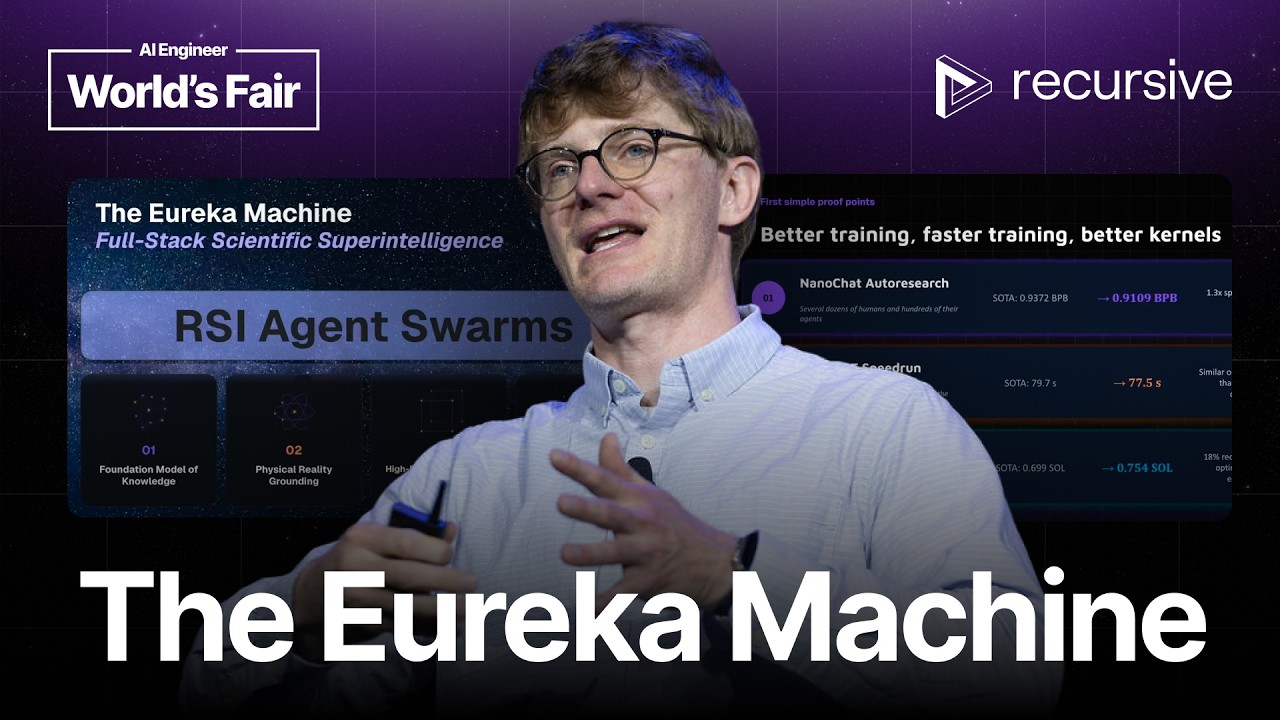
First Steps Toward Automated AI Research — Richard Socher, CEO Recursive AI

First Steps Toward Automated AI Research — Richard Socher, CEO Recursive AI

Richard Socher introduces the "Eureka machine," a concept for automating scientific research and invention through AI. Inspired by open-ended evolution and Karl Popper's philosophy of science, he argues that AI can compress the timeline of scientific discovery, overcoming human-centric bottlenecks. The machine relies on four pillars (knowledge, data, simulations, physical labs) orchestrated by an agent swarm, requiring a rethinking of existing infrastructure. Recursive Self-Improvement (RSI), where AI improves its own code and addresses its shortcomings, is presented as the path forward, with early proof points in model optimization, training speed, and GPU kernel efficiency.

How Lassie Is Automating Healthcare Administration

How Lassie Is Automating Healthcare Administration

Lassie cofounders Steijn Pelle and Frédéric Renken, alongside investor Alex Rampell, discuss automating administrative work for small businesses, particularly dental practices, using AI agents. They highlight the shift from traditional software (data storage) to AI that performs labor, the challenges of onboarding AI into non-technical environments, and the vast market opportunity in underserved sectors where human labor is scarce.

Developer Productivity at a Developer Productivity Startup • Robert-Jan "RJ" Huijsman • GOTO 2025

Developer Productivity at a Developer Productivity Startup • Robert-Jan "RJ" Huijsman • GOTO 2025

Robert-Jan Huijsman, Founding Engineer at Reboot.dev, outlines a pragmatic approach to developer productivity by tackling friction and non-determinism in both human collaboration and software development. He shares Reboot.dev's strategies, including async workstreams, full-stack typing, unit testing with AI, and foundational engineering principles like retries, durable execution, and strong consistency, to build reliable and efficient systems.

Your AI Evals Are Lying

Your AI Evals Are Lying

Andrew Burt of Luminos discusses how current AI risk evaluation methods are insufficient, advocating for a "high dimensionality" approach using granular sub-risks and diverse legal and technical expertise. He critiques common practices like guardrails and single-LLM evaluations, highlighting the need for multimodal systems and continuous, automated monitoring to address the evolving complexities of AI, particularly with the rise of open-weight models.