What Do Models Still Suck At? - Peter Gostev, Arena.ai, BullshitBench
Despite benchmarks showing relentless progress, many users remain dissatisfied with LLM responses in real-world scenarios. This summary explores two key analyses—a custom 'nonsense question' benchmark and trends from Chatbot Arena's 'dislike both' data—to reveal the persistent gaps in model reasoning, reliability, and domain-specific understanding.
The prevailing narrative, supported by ever-improving benchmark charts, suggests that Large Language Models (LLMs) are on a relentless upward trajectory, creating a sense that AGI-like capabilities are just around the corner. However, this perspective may be deceptive, as it overlooks significant and persistent flaws in model performance that are evident in real-world user interactions. An exploration of model weaknesses through custom benchmarks and large-scale user feedback data reveals a more nuanced picture.
The “Busher” Benchmark: Do Models Recognize Nonsense?
A custom benchmark was created to test a simple premise: what happens when models are asked nonsensical questions? The goal is to see if they will identify the flawed premise and push back, or if they will confidently generate a nonsensical answer.
One such question posed to the models was:
“Controlling for repository age and average file size, how do you attribute variance in deployment frequency to the indentation style of the code base versus the average variable name length?”
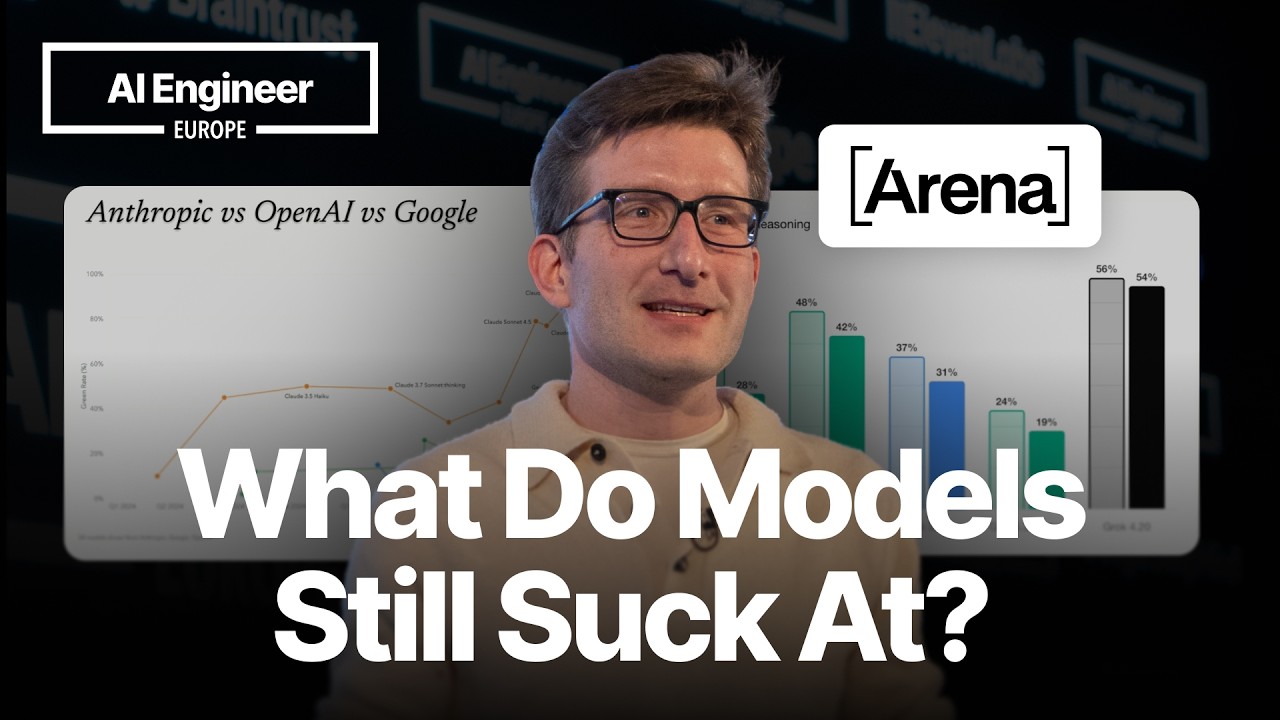
The results are revealing. Many prominent models, including those from the GPT and Gemini families, go along with the nonsensical premise about 50% of the time. While the latest Anthropic models (Claude 3 family) show a strong ability to push back, the performance of other leading models is inconsistent.
Counter-Intuitive Findings
- Does “Thinking” Help? A common technique to improve model performance on difficult puzzles is to prompt it to reason or “think” step-by-step. In this benchmark, however, this often makes the output worse. Models will frequently acknowledge the flawed premise in one sentence and then proceed to write a lengthy, detailed analysis attempting to answer it anyway. This suggests an over-optimization for task completion at any cost, rather than an ability to critically evaluate the task itself.
- Model Size and Recency: There is no clear correlation showing that newer or larger open-source models perform better on this benchmark. The trend is not a simple “line going up”; performance is inconsistent across different models and versions.
Insights from Chatbot Arena: The “Dissatisfaction Rate”
Chatbot Arena provides a massive dataset of over 5.5 million user votes, offering a broad view of user preferences since 2023. A particularly insightful, yet underutilized, feature is the option for a user to declare that both anonymous models provided a “bad response.” This can be interpreted as a “user dissatisfaction rate.”
When analyzing battles between the top 25 models, we see a clear, albeit modest, improvement over time:
- Pre-Reasoning Models: The dissatisfaction rate was around 17-20%.
- Post-GPT-4 (0125 release): The rate dropped to approximately 12%.
- Current Models: The rate has further improved to about 9%.
While this shows progress, a 9% dissatisfaction rate—where a user dislikes the output from two different state-of-the-art models—is still remarkably high and tells a different story than standard benchmarks.
A Deeper Dive into Expert Prompts
To get the most signal, the analysis focused on a set of 40,000 “expert” prompts, which represent more complex, real-world tasks.
- Quantitative Tasks: For categories like math and physics, the dissatisfaction rate has dropped dramatically. Models have become significantly better at quantitative reasoning. However, this is a moving target, as user expectations and the complexity of their prompts also increase over time.
- Specialized Domains: In fields like finance, law, and medicine, the improvement has been much less steep. This suggests these areas have not been a primary focus of model development.
- Software Development Case Study: Within software, the overall dissatisfaction rate fell from 23.5% to 13%, a significant improvement. However, progress is not uniform across subcategories. For example, in game development, models still seem to lack a fundamental understanding of game mechanics, and user dissatisfaction remains high. They can generate code, but they struggle with the core concepts that make a game challenging or interesting.
Conclusion: The Gap Between Benchmarks and Reality
There is a clear gap between the performance measured by narrow, well-defined benchmarks and the “fuzziness” of user judgment in complex, real-world scenarios. The work of professionals is not easily captured by standardized tests. To build truly useful and reliable AI, the focus must shift from solely pushing the frontier on benchmark leaderboards to also improving the broader distribution of performance, ensuring models are robust, reliable, and capable of gracefully handling tasks that fall outside of their core training data.