Should You Trust ChatGPT With Your Health?
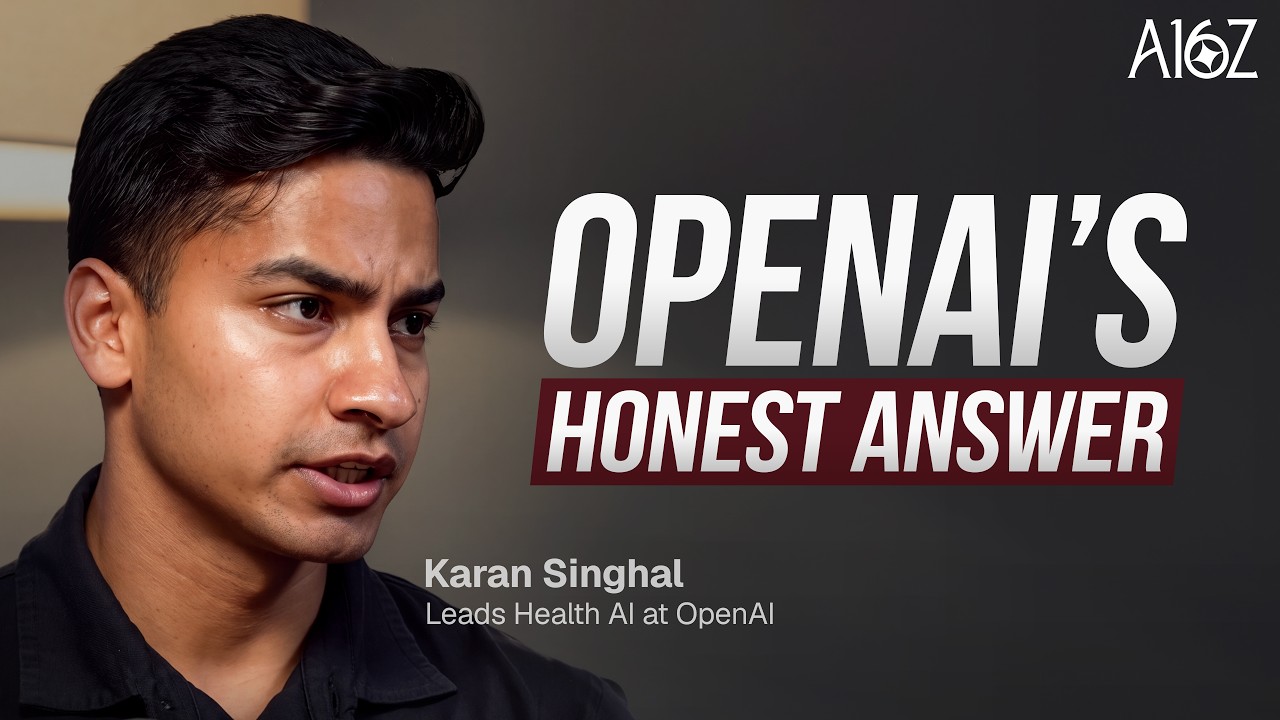
Karan Singhal, who leads health AI research at OpenAI, joins a16z's Jay Rughani to discuss how OpenAI is building trustworthy health intelligence into general-purpose frontier models. The conversation covers expert-driven evaluation and disagreement handling, the role of AI as a complement to doctors, integrations with Epic and clinician copilots, personal agents navigating fragmented healthcare, the distinction between medical information and medical care, and how falling costs of medical intelligence could compress the lag in clinical consensus and accelerate treatment discovery.
Overview
This conversation between Karan Singhal, who leads health AI research at OpenAI, and a16z partner Jay Rughani covers why OpenAI is investing in health, how it trains healthcare expertise into general-purpose frontier models, how trust and correctness are handled, how personal agents may reshape care navigation, and how the cost of medical intelligence might fall over time.
Why health, and the scale of the problem
Singhal frames OpenAI’s mission as ensuring AGI benefits all of humanity, pursued through three channels: building and deploying AGI, preventing downside through safety work, and making upside happen. Health is presented as a concrete way to pursue the upside while also tackling safety problems unique to healthcare. The stated goal is to “raise the floor” of human health by offering trustworthy, reliable health intelligence for free or nearly free, and to “raise the ceiling” by making previously impossible things possible.
Jay Rughani anchors the discussion in scarcity: the US spends over $5.3 trillion on healthcare, which would make it the third-largest GDP if it were a country, and yet over 100 million Americans lack a regular primary care doctor, and waits of 40-plus days are common. Singhal describes the care experience as often limited to 15-minute visits after weeks or months of scheduling, leaving patients with unanswered questions. The argument is that health is not confined to these intervals, and AI is most valuable “in between visits” as patients prepare for appointments, interpret lab results, and follow up on instructions. More than 300 million people weekly use ChatGPT for health and wellness questions, and most of them are free users, many outside the US.
Human stories and the motivation
Singhal describes the team’s most gratifying signals as both usage numbers and direct messages from users. He highlights the story of Nathan Labenz, host of the Cognitive Revolution podcast, whose young son suffered prolonged fatigue and irritability. AI helped the family recognize the seriousness of the symptoms while they were on vacation, supported their decision to pursue testing, and encouraged them to keep pressing even when doctors seemed less concerned. The son was ultimately diagnosed with an aggressive form of leukemia, and Labenz reportedly used GPT-5 Pro to help interpret lab reports before a specialist had time to explain them, which gave the family considerable peace of mind.
General versus specialized models
A recurring theme is the architecture question: why use a general-purpose model for something as complex as medicine? Singhal, who previously worked on specialized models, argues that the answer is “specialized training in a general model,” which he calls the best of both worlds. Healthcare data is added to every phase of training for ChatGPT’s models over the past year, so the models gain both frontier-scale reasoning and the domain expertise drawn from working with physicians worldwide. His experience is that dedicated healthcare-only models fall behind the frontier quickly, and the approach is to “hitch a ride” on scale while using evals and training data to specialize.
The personal doctor vision and distribution
Rughani describes the appealing vision of a personal doctor in your pocket: knowledgeable across all specialties, aware of full medical history and preferences, able to nudge people toward better health behaviors and protocol adherence. Singhal calls this a proactive personal health assistant and is clear that it is not a replacement for a doctor. The consumer product, ChatGPT Health, lets users connect their health information securely, with the explicit commitment that the data is not used for training or ad targeting. Distribution has been intentionally broad, reaching free as well as Pro users.
Rughani recounts Greg Brockman’s story of a friend whose physician was about to administer a medication, and whose ChatGPT check, informed by her medical history, surfaced a likely interaction. The doctor agreed and said there had not been time to review the full history. This prompts the question of whether second and third opinions should become routine for every clinical scenario if they are cheap and convenient. Singhal sees AI as a safety net for both patients and clinicians that augments existing care rather than acting as a middleman. OpenAI’s study with Penda Health of a clinician copilot is one example: the system proactively flagged possible medication interactions and, in one notable pattern, nudged clinicians away from antibiotic overuse by considering global antibiotic resistance rather than only the local case.
Personal agents and the fragmented system
Rughani connects this to the emergence of personal agents that can execute multi-step objectives using preferences, applications, and even payment details. Potential health applications include scheduling appointments, verifying insurance coverage, following post-discharge protocols, and contesting billing errors. Singhal is excited about this direction but notes that healthcare is burdened by legacy software, fragmented data, and systems like EHRs often running on virtual machines in the cloud. He argues that this is ripe for agents and computer use, and that many current barriers between patients, clinicians, and data may dissolve in the coming months.
Trust, tailoring, and disagreement
Singhal emphasizes that healthcare “moves at the speed of trust,” so models must be measured and the world brought along. Tailoring responses to the user is central: HealthBench, released in May 2025, evaluated how models adjusted technical jargon for lay users versus clinicians.
Disagreement is treated as a core challenge. A user may hope to hear reassurance, while medical reality may require something very different. Singhal explains that OpenAI deliberately avoided relying on a few clinicians, because “if you ask five physicians… you’ll get like eight different answers.” Instead, it built a global physician network of hundreds of experts across dozens of specialties, languages, and countries to aggregate expert judgment. Where competing objectives arise, safety is prioritized, and evaluations test whether the model tells users clearly that something is unsafe and they should seek care, even when they would prefer otherwise. When a patient’s physician disagrees with ChatGPT’s answer, Singhal’s advice is to treat it like any medical disagreement and seek a second opinion.
Correctness and the lag in medical consensus
For areas where science is still evolving, Singhal describes the existing pipeline: biomedical papers, annual specialty clinical guidelines, and finally practice. The final step is a massive bottleneck; studies suggest it takes 5 to 17 years for guidelines to penetrate everyday practice. The goal is to compress that lag to weeks, days, or even hours by bringing the latest literature into the point of care, through offerings such as ChatGPT for Clinicians and ChatGPT for Healthcare. For genuine uncertainty, models should recognize and state their own uncertainty, and HealthBench includes evaluations on appropriate hedging. Singhal also points to AI accelerating science itself as a way to push the medical frontier.
On politicized or contested topics, such as unapproved peptides or vaccines, the approach is to rely on experts to define standards for how the model should respond.
Serving multiple constituents
Singhal organizes product thinking around three parts: making models good for each user type, building the right harness and product around them, and deploying through partnerships that reach the right users. A key principle is reducing activation energy: even a strong model is useless if adoption requires too much effort. This drove investments in security and compliance, including HIPAA compliance and privacy protections, roughly two years ago. He describes OpenAI as early in speaking healthcare’s language, and says the company has since worked to understand each constituency’s needs.
The Epic integration is presented as a key step against fragmentation. Providers can use ChatGPT for Healthcare within Epic through a sidebar, and ChatGPT can be used in Epic workflows, with additional connectors coming.
Mental health
For mental health, Singhal says the company commits to a baseline safety floor across all surfaces, including the ChatGPT product Dots. The effort goes further through a mental health benchmark developed with licensed experts worldwide. Consensus is harder to reach here than in physical health, but the aim is a shared measuring stick across the industry that also tracks how models can proactively provide positive mental health experiences, moving beyond merely avoiding harm.
Information versus care
Rughani draws a sharp distinction between medical information and medical care. LLMs are increasingly the faster, cheaper way to resolve questions, but diagnosis, prescriptions, in-person specialists, imaging, examinations, liability, and licensure still belong to the traditional system. Singhal agrees that AI will not provide all of this. OpenAI’s role is to enable the ecosystem, with the “last mile” of care becoming easier for partners, while it acts as a quarterback by helping users navigate the process of finding care. He expects OpenAI to avoid directly running the full care delivery business.
In terms of partners, UCSF is highlighted as an early adopter for connecting Epic and ChatGPT and for clinician chart review, and AdventHealth is cited for deploying agents across workflows with reported roughly 80% reduction in certain administrative workflow costs.
On whether patients should be alarmed to see ChatGPT on a doctor’s screen, Singhal says the Overton window is shifting. Both clinicians and patients increasingly find the tools useful as a sanity check, though he does not claim full acceptance has arrived. For future visits, he hopes the human elements of care, including empathy, bedside manner, physical examination, and the comfort of a second check, remain central.
Proactive care and discovery
Singhal sees the highest near-term health impact in chronic care, such as flagging rising A1C levels and prompting medication review, but says OpenAI will not manage these processes alone. He also discusses the “Move 37” concept from AlphaGo as an aspiration for health: predictions or strategies that initially seem wrong but later prove insightful. Longitudinal models that integrate years of EHR, claims, and chat data could make predictions that a human could not integrate. He is also optimistic that agents can mine existing data stored in silos, and that AI can accelerate validation, which he sees as the true bottleneck, more than idea generation.
Cost and economics
On cost, Singhal argues that making health intelligence widely accessible is a core part of the mission, including free access and API pricing. He cites GPT-5.4 nano-level efficiency as an example: a cheaper model outperformed a recent best model on HealthBench Professional at a fraction of the cost. The bet is that the cost of a fixed level of trustworthy health intelligence will plummet, moving toward commoditization. He is careful to say that health intelligence alone has not yet changed macro healthcare spending. Real savings will come from integration into workflows, particularly chronic care management, documentation, administration, and back-office processes.
On the provider-payer arms race reported in the press, Singhal views it as a short-term distraction. In the long run, ambient intelligence and shared ground truth from visits could let AI adjudicate claims with a handshake between providers and payers, eliminating much of the wasteful conflict.
For entrepreneurs, his advice is to build on capable models and to bet that they will keep improving, rather than betting against them.
Procedural care and the road ahead
For procedural care, such as imaging, surgery, and robotics, Singhal expects AI to improve targeting and help patients know when to seek care. Preventive, proactive interventions could avoid expensive downstream procedures, which he calls probably the biggest macro factor over the next year or two. Robotics in care is a longer-term question involving technology, reimbursement, and industry integration.
Looking ahead, the two goals are raising the floor through trustworthy, abundant intelligence that patients and clinicians feel safer with, and raising the ceiling through proactive personal assistants and unlocking existing data. Over the next five to ten years, Singhal expects the largest impact to come from new treatments, driven by AI-guided target and molecule generation and AI-guided prioritization and validation of clinical trials, where the number of candidate drugs far exceeds available trial slots. The result should be improved and more personalized medicines.