Why AI Startups Will Disappear Without Compute Markets — Evan Conrad, San Francisco Compute
Evan Conrad explains how San Francisco Compute went from an AI lab forced to sublease its own GPU cluster to an operator of supercomputers and a market for compute. He lays out the chain of risks facing new labs and inference companies, from sold-out capacity and oversized deposits to late, broken clusters and unpredictable demand, and argues that these form one credit-driven risk problem that a working compute market must solve.
Why a compute market has to exist at all
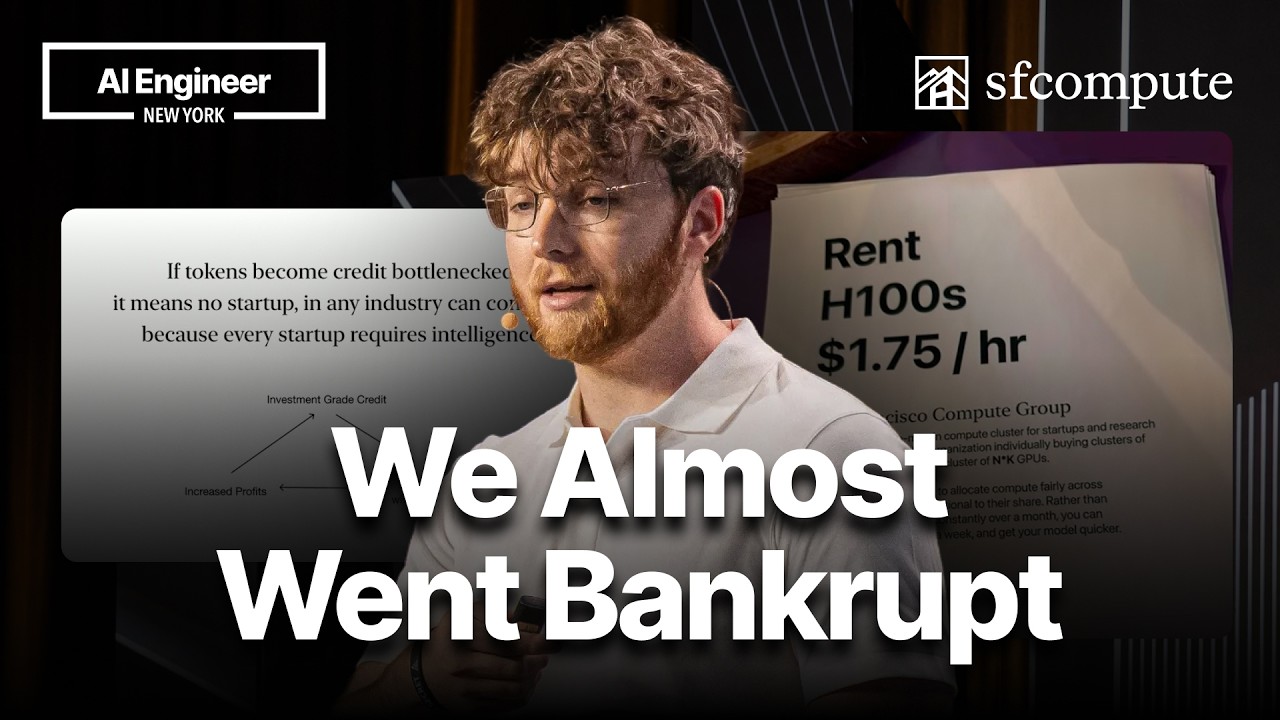
San Francisco Compute started as an AI music lab, originally aiming to build something in the vein of Suno or Udio. The founders expected to raise a modest sum and rent capacity from someone else, but once they bought their own cluster they were underwater on it every month. Subleasing it was the only way to avoid bankruptcy, which made them the first GPU broker by necessity. The company’s first year was spent selling that capacity just to stay alive. The founders’ view is that compute markets should come from the real problems companies face, not from a wish to build a marketplace for its own sake.
What the company actually does
San Francisco Compute runs a physically settled forwards market. It is both the operator of the hardware, the way a cloud is, and the market where that capacity is bought and sold, closer to a grid for compute. Its supercomputing-as-a-service offering serves three kinds of customers: operators who want to become a GPU cloud (what Nvidia calls an NCP), venture firms that hold clusters for portfolio companies and need to reallocate them when a company takes off, and AI companies that want the residual value of their compute without running a supercomputer. On top of this physical layer sits a live order book for reserved capacity, available now or in the future.
The operator’s responsibilities reach well past the data center. They include the bill of materials, the backplane fabric, bare-metal orchestration, VMs, and the services layered on top. Without control of that full stack, a data center owner who tries to become a GPU cloud tends to fail the customer.
Why AI compute financing differs from the SaaS era
SaaS companies have high margins, so a cloud that doubles its prices hurts but does not kill them. AI companies have thin margins and are price sensitive. A doubling of prices can bankrupt them, and nothing keeps them tied to one provider, so they leave for whoever is cheapest. Because of this, capacity cannot be sold purely on demand. Financing a cluster requires long-term take-or-pay contracts, ideally with investment-grade counterparties. If reserved capacity is illiquid and customers cannot exit, a company that needs capacity right now cannot get it, and must finance a new cluster that has its own lead time.
The chain of failures a new lab hits
The problems arrive in sequence. Everyone is sold out, and a new cluster has a lead time that no one can shorten, so the choice is to pay for capacity that arrives later. Lenders cannot underwrite a two-person startup building super intelligence and have no way to value the asset, so they demand a deposit that can consume the company’s entire bank balance. Venture capitalists fund that deposit by writing the check to the cloud.
Delays follow because the lender needs to know who the customer is before the cluster is deployed. Signing the customer becomes the riskiest moment in the whole operation. The better order would be to build the cluster first, land it in the data center, and only then sell it. Clusters then break in the hands of customers who lack the liquidity to swap in replacement nodes. Failed nodes must go through RMA, which brings back the lead-time problem. Finally, demand is almost impossible to predict. Companies end up either over-provisioned or under-provisioned, with no way to sell surplus or buy more when needed.
One bundled risk, and credit as the real bottleneck
The founders argue that technical risk, financial risk, and credit risk are all one problem. The most important bottleneck in AI right now is credit, not power. Companies hit credit limits long before they run into power constraints. Since AI margins leave little room for error, a company that underbuys loses to a competitor who bought correctly, and a company that overbuys can collapse, as Stability AI and Character AI did in different ways.
A functioning compute market therefore has to underwrite the value of the GPU cluster rather than the credit of each individual customer. The analogy they use is a hotel room. You cannot resell a room to someone else if you do not run the hotel, because room service, cleaning, and repairs all depend on the operator. Brokering clusters works the same way: the entity selling the capacity has to operate it, or the market cannot achieve physical settlement.
Why almost nobody builds physical settlement
The incentive structure pushes everyone away from it. Building physical settlement for compute means building the full operating capacity of a GPU cloud. Once you have done that, the rational move is to become a cloud and sign billion-dollar deal after billion-dollar deal, which is what nearly everyone does. San Francisco Compute built physical settlement because it was the only path to the thing it really wanted, which was to start an AI lab. Without a market that solved the credit problem, that lab could not get off the ground.
The deposit ladder and where it leads
The minimum deposit needed to start a lab has climbed from $10 million to $100 million to roughly $1 billion, and the founders do not believe that curve can continue. Nobody is going to raise a $10 billion round before showing revenue, traction, or a product.
One alternative is to push the credit risk onto the application layer by signing only Fortune 500 customers, locking them into five-year token contracts, and demanding large upfront deposits. The founders see this as the end of the startup ecosystem. If inference providers are bottlenecked by credit, only firms that already have credit can access intelligence at scale. Those incumbents then build the products, earn the revenue, and strengthen their credit further, creating a flywheel of consolidation across the economy.
If the current trajectory holds, the founders expect that within three to five years a new startup will need to buy hundreds of millions of dollars of tokens just to compete. A two-person company trying to raise $100 million will find that nobody wants to work with it, and it will be asked for a five-year contract on the full amount. The industry would then look more like TSMC, with a few buyers and a few labs, and few new entrants.
What is at stake
The founders want a world full of small teams building things, the kind of companies that might develop cancer cures or find applications nobody has imagined, rather than undifferentiated AI output. They argue that compute markets are the mechanism that keeps that world possible. Without a market that solves the credit and operating problems, the startups that would build those things will not get started.