Bridging Neurotechnology with Immersive Systems: Getting BCIs outside of the lab?
This talk by Hakim Si-Mohammed explores the evolution of Brain-Computer Interfaces (BCIs) from clinical rehabilitation tools to integral components of immersive systems. It details research on integrating BCIs with Virtual and Augmented Reality (VR/AR), focusing on SSVEP-based interaction, user experience enhancements, and the development of passive, neuro-adaptive systems that respond to user mental states to mitigate issues like cybersickness.
The core concept of a Brain-Computer Interface (BCI) is not just about reading the brain, but about creating a system where the brain and a computer can mutually influence each other. The BCI Society formally defines it as:
A system that measures brain activity and converts it in nearly real time into functionally useful outputs to replace, restore, enhance, supplement, and/or improve the natural outputs of the brain.
Historically, BCIs like the P300 speller and Motor Imagery systems were developed primarily for rehabilitation and assisting users with disabilities. However, the field’s primary challenge today is moving these technologies “outside the lab” for widespread, non-clinical use by healthy individuals. This transition is being explored through two main avenues:
- Explicit Control: Using active or reactive BCIs to directly command external devices.
- Neuro-adaptation: Using passive BCIs to infer a user’s mental state and adapt a system’s behavior accordingly.
Both approaches are highly synergistic with immersive systems like Virtual and Augmented Reality (VR/AR).
The Symbiotic Relationship Between BCIs and Immersive Systems
The integration of BCIs and immersive technologies offers mutual benefits, accelerating the maturity of both fields.
-
How VR/AR Benefits BCIs:
- Enhanced Feedback: VR/AR can provide rich, integrated, and ecologically valid feedback, which is crucial for the closed-loop operation of a BCI.
- Controlled Environments: VR allows researchers to create highly controlled, reproducible experimental environments to study specific brain functions.
- Improved Performance: Studies have shown that embodiment in VR, where a user feels present in a virtual avatar, can significantly enhance the effectiveness of paradigms like Motor Imagery. Neurofeedback in VR is also being used to train athletes, improving performance by providing real-time feedback on their mental state during practice.
-
How BCIs Benefit VR/AR:
- Hands-Free Interaction: BCIs provide a novel, hands-free input modality for controlling immersive environments.
- User State Information: Passive BCIs offer a direct channel to the user’s cognitive and affective states (e.g., workload, engagement, cybersickness), enabling the creation of neuro-adaptive systems that can personalize the user experience in real-time.
Advancements in Explicit BCI Control for AR/VR
SSVEP for Augmented Reality Interaction
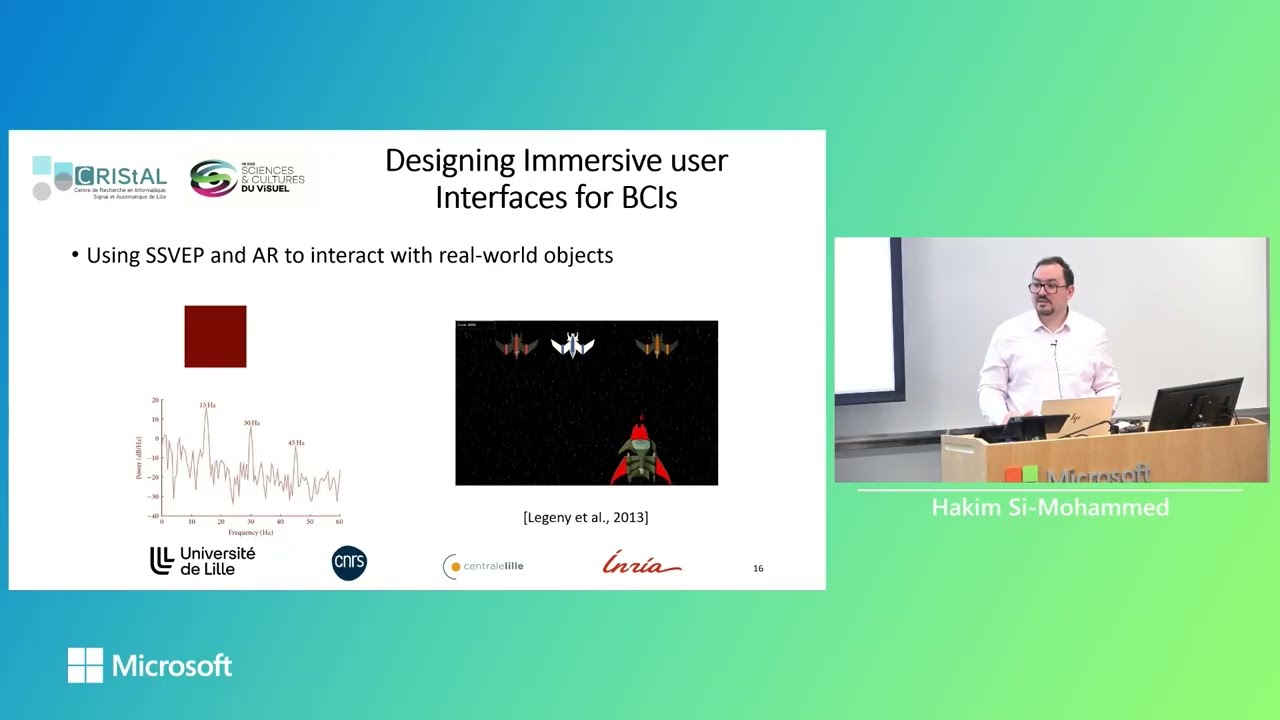
Steady-State Visually Evoked Potentials (SSVEPs) are a robust BCI paradigm where the brain’s electrical activity synchronizes with the frequency of a flickering visual stimulus the user focuses on. Research has demonstrated its viability for interaction in AR.
- System Design and Application: An early application involved controlling a robot in AR by having the user focus on flickering targets. This work evolved into a collaboration with Orange to develop a system for controlling a commercially available smart home. The project required a robust, modular software architecture with a middleware layer to handle asynchronous commands, manage different object types (single-command vs. hierarchical menus), and remain hardware-independent.
- Improving User Experience (UX): A significant drawback of SSVEP is the visual annoyance of flickering targets. Research was conducted to improve user-friendliness:
- Display Strategy: An evaluation of 32 different display strategies found that fixing targets to the center of the user’s field of view yielded the best classification accuracy.
- Stimulus Properties: An investigation into the cross-effects of stimulus size and contrast (luminance) revealed that while larger targets improve accuracy, they are also more annoying. Interestingly, reducing contrast did not significantly impact accuracy, a finding potentially explained by the non-linear luminance output of display hardware.
- Bio-Inspired Stimuli: A promising alternative to flickering boxes is the use of more natural, “bio-inspired” stimuli, such as the fluttering motion of a butterfly’s wings. Pilot data showed this can trigger the same SSVEP brain response, paving the way for more aesthetically pleasing interfaces.
Beyond Gaze: Covert and Split Attention
A common question is how BCIs differ from eye-trackers if a user must look at a target. Research into a P300-based BCI demonstrated that it’s possible to distinguish between overt attention (gazing directly at a target) and covert or “split” attention (attending to a peripheral target while gazing at a central point). This proves that the BCI responds to the user’s intent rather than just their gaze direction, a key differentiator from simple eye-tracking.
Passive BCIs for Neuro-Adaptive Systems
Passive BCIs do not send explicit commands but instead monitor the user’s mental state to adapt a system’s behavior. The general framework involves identifying a relevant neuromarker, designing a real-time classifier for it, and using the output to modify the system.
Detecting System Errors in VR
An experiment was designed where users performed a simple pick-and-place task in VR. By intentionally introducing system-level errors (e.g., a simulated tracking loss where an object freezes mid-air), researchers could detect a corresponding error-related potential (ERP) in the user’s EEG with over 80% single-trial accuracy. This opens the door for systems to automatically tag or even correct errors without explicit user reports.
Tackling Cybersickness with Neuromarkers
Cybersickness is a major barrier to widespread VR adoption. While many studies have used EEG to classify whether a user is sick, this research often yields overly optimistic results and fails to address the root cause.
- Etiology and Vection: The research focused on the sensory conflict theory, which posits that cybersickness arises from a mismatch between the visual system (which perceives motion) and the vestibular system (which does not). This visual illusion of self-motion is known as vection. The hypothesis is that by detecting vection, one could predict and mitigate cybersickness before it becomes severe.
- Identifying a Vection Neuromarker: An experiment was conducted where users experienced different levels of acceleration in a minimalistic VR environment. The results identified, for the first time, a stable ERP marker—a P600 (a positive peak at 600ms)—whose amplitude correlated with the subjective intensity of vection reported by the user. This marker could serve as a reliable, real-time indicator to trigger adaptive interventions, such as reducing the field of view or momentarily pausing the experience.
The Future of BCI
Despite the progress, significant challenges remain, including hardware integration (combining bulky EEG and VR headsets), data synchronization, and the need for robust, real-time, single-trial classification algorithms. Privacy is also a growing concern, as EEG data may one day become personally identifiable.
However, the field is at an exciting inflection point, driven by:
- Advanced Models: Transformer-based models are showing great promise for EEG analysis, potentially outperforming simpler models.
- Hardware Progress: New technologies like portable MEG, in-ear EEG, and saline-based electrodes are making data acquisition more user-friendly and robust.
- Standardization: Efforts like the Brain Imaging Data Structure (BIDS) and benchmark datasets are enabling the large-scale data sharing needed to train powerful new models.
The future of BCI lies not in paradigm-specific models but in generalized systems trained across multiple tasks and users, making them truly ready to move outside the lab.