Ben Horowitz on Investing in AI: AI Bubbles, Economic Impact, and VC Acceleration
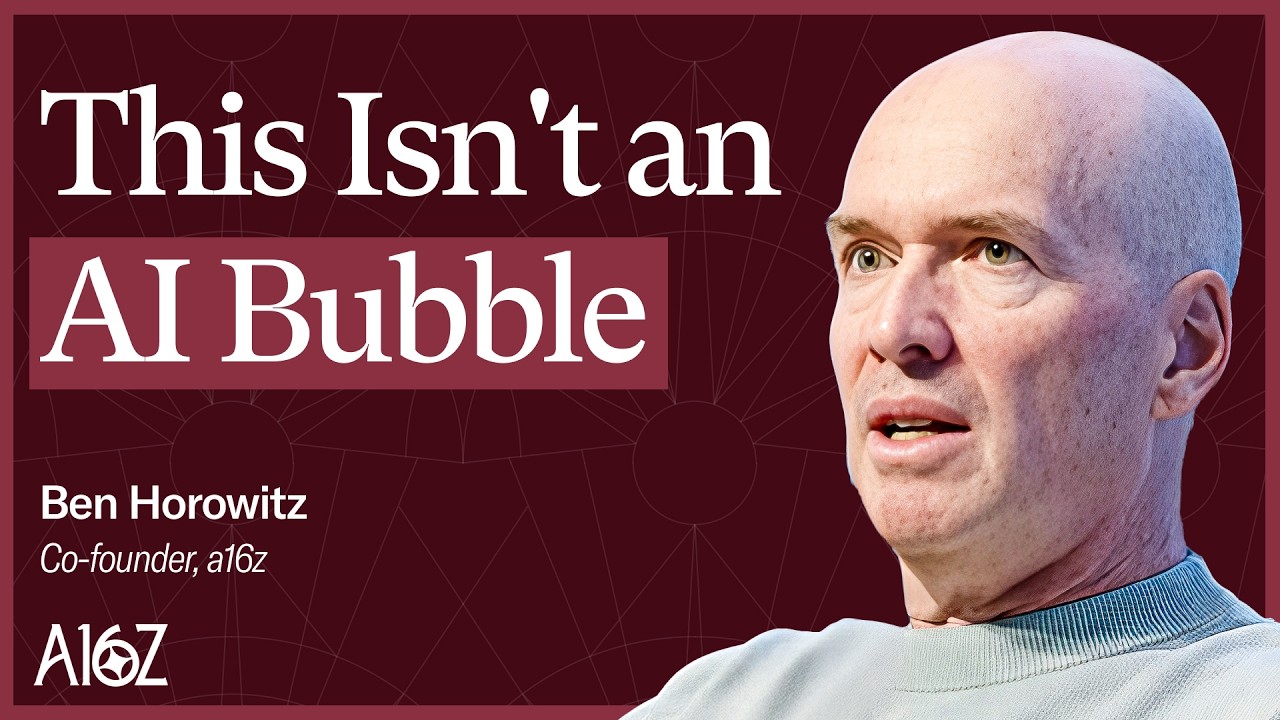
Ben Horowitz of Andreessen Horowitz discusses how AI is reshaping venture capital, detailing the firm's strategy for managing partners, verticalizing teams, and evaluating investments in real-time. He breaks down the current AI cycle, arguing that application design and model orchestration are key, and explains why the current market's growth is driven by real demand, not just hype.
Managing a Venture Firm in the Age of AI
Managing General Partners (GPs) in a venture firm is fundamentally different from managing a company. The concentration of high-IQ talent, including former founders and top technologists, means the role is less about direct instruction and more about guidance. The focus is on refining the investment process—helping partners understand how conversations affect investment decisions, how to take the right amount of risk, and how to avoid getting fixated on a company’s weaknesses rather than its unique strengths. The key is to identify founders who are “literally the best in the world at a thing,” as this is a far better investment than a team that is merely “pretty good at a lot of things.”
Accountability for GPs is not measured by 10- or 15-year portfolio outcomes, as the feedback loop is too long. Instead, performance is evaluated at the “point of attack”:
- Quality of Opportunities: How effective are they at finding promising new ventures?
- Competitiveness: How good are they at winning those deals?
- Judgment at Investment: What is the assessed quality of the founder and the opportunity at the moment the decision is made? Winning a deal with a special founder is a significant indicator, regardless of the ultimate outcome.
The Verticalization Strategy
The firm’s structure is built on a verticalization strategy, designed to scale without sacrificing the quality of investment discourse. This approach was inspired by the late David Swenson, who advised that an investing team “shouldn’t be too much bigger than a basketball team.”
A basketball team’s like five people who start, and the reason for that is the conversation around the investments really needs to be a conversation.
To maintain this dynamic as the firm grew, it was broken into specialized verticals. This structure ensures deep expertise and high-quality dialogue within each team. To prevent silos and foster collaboration:
- Cross-Pollination: Members from adjacent teams (e.g., AI Infrastructure and AI Applications) attend each other’s meetings.
- Leadership Syncs: Management meetings and bi-annual GP offsites bring leadership together without a rigid agenda to encourage open discussion.
- Cultural Alignment: The firm actively discourages internal politics, creating a culture where everyone is economically and culturally incentivized for the collective’s success. This contrasts with zero-sum environments where “protecting fiefdoms” can become prevalent.
The AI Revolution: Beyond Foundation Models
The initial belief that a few large foundation models would become “giant brains that could do anything” has not materialized. Instead, the landscape is proving to be far more nuanced. While large models provide crucial infrastructure, the complexity of specific applications requires a more sophisticated approach.
- Application-Specific Models: The “fat tail of human behavior” and the specific needs of a use case demand specialized models. For example, the coding assistant Cursor uses 13 different AI models to understand various aspects of programming and even released its own foundation model specifically for coding. This demonstrates that the application layer is not simply subsumed by the base model.
- Orchestration Over Size: The complexity and value are often in the application design and the orchestration of multiple models, not just in having the biggest model trained on the most GPUs. This is true across modalities, as highlighted by a16z’s post, “There is No God Tier Video Model,” which argues that different use cases require different, specialized video models.
- A Real Market, Not a Bubble: The rapid rise in AI company valuations is often met with fears of a bubble. However, this growth is supported by unprecedented underlying fundamentals. The customer adoption rates and revenue growth are unlike anything seen in previous technology cycles. The demand is real and intense, suggesting that while valuations are high, they are not unmoored from reality. This is a bigger technology market than ever before.
The Future of Venture and Investment Strategy
AI is a new computing platform, creating an enormous design space for new companies—comparable to the number of applications built on computers or the internet. This will likely produce more winners than previous technology cycles.
- M&A Resurgence: The disruptive threat of AI is forcing every incumbent company to rethink its strategy. To survive, they must acquire the “DNA of the future,” which will drive a significant wave of M&A activity.
- The Enduring Role of VCs: Despite the proliferation of capital sources, building a company remains incredibly difficult. A financial partner who can provide genuine guidance on company-building is invaluable. For smart entrepreneurs, the quality of the partner is more important than the initial valuation.
- Identifying Markets: The firm’s verticals are designed around clusters of entrepreneurs creating multi-billion dollar companies. The goal is to be neither too early nor too late. For example, an ESG-focused vertical was rejected in favor of “American Dynamism” because the latter has a clearer focus on economic outcomes and addresses tangible, critical problems in defense, public safety, energy, and supply chains. The key is to distinguish between a “marketing message” and a real, technology-driven investment thesis where venture returns can be generated.