Your AI Pilots Won't Move the P&L. Here's What Will - Adam Nahari, Apollo
Most companies use AI, but few see it in their margins. Adam Nahari of Apollo Global Management argues that engineering is the smaller part of an AI transformation and lays out six moves, illustrated by an airline's crew-scheduling desk, for turning AI into measurable EBIT impact.
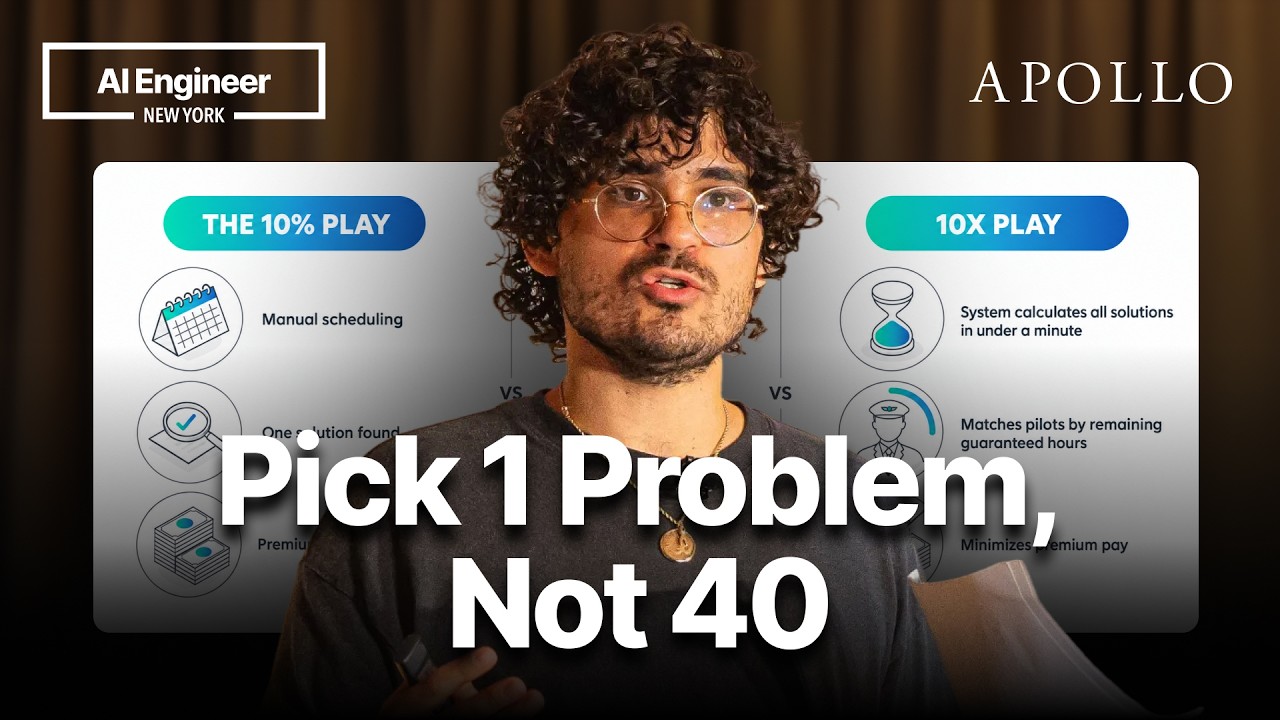
Most companies have adopted AI, yet only a small fraction see it reflected in their margins. The core argument is that the gap is not primarily an engineering problem. For every AI transformation the speaker has led or watched closely, engineering was the smaller share of the work, roughly one unit of engineering for every five units of change management. As models improve, that engineering share keeps shrinking, while picking the right problem, building buy-in, driving adoption, and measuring impact remain hard and are where most failures occur.
The adoption paradox
Usage is widespread. Over 55% of US adults have used generative AI within the last three years, a faster curve than the PC (around 20% at the same point) or the internet (around 30%). Almost 90% of businesses report using AI in at least one business function, yet only 6% report significant EBIT impact. Time savings are real and people report them, adding up to about 2% of total US working hours, but almost none of that shows up in the P&L. The same pattern appeared in 1987, when Robert Solow observed that "you can see the computer age everywhere but in the productivity statistics." AI is repeating that pattern faster and at larger scale.
Three layers of AI value
- General productivity: copilots and chatbots that everyone can access. Because access is universal, gains show up in price and get competed away rather than in margin.
- Domain-specific AI: function-specific copilots and retrieval over business documents, enabling faster and deeper use of enterprise knowledge.
- Core operational AI: vertical systems embedded in the processes that define the business. Airline crew scheduling is the example. These cannot be bought off the shelf, so their gains tend to stay in margin.
Most businesses invest in the first layer. Those that see material EBIT impact are three times as likely to redesign an entire workflow end to end rather than simply adopt a new tool, and they invest in the third layer alongside the first.
The airline crew scheduling case
The anchor example is a scheduler at a large cargo airline who has 15 minutes to re-crew a flight after an aircraft failure. The process is entirely manual. The scheduler must check rest rules, qualifications, and where each pilot is located. Often there is one legal solution, and it is not necessarily the cheapest. Sometimes there is none, and the release valve is premium pay. This happens every day across the network, and crew is the second largest cost after fuel.
Six moves to move the P&L
Start from the P&L and pick one or two problems
Work backward from the North Star metric, which for an airline is EBITDA. Its four drivers are routes (demand), aircraft (supply), maintenance (constraints), and crew (cost). Crew was chosen because it is the second largest cost driver. The team deliberately avoided spreading effort across many use cases: "Pick one or two problems, not 40." Each candidate was evaluated against five criteria: it moves a line the CFO recognizes; it has a baseline agreed upfront, not reconstructed in retrospect; the data and technical infrastructure are ready and the company owns its data; a named person, not a department, wants it and can champion it; and it is among the CEO’s top five priorities.
Reimagine the process end to end
Automating an existing process produces incremental gains. Redesigning the process around the new technology can produce transformational ones. The 10% play would have given schedulers a tool to work somewhat faster. The 10x play built an optimization agent engine that accounted for every constraint, generated the full set of feasible solutions, ranked them by cost, and returned results in under a minute. That required consolidating company data across flights, crew, and maintenance, building the optimization engine, creating a decision-support app for schedulers, and redesigning the workflow itself. Even so, the engineering was still the smaller part of the project. The bigger job was getting it used.
Start with the CEO
Before committing any money, the first question is whether the CEO has publicly committed the initiative as a priority. Without that commitment, the company does not necessarily say no, but scheduling conflicts, data requests that take weeks, and rescheduled pilots accumulate. Everyone takes their cue from the CEO. The P&L owner staffs the effort, the CFO funds and tracks it, and the CTO prioritizes engineering resources for it. This alignment wears off over time and has to be renewed.
Build with the business
Significant transformation requires the P&L owner to drive change. At the airline, the VP of crew scheduling co-sponsored the work. Crew schedulers were embedded as AI champions from day one. They met with the engineering team every other day, co-designed the interface, took part in A/B testing, and drove adoption among their peers. They adopted the tool because they had a hand in building it. The company also recruited new leadership with both technical and airline domain expertise, including a chief information officer, a VP of data and AI, and a senior director of data science, so they could understand how schedulers worked and design a tool that fit their needs. The organizational investment exceeded the technology investment.
Put the tools in everyone’s hands
At an AI workshop with about 30 other executives, three out of four people had never used an AI tool before that week. Redesigning a workflow with AI is not possible without using AI. Intuition about where value lies and which use cases AI can enable comes from hands-on experimentation, which is the absolute minimum requirement for this kind of transformation.
Set kill metrics first
Before a pilot starts, define the criteria that will determine whether it continues or stops. Three gates were used. A time gate allowed 90 days per stage to show value. A metric gate ran A/B tests against a baseline agreed in advance. An adoption gate required crew schedulers to use the tool at over 50%. Working with the CFO, the team also tested whether the cost of the initiative at scale, including compute, tokens, and the people involved, was significantly lower than the impact it would generate. Many pilots fail at this stage.
The durable advantage
The models are available to everyone, so access alone is not a differentiator. The ability to absorb these models into real business processes is. Companies that do this will be positioned to benefit as the models continue to improve. In the airline case, a search that once took 15 minutes now takes less than a minute.