Building ChatGPT for Finance — Joseph Kim, OpenAI's Head of Financial Services
Joseph Kim of OpenAI discusses building ChatGPT for Financial Services on a general-purpose model: upstream financial reasoning training, bundling market data after MCP reliability tests, plugin primitives startups can reuse, human-in-the-loop review, training judgment and taste via reward models, and the difficulty of building financial evals.
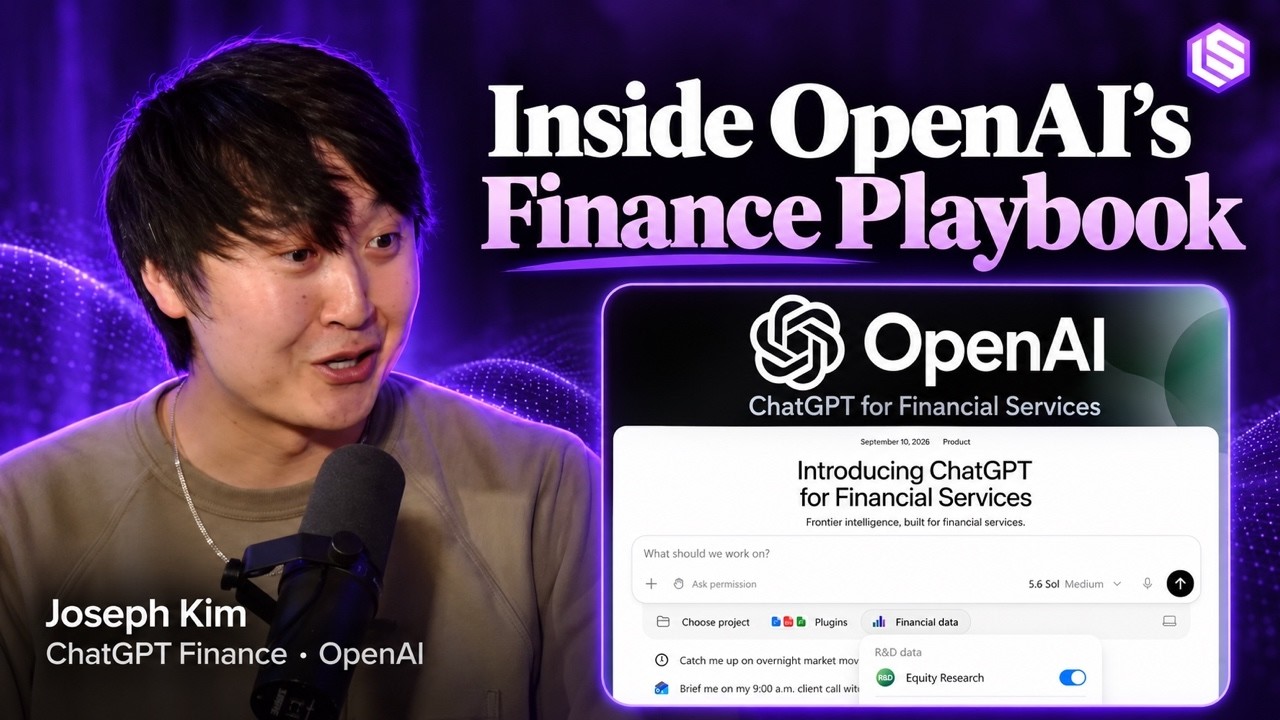
Building Finance AI on a General-Purpose Model
Joseph Kim, who leads ChatGPT for Financial Services at OpenAI, lays out the product logic behind the launch: a finance-specific experience built on the same general-purpose model and plugin primitives available to anyone else. The central claim is that financial reasoning is trained upstream into the main model rather than into a separate vertical model, so the intelligence stays accessible to startups, enterprises, and first-party products alike. The product itself combines consumer ChatGPT tooling with an enterprise layer: firm-specific templates, and data sources such as Dow Jones and S&P. Morgan Stanley and Evercore were design partners.
Research before deployment
OpenAI describes itself as a research and deployment company, and the ordering is deliberate. Research defines where model capabilities are heading and what they enable; product work then determines which surfaces make that intelligence usable by more people. Codex adoption inside the company illustrates the point. Software engineering adoption climbed steadily, while finance, legal, and sales sat near zero until the Codex desktop app shipped in February, after which non-engineering adoption jumped toward 90%. The lesson drawn is that co-developing model and product matters more than either alone.
Why bundle financial data
The most contested product decision was bundling financial data such as quarterly earnings transcripts, even though MCP connectors already existed. On paper the bundle looks weak: customers may already hold licenses and could feel they are paying twice. The team’s testing changed the picture. Error rates across several connected MCP servers, including some from well-known names, ran above 40%. Bringing data in-house and controlling the experience end to end was the only scalable fix, and customers now cite the data as the feature they value most.
What a startup can build on the same primitives
The team argues that roughly 95% of the product was built on the ChatGPT plugin architecture and primitives that any builder can use. The internal framing is that the team behaves like a startup building on OpenAI. Codex, with its persistent memory and skills, gets a product about 80% of the way, but the remaining 20% (proprietary data, UI changes, integrations) decides whether it succeeds; launching raw Codex as a finance product would have failed. The expectation is that a billion-dollar business will be built as a thin layer of differentiated “secret sauce” over horizontal functionality.
Safety, human review, and the shape of agents
The current product assumes a human is always in the loop: an analyst works through a daily task list, uses the model for each item, and carries responsibility for auditing the output. Looking ahead, as agents become more autonomous, the plan is to make their security profile resemble how people are managed. The model is treated like a new colleague or intern, subject to the same checks that already exist in institutions: read-write permissions, readability reviews, and hierarchical review chains running from junior analyst to associate, VP, director, and managing director. The argument is that these systems already catch human errors, and models can plug into them.
Mistakes, accuracy, and career risk
The view is that the career-ending mistake, a factually wrong input that changes a conclusion, is becoming rarer as factual reliability improves. The term “hallucination,” common in 2022 and 2023, now comes up much less. What models still lack is judgment and taste: a slide that is technically correct but looks sloppy still reduces the usefulness of the work. These softer, comparative objectives are where the team expects the largest gains.
Training taste
The method proposed is the same one that shaped early reinforcement learning from human feedback: pairwise preferences fed into a reward model. Humans are notably better than models at aesthetic comparison, judging two slides in seconds where a grading model may spend many reasoning tokens and still err. Coding offers precedent. It combines verifiable rewards (does it compile, do the tests pass) with taste (is the design clean, maintainable, and idiomatic). Finance has a parallel structure. An Excel model can be checked for sums and reference errors, but an experienced professional also judges the “feel” of a model, how the data flows when inputs are perturbed. The success of coding suggests that comparable gains are reachable in finance.
Moving up the analyst stack
Most AI in finance has so far targeted junior analyst work, for two reasons: current models follow concrete instructions well, and the tasks (building Excel models, placing logos precisely on slides) are tedious work people prefer to offload. The next step is moving up toward associate and MD tasks, where objectives blur. Whether an investment idea is good may take years to verify against market outcomes. That makes training harder, but the expectation is that it remains tractable with focused research, rich data, expert feedback at very high quality, and continued scaling of base models.
Why financial evals are hard
Building an eval that correlates with the real capability is described as very difficult. Any benchmark is a proxy along one dimension, and grading is tedious; weak answer keys make an eval easy to game, so a model can score well while lacking the underlying skill. No satisfactory financial eval exists yet. The GDP eval, which covers broader knowledge work, has become saturated, and its remaining unsaturated items are largely broken, so it is no longer reported. A recurring bias compounds the problem: researchers investigate when scores look flat but accept scores that look good. That is what happened with a model where financial evals barely moved, and a deep dive found saturation, incorrect answer keys, and poorly specified prompts. The team is now building evals meant to predict whether a model can automate a specific profession’s work, such as an investment banking eval that would indicate how much junior analyst work could be automated.
Hiring for finance expertise
The team is scaling quickly and is hiring engineers, product managers across investment banking, equity research, and asset management, and subject matter experts. The subject matter experts are seen as the critical gap: coding benefited from trainers who understood good code, and finance lacks an equivalent advantage. Professionals who can work alongside engineers and researchers to improve the model in their domain are the priority.