Can AI Understand a Distressed Credit? - Harneet Kaur, Axim Intelligence
Harneet Kaur, founder and CEO of Axim Intelligence and a former distressed credit investor, tests whether frontier models can reason about a live distressed situation, iHeartMedia. Two top models disagreed sharply on the odds of bankruptcy, but a layered reasoning process brought them to the same answer, raising the question of whether agreement is the same as being right.
Distress is not a single event. A credit is simply a bond or loan issued by a corporation, and stress arises when some underlying risk threatens either the company’s liquidity or its ability to repay its debt. Distress can be cyclical, as when construction or housing slumps, operational, as when a restaurant chain faces a major food recall, or secular, as when a software business faces AI disruption. Some companies recover from these shocks, while others slide into genuine distress.
Distress also does not resolve into one outcome. Bankruptcy is only one path. Liability management exercises and out-of-court negotiated exchanges are others. Traditional default modeling treated the problem as binary, either a default or no default, and that framing no longer fits. The Altman Z-score, which dominated credit scoring for a decade or two, is static in a market where situations can change monthly, quarterly, or yearly. The rise of private credit has also made pricing opaque.
Understanding a credit as a prediction problem
The real test of understanding a distressed credit, in this view, is whether you can predict what happens next and assign a probability distribution to the paths a company could take. Analysts examine liquidity and the capital structure, the legal priority of each piece of debt, and the operating fundamentals that determine whether revenues will rise or fall. Large AI players have mostly approached this through benchmarks covering many such questions, such as identifying which debt is structurally senior. Benchmarking isolated facts, however, is not the same as forecasting outcomes.
Case study: iHeartMedia
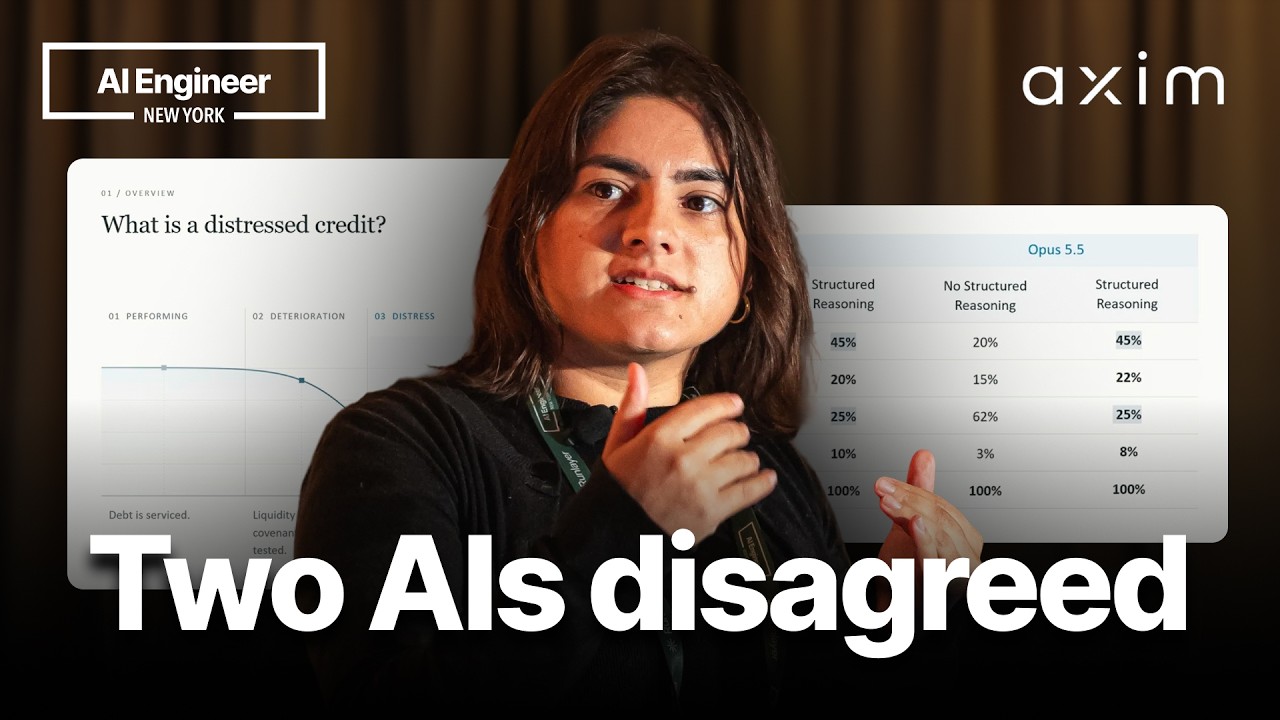
iHeartMedia filed for bankruptcy in 2018 and completed another stressed transaction in 2024, which makes it a live situation with no ground truth for what comes next. The same context was given to two frontier models, Astra 6 and Opus 5.5, and they disagreed sharply. Opus put bankruptcy at 62 percent, while Astra put it at 25 percent, and they differed on which path was most likely. Without ground truth, neither can be declared right. The author admits a lean toward Astra 6 while acknowledging that judgment is itself human.
Layered reasoning as an audit
Instead of judging only final answers, the analysis was decomposed into layers that can each be checked: extraction, derivation, judgment, and prediction. Extraction pulls raw inputs such as EBITDA and debt from filings. It is largely solved for public companies but remains hard for private loans buried in spreadsheets and PDFs. Derivation combines those inputs into metrics, such as leverage from EBITDA and debt. Judgment decides whether the company is genuinely distressed given those metrics. Prediction comes last and only makes sense once the earlier layers are verified, because a judgment built on a bad data point will be bad. This mirrors how a human analyst reasons.
Convergence and what it does not prove
Once the structured process was in place, the two models converged. Instead of 62 percent versus 25 percent bankruptcy probabilities, both now put bankruptcy at roughly 25 percent and both identified negotiated restructuring as the more likely path. Two takeaways follow. First, on non-verifiable questions, even with the same organized context, these models do not show a clear predictive edge. Second, structure can align different models on a shared view of the future and of the business.
Convergence, though, is not correctness. Whether the consensus is right remains unknown, and a rigorous historical test would have to avoid look-ahead bias, which is difficult to guarantee. Still, a process that reliably produces the same probabilistic outcomes resembles what a market price does, and that is what makes convergence worth studying. The open question is whether agreement is the same as being right.