Siemens’ Digital Thread: Connecting Design & Simulation - Bob Ransijn | Podcast #158
A conversation with Bob Ransijn from Siemens exploring the evolution and application of system simulation, from its historical roots to its modern-day integration with multi-physics modeling, digital twins, and AI-driven reduced-order models for predictive maintenance and real-time analysis.
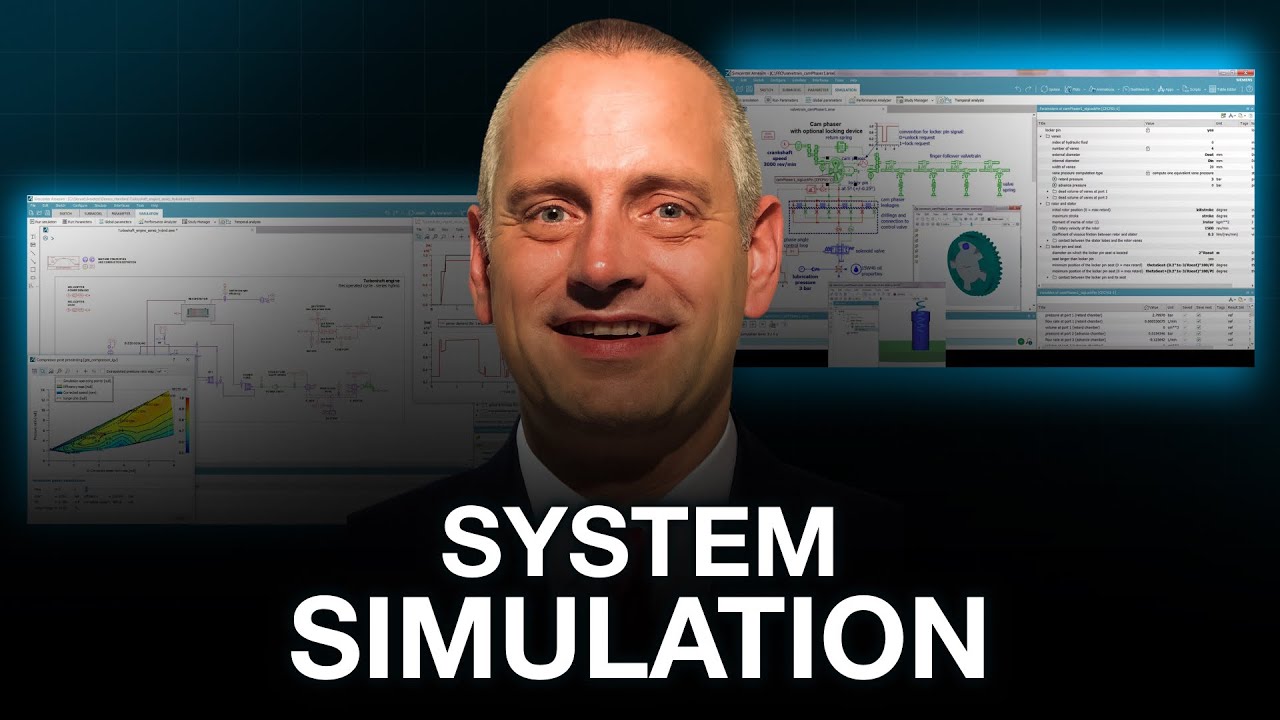
System simulation is no longer an optional step in product development; it is essential for companies to remain competitive. The process allows for rapid design iterations and performance analysis long before physical prototypes are built, embodying the “shift left” principle in the engineering workflow.
The Essence of System Simulation
System simulation is defined as lumped parameter modeling. It represents a complex system by breaking it down into discrete elements with lumped physical properties, such as a mass, spring, damper, or electrical inductor. This approach allows the system to be described by a set of ordinary differential equations (ODEs) that can be solved very quickly, sometimes even in real-time. The core idea is to combine different physical domains—mechanical, electrical, thermal, and fluids—to create a comprehensive model of an entire system and analyze the interactions between its components.
From Manhattan Project to Mainstream Engineering
The journey of computer simulation began in the 1940s during the Manhattan Project, where it was used to model nuclear detonations. However, system simulation as we know it became mainstream with the rise of personal computers 20-30 years ago. Initially, these tools were highly specialized and focused on single-physics problems for critical applications that were costly to design and test, such as fluid power and fuel injection systems.
Early limitations were significant, including constraints in computing power, nascent solver technology, and a lack of user-friendly interfaces. Engineers needed deep expertise not only in physics but also in coding and solver mechanics. The ability to simulate the interaction between multiple physical domains only began to take off in the early 2000s.
Core Principles: 0D/1D and Multi-Physics Modeling
A lumped parameter model is often called a 0D model because it treats a physical part as a single point, where the only independent variable is time. There are no spatial dimensions (X, Y, Z), which allows for the use of ODEs.
When a spatial dimension is added, the model becomes 1D, requiring the use of partial differential equations (PDEs), which are significantly more complex to solve. In practice, system simulation often creates a “pseudo-1D” model by connecting multiple 0D elements. For example, a valve spool can be modeled as a series of discrete masses connected by springs to capture its first-order flexibility, while mathematically still being a collection of 0D ODEs.
By grouping these elementary blocks, engineers can model complex components like pumps or motors, and by assembling these components, they can simulate an entire system’s behavior under specific boundary conditions, such as a vehicle drive cycle.
The Digital Thread and the Digital Twin
It’s important to distinguish between the Digital Thread and the Digital Twin, as they are foundational concepts in modern engineering.
-
The Digital Thread represents the connected and continuous flow of data throughout the product lifecycle. It ensures that data is centrally managed and that different analysis tools (e.g., CFD, structural, system simulation) use the same source of truth. For example, the results of a CFD analysis can be used to characterize a pump within a larger system simulation model.
-
The Digital Twin is a broader concept, not a single entity. It is a virtual representation of a physical asset. A digital twin can exist for various purposes: a CAD model for design, a simulation model for performance analysis, or a real-time model running alongside a production machine.
The Role of AI in Creating Reduced-Order Models (ROMs)
While system simulation is fast, the demand is always for more speed. This is where Artificial Intelligence and Machine Learning come in. AI/ML techniques are now used to create sophisticated Reduced-Order Models (ROMs), often in the form of neural networks.
These ROMs capture the complex dynamics of a high-fidelity model but run exceptionally fast. While they lose the underlying physical details, they accurately reproduce the outputs. This speed and accuracy enable several key applications:
- Embedded Control Systems: ROMs can be fast enough to be deployed as part of an embedded control algorithm.
- Executable Digital Twins: A ROM can run in real-time alongside a physical machine. This “executable digital twin” can be used for:
- Virtual Sensors: Predicting physical quantities that are not being measured, potentially reducing the need for physical sensors.
- Predictive Maintenance: By comparing the twin’s output with data from an actual sensor, deviations can be detected, triggering a warning for maintenance (e.g., replacing a filter) before a failure occurs.
The Future Trajectory of System Simulation
The future of system simulation is focused on integration, ease of use, and standardization.
- Integration: A key area of development is creating a seamless workflow where data from requirements management and other tools flows directly into the simulation model, creating a single source of truth.
- Standardization: Industry-wide efforts like the Functional Mockup Interface (FMI) are critical. FMI provides a common interface that allows simulation tools from different vendors to co-simulate, enabling the integration of various subsystems.
- Democratization and Ease of Use: The goal is to make these powerful tools accessible to a broader range of engineers. This involves developing more intuitive user interfaces, creating apps that automate model creation from geometry, and using AI to provide contextual help and guidance during the model-building process. Tools like Siemens’ System Analyst are designed for non-experts to run trade-off studies using pre-built, validated models.