From NotebookLM to Audio Companions: Why Google’s AI Team Went Startup
Raiza Martin, co-founder of Huxe and former leader of Google’s NotebookLM team, discusses the move from the text-based, source-grounded world of NotebookLM to building Huxe, an audio-first, mobile-first personal AI companion designed to create delightful and useful experiences in the interstitial moments of a user's day.
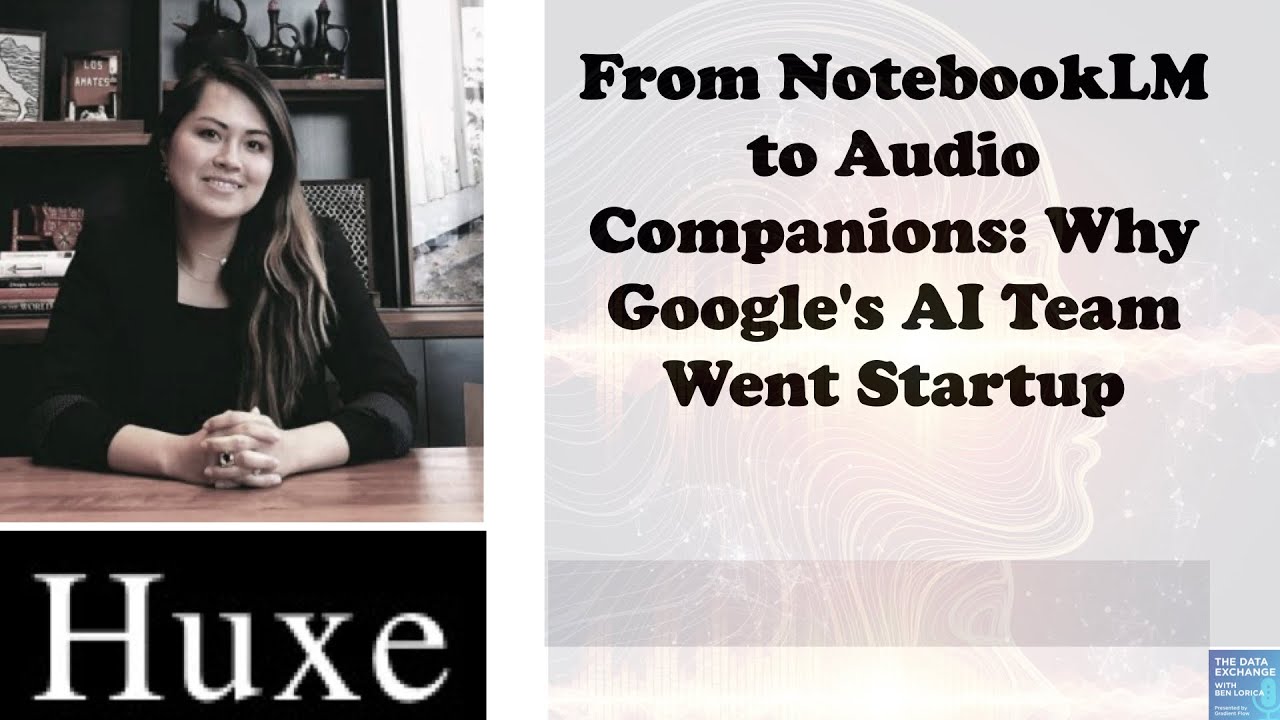
Raiza Martin, former lead of Google’s NotebookLM team, explains the motivation behind leaving a successful project at a tech giant to build Huxe, an audio-first personal AI companion. The decision was driven by a desire to explore the rapidly evolving AI landscape with the speed and agility of a startup, focusing on creating new, delightful experiences for users rather than just solving acute pain points.
From NotebookLM to Huxe: A Shift in Modality
NotebookLM was designed as a contextualized intelligence tool, grounded in user-provided sources like class notes or home appliance manuals, creating an expert on that specific information. While powerful, the team saw an opportunity in a different modality. The core insight was that changing the interaction modality from text to audio fundamentally changes user behavior and opens up new, undiscovered use cases.
Martin notes her own experiences using ChatGPT’s voice mode for personal “brain dumps” during walks, which felt distinctly different from typing. This led to the central thesis for Huxe: an audio-first, mobile-first approach could unlock new forms of interaction and consumption, particularly in the “in-between” moments of life, like a daily commute.
The Philosophy of an Audio-First Companion
Huxe is being built to explore what personalized audio content people truly want. The initial experiments focus on summarizing news, emails, and calendars, but the vision extends further. Martin categorizes the potential audio formats into two main buckets:
- Passive Formats: Content consumption where variables like topic, length, speed, and malleability to user feedback can be customized.
- Interactive Formats: Experiences where the user can actively participate, converse with the audio, or even co-create and share conversations.
The goal is to create a system so supportive that the user doesn’t have to struggle to figure out how to use it, a key lesson learned from the limitations of smart speakers.
Lessons from Smart Speakers and Privacy by Design
The failure of smart speakers to live up to their initial hype offers crucial lessons. Martin attributes their limited adoption (often relegated to being kitchen timers) to two factors:
- The underlying technology wasn’t advanced enough to meet user expectations.
- The lack of a screen or UI created a steep learning curve, leaving users unsure of the device’s capabilities.
With today’s powerful AI, Huxe can be much more capable, potentially overcoming the “what can I do with this?” problem.
Privacy is a cornerstone of Huxe’s design, a principle carried over from NotebookLM.
- Data Handling: User data from sensitive sources like email and calendars is used solely to improve that individual’s personal experience, not for training models for all users.
- External Models: When using commercial foundation models, Huxe opts for APIs that do not train on the data sent to them.
- Context Management: A durable context layer is maintained at the application level, not passed wholesale to the LLM. The system intelligently selects the most relevant pieces of information to pass to the model for a given interaction, minimizing data exposure. This approach allows for providing proactive utility—like checking a flight status or traffic conditions—without leaking personal information to external services.
The Future: Companionship, Stickiness, and Foundation Models
Martin sees the line between an “assistant” and a “companion” as blurry from a capabilities standpoint but distinct in marketing and user perception. Users increasingly treat AI models like ChatGPT as personal coaches, friends, or thought partners, indicating a strong, unmet need for personal AI.
“I think a lot of people use AI for companionship more than we think and I think not in the ways that we even imagine… the more emerging side of AI is actually on the personal use cases and not the work ones.”
This personal utility creates a powerful “data lock-in” effect. As a user builds a history and relationship with a specific AI, the inconvenience of porting that data to a competitor creates significant stickiness.
As a consumer of foundation models, Martin’s feedback to the builders focuses on key areas critical for a seamless audio experience:
- Lower Latency: To enable natural, interruptible conversation.
- Improved Tool Calling: For more reliable, parallelized actions.
- Voice and Language Diversity: To create more natural and inclusive-sounding voices.
- Bridging the Cloud-Device Gap: While on-device models are improving, the complexity of running a full-featured LLM and voice model locally remains a significant hurdle.