Why We Always Evolve Eyes
Professor Chris Kempes of the Santa Fe Institute proposes a universal theory of life that transcends Earth-based biochemistry. He introduces a three-level framework (Materials, Constraints, Principles) to explain how abstract rules like evolution could define life on any substrate, including culture, language, or artificial intelligence, leading to the concept of convergent evolution where similar solutions, like the eye, emerge independently across different physical forms.
Towards a Universal Theory of Life
The fundamental question “What is life?” is evolving beyond a purely Earth-based biological perspective. The goal is to establish a universal theory of life, composed of principles that can explain living systems anywhere, on any substrate. This perspective suggests that phenomena like human culture, language, and even artificial intelligence can be considered life forms. They are simply life expressed on unconventional substrates—human minds and computers, respectively. This approach seeks to identify the core principles that unite these diverse manifestations of living processes.
A Three-Tiered Framework for Understanding Life
A hierarchical framework helps to organize the search for universal principles by separating the particular from the universal. It consists of three levels:
-
Materials: This is the most diverse and least fundamental level, representing the physical substrate of life (e.g., DNA, RNA, proteins). Life across the universe could be built from radically different materials, and we should not expect extraterrestrial life to share our specific biochemistry. The material is necessary for embodiment and interaction with the physical world, but its specific form is contingent.
-
Constraints: All life, regardless of its material composition, must operate within the universal laws of physics. Constraints like gravity, diffusion, thermodynamics, and fluid dynamics create a more compressed, convergent space than the vast possibilities at the material level. A theory based on a cell interacting with a diffusive process, for example, is generalizable to any small, spherical organism anywhere in the universe, without needing to specify its internal biochemistry.
-
Principles: At the highest and most abstract level are the optimization principles that any living system would follow. These are computational or logical rules that define the dynamics of life. Evolution, for example, can be described as a form of learning dynamic. Another such principle is the “error threshold,” which dictates the maximum mutation rate a system can sustain while still successfully propagating its information to the next generation. This principle is substrate-agnostic, applying equally to genomes, language, and culture.
This framework suggests that as we move from materials to constraints to principles, the space of possibilities shrinks, and life becomes more predictable and unified by abstract rules.
Convergence, Functionalism, and Information
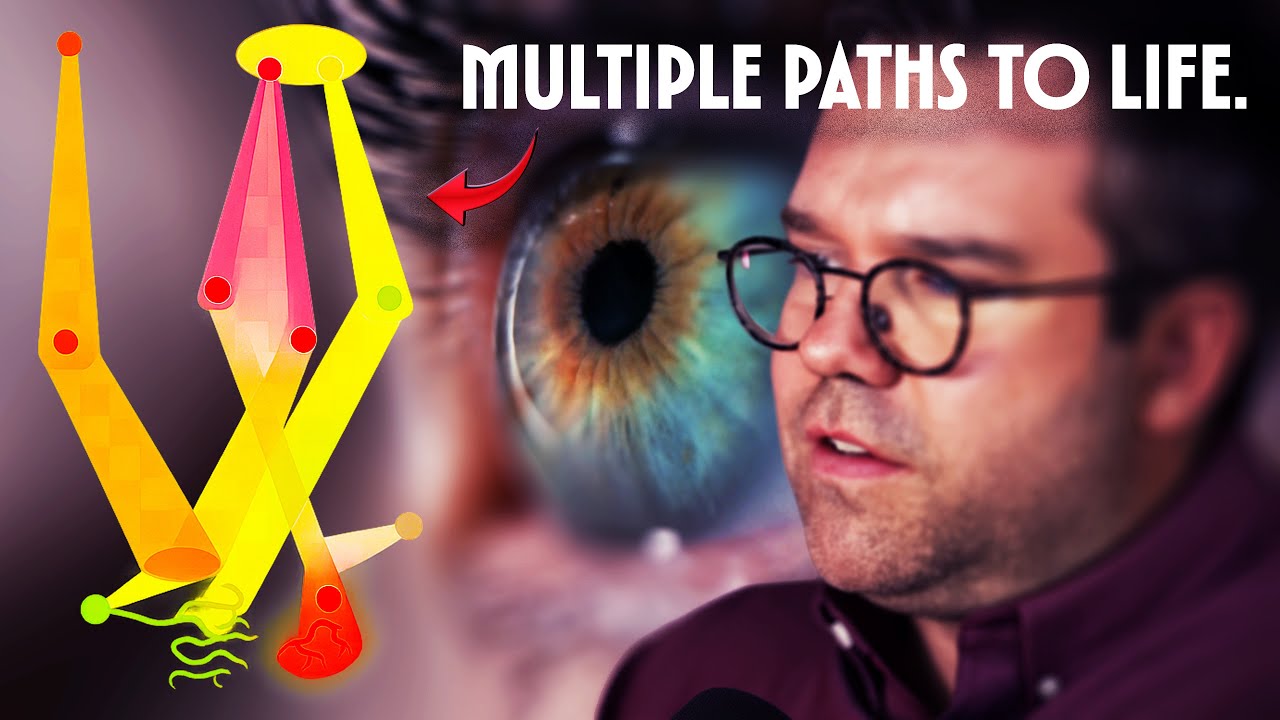
The concept of convergence illustrates how universal constraints and principles shape evolution. The eye is a classic example. Despite its complexity, it has evolved independently multiple times across different lineages. The physics of light acts as a clear “target,” and evolution finds similar functional solutions to the problem of seeing, even with different starting materials and slightly different constructions.
This leads to a functionalist perspective, where the processes and functions of life are more important than the specific material instantiation. An abstract algorithm can be implemented on various hardware, and similarly, a living process could be realized in different materials. Life can be defined as the union of energetic and informational processes that produce an autonomous system capable of encoding survival-relevant information and propagating it through time.
The Dynamics of Evolution and Complexity
Life’s progression is marked by key dynamics and transitions:
- Major Transitions: Evolution is not always gradual. It features “phase transitions” where new levels of organization emerge, such as the jump from single-celled bacteria to eukaryotes, or from unicellular to multicellular life. These transitions often occur when a particular organizational form hits a physical scaling limit—an “evolutionary wall.” A new architecture is required to overcome this wall, often induced by significant environmental shifts, like the “Snowball Earth” periods that may have triggered the rise of multicellularity.
- Life as a Spectrum: Instead of viewing life, intelligence, or agency as binary categories, it’s more useful to place them on a spectrum. A cyanobacterium might be considered “most living” because it’s self-contained, while humans and viruses are more parasitic, relying on complex environments (ecosystems and host cells, respectively). From one perspective, a virus is a life form with a very complex environment. This framework allows for a more nuanced comparison of different systems, including AI.
- Simulating Life: In principle, there is no reason life couldn’t be simulated in a computer, provided enough complexity and constraints are built into the artificial world. The primary obstacle is the lack of a compact, agreed-upon theory of life that would allow us to determine when a simulation has crossed the threshold into “being alive.”
Assembly Theory: A New Way to Quantify Complexity
To aid in the search for life and to create a fair, substrate-agnostic comparison of complexity, Assembly Theory was developed. It provides a method for quantifying the complexity of an object, such as a molecule, without prior knowledge of its origin.
The theory measures complexity by finding the shortest path to construct an object through the recursive use of its parts. Each step—either creating a new part or reusing an existing one—is counted, and the total number of steps forms the “assembly index.” This method avoids being misled by large but simple objects (like a C60 molecule) and focuses on the structural complexity derived from a recursive synthesis pathway. Experimental work suggests there may be a clear threshold in assembly space that distinguishes abiotic chemistry from the products of living systems.