Tokenless

Interactive discovery

Explore the topic map

Follow the connections between themes, people, and ideas across the Tokenless archive in an interactive topic modeling map.

Machine Learning

View All
Frontier results, on device - RL Nabors, Arize

Frontier results, on device - RL Nabors, Arize

RL Nabors discusses the significant costs associated with using frontier AI models, covering security, latency, and financial implications. She introduces a framework for right-sizing AI solutions by leveraging smaller, task-specific models and Small Language Models (SLMs). The framework details how to prove task feasibility, establish success criteria with golden datasets, conduct capability evaluations (using tools like Phoenix), and select the most appropriate "Small And Good Enough" (SAGE) model. Nabors further demonstrates how prompt engineering, particularly few-shot prompting, and post-processing can close performance gaps with larger models, while advocating for continuous regression evaluations to maintain performance integrity. The overarching message is to "prototype big, deploy small" to optimize AI deployments.

Research to Reality: Bringing Frontier ML Research to Production - Vaidas Razgaitis, Higharc

Research to Reality: Bringing Frontier ML Research to Production - Vaidas Razgaitis, Higharc

Vaidas Razgaitis, Senior Research Engineer at Higharc, shares three tactical tips to accelerate the transition of novel AI/ML research into production-ready features. He emphasizes addressing the critical handoff challenge between ML researchers and software engineers through structured documentation (Research Prototype Taxonomy Document), a well-organized monorepo utilizing decoupled microservices, and a systematic approach to code decomposition and PR review. These strategies aim to improve legibility, maintainability, and delivery speed for ML-driven products.

Uncertainty-Guided Data Augmentation for Engineers | Deep Dive - Yongmin Kwon

Uncertainty-Guided Data Augmentation for Engineers | Deep Dive - Yongmin Kwon

This session details a data-efficient method for training engineering surrogate models by using uncertainty quantification (UQ) to guide geometric data augmentation. Instead of random deformations, the approach lets the deep ensemble model identify its own knowledge gaps (epistemic uncertainty), then uses Free-Form Deformation (FFD) to generate new shapes specifically in those uncertain regions. This ensures every expensive simulation run yields maximally informative data, significantly improving model accuracy for a fixed computational budget across domains like structural mechanics and aerodynamics.

Artificial Intelligence

View All
How Nuclear Will Unlock Energy Abundance with Valar Atomics Founder Isaiah Taylor

How Nuclear Will Unlock Energy Abundance with Valar Atomics Founder Isaiah Taylor

Valar Atomics founder Isaiah Taylor discusses how his company is rapidly advancing nuclear energy through hardware iteration, manufacturing, and a unique regulatory pathway. He explains their intrinsic safety philosophy, the strategic importance of vertical integration for speed and cost reduction, and their venture-backed approach to building gigasites. Taylor highlights how the demand for AI compute is a major driver for nuclear, showcasing their direct powering of an NVIDIA Blackwell chip, and casts a compelling vision for a future of "hyper-technoindustrialism" enabled by abundant, cheap atomic energy.

The Platform Engineer’s Handbook • Ajay Chankramath & Kaspar von Grünberg • GOTO 2026

The Platform Engineer’s Handbook • Ajay Chankramath & Kaspar von Grünberg • GOTO 2026

This conversation with Ajay Chankramath, author of 'The Platform Engineer’s Handbook,' delves into why practical, code-first guidance is essential for building Internal Developer Platforms. He argues that developer adoption failures stem from a "product discipline gap," not a technology one, emphasizing developer experience as a first-class outcome. The discussion covers the book's arc from foundations to enterprise-grade features and its focus on 100% open-source, vendor-agnostic tooling. Crucially, it highlights how agentic AI raises the stakes for platform engineering, requiring new IDP layers for agent context, memory, and guardrails, asserting that these must be built, owned, and operated internally for safe and productive AI adoption.

Ex-Google Cloud AI Boss: Your Data Is the Real Moat

Ex-Google Cloud AI Boss: Your Data Is the Real Moat

Andrew Moore, CEO of Lovelace AI, discusses YottaGraph, a rapidly growing, automatically constructed knowledge graph designed as a context engine for enterprise AI agents. He highlights Lovelace's differentiation from public knowledge graphs by focusing on integrating private enterprise data, the engineering challenges of entity resolution and fast multi-hop reasoning, and the critical importance of graph amendability and auditability for mission-critical applications. Moore also touches upon the future of computer science education, advocating for product management skills and emphasizing the strategic importance of domestically developed open-weights models.

Technology

View All
Are Your Tests Slowing You Down? • Trisha Gee • GOTO 2025

Are Your Tests Slowing You Down? • Trisha Gee • GOTO 2025

Trisha Gee delivers a compelling talk on Developer Productivity Engineering (DPE) for testing, dissecting common pain points in writing, troubleshooting, and running tests. She advocates for strategic use of IDEs, advanced tooling like build caches and predictive test selection (leveraging ML), and a disciplined approach to test design to overcome these challenges, emphasizing that good tests serve as crucial living documentation.

The new post-quantum cryptography executive order. Plus: What is Q-Day, really?

The new post-quantum cryptography executive order. Plus: What is Q-Day, really?

This episode delves into Q-Day, the anticipated future when quantum computers can break public key cryptography, and the U.S. Executive Order accelerating the transition to post-quantum cryptography. Experts discuss why Q-Day is a gradual process rather than a sudden event, the critical importance of "crypto-agility" as a long-term strategy, and the necessity for organizations to begin immediate discovery and planning to secure data against "collect now, decrypt later" threats. The discussion also touches upon the broader, transformative benefits of quantum computing beyond just security.

Plenary Talk 3​: Challenges and research opportunities for global hyperscale services

Plenary Talk 3​: Challenges and research opportunities for global hyperscale services

Jim Kleewein's talk outlines the immense challenges and critical research opportunities in building and operating global hyperscale services like Microsoft 365 and Azure. He emphasizes that at this scale, traditional approaches fail, necessitating a "new golden age of applied research" across areas like continuous availability, data management, security, and sustainability. Kleewein also discusses AI's powerful but limited role, stressing the ongoing need for human expertise, and highlights the ethical imperative to prevent failures that can have life-or-death consequences.


Recent Post

Moltbot (Clawdbot): Open-source agents go mainstream

Moltbot (Clawdbot): Open-source agents go mainstream

The panel discusses the rise of Moltbot, a community-driven open-source AI agent, and the debate it sparks around vertical vs. horizontal integration and security. They analyze Anthropic CEO Dario Amodei's essay on AI's "adolescence," exploring the growing pains of the technology, the pace mismatch between innovation and safety, and the need for broader societal engagement. The conversation also covers IBM's GRAMMY IQ, an AI-powered fan experience, and the strategic implications of Microsoft's Maia 200 chip, signaling a shift toward vertical integration in the AI hardware space to challenge NVIDIA's dominance.

This Startup Beat Gemini 3 on ARC-AGI — at Half the Cost

This Startup Beat Gemini 3 on ARC-AGI — at Half the Cost

Poetic, a startup by ex-DeepMind researchers, has significantly advanced performance on the ARC-AGI benchmark by applying a recursive self-improvement system to Gemini 3. Co-founder Ian Fisher discusses how their approach of automating prompt and system engineering provides a substantial performance boost without needing access to model weights, and explores its potential as a path toward AGI.

The Lean Tech Manifesto • Fabrice Bernhard & Steve Pereira • GOTO 2026

The Lean Tech Manifesto • Fabrice Bernhard & Steve Pereira • GOTO 2026

Fabrice Bernhard, co-author of 'The Lean Tech Manifesto,' discusses the limitations of Agile at scale and how Lean thinking provides a robust framework for growth. The summary explores the symbiotic relationship between the two methodologies, debunks common misconceptions, and introduces the concept of tech-enabled networks of teams as a modern organizational model, all while emphasizing a human-centric approach to achieving sustainable outcomes.

Securing AI for the Quantum Era: A CISOs Cyber Security Guide

Securing AI for the Quantum Era: A CISOs Cyber Security Guide

Explore the significant security risks posed by Agentic AI and quantum computing, from data breaches of sensitive information to the breakdown of modern cryptography. Learn proactive strategies for governing AI and preparing for a quantum-safe future.

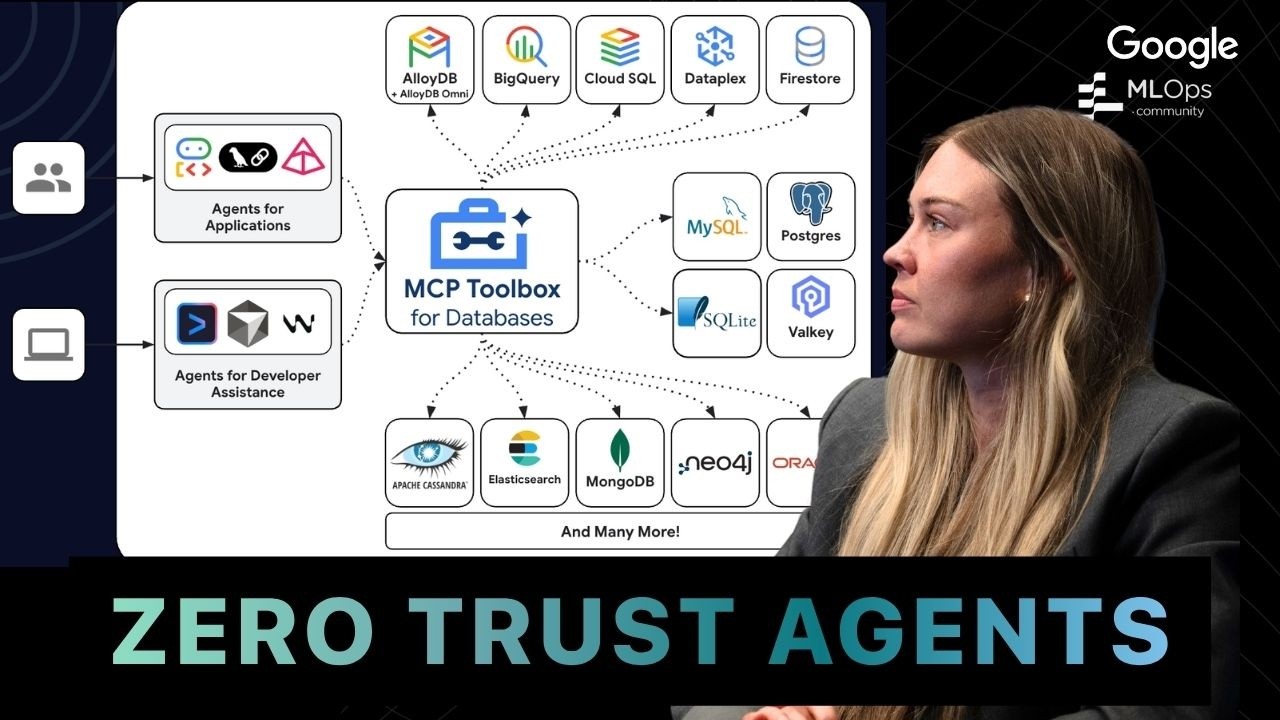
Securing AI Agents

Securing AI Agents

Jason Martin of Permiso Security discusses the exponential rise of AI agents in enterprises and the urgent security challenges they present. He covers the concept of Non-Human Identity (NHI), applying Zero Trust principles to ephemeral and over-permissioned agents, and outlines key attack vectors like prompt injection and data poisoning, while also exploring the potential of defensive AI to enhance security operations.

Scaling Cryopreservation with Until Co-Founder and CEO Laura Deming

Scaling Cryopreservation with Until Co-Founder and CEO Laura Deming

Laura Deming, co-founder and CEO of Until, discusses the ambitious goal of making reversible cryopreservation a reality. She outlines the company's vision, starting with preserving human organs to revolutionize transplantation and progressing towards whole-body medical hibernation, allowing patients to "pause" biological time and await future cures. The conversation delves into the core scientific challenges, reframing cryopreservation as an engineering problem of heat transfer and managing ice formation, and explores why this promising field has been historically underfunded.

Stay In The Loop! Subscribe to Our Newsletter.

Get updates straight to your inbox. No spam, just useful content.