
Tokenless

How to Make AI Forget

Machine Learning

View All
Post-training best-in-class models in 2025

Post-training best-in-class models in 2025

An expert overview of post-training techniques for language models, covering the entire workflow from data generation and curation to advanced algorithms like Supervised Fine-Tuning (SFT), Direct Preference Optimization (DPO), and Reinforcement Learning (RL), along with practical advice on evaluation and iteration.
Anaximander: Interactive Orchestration and Evaluation of Geospatial Foundation Models

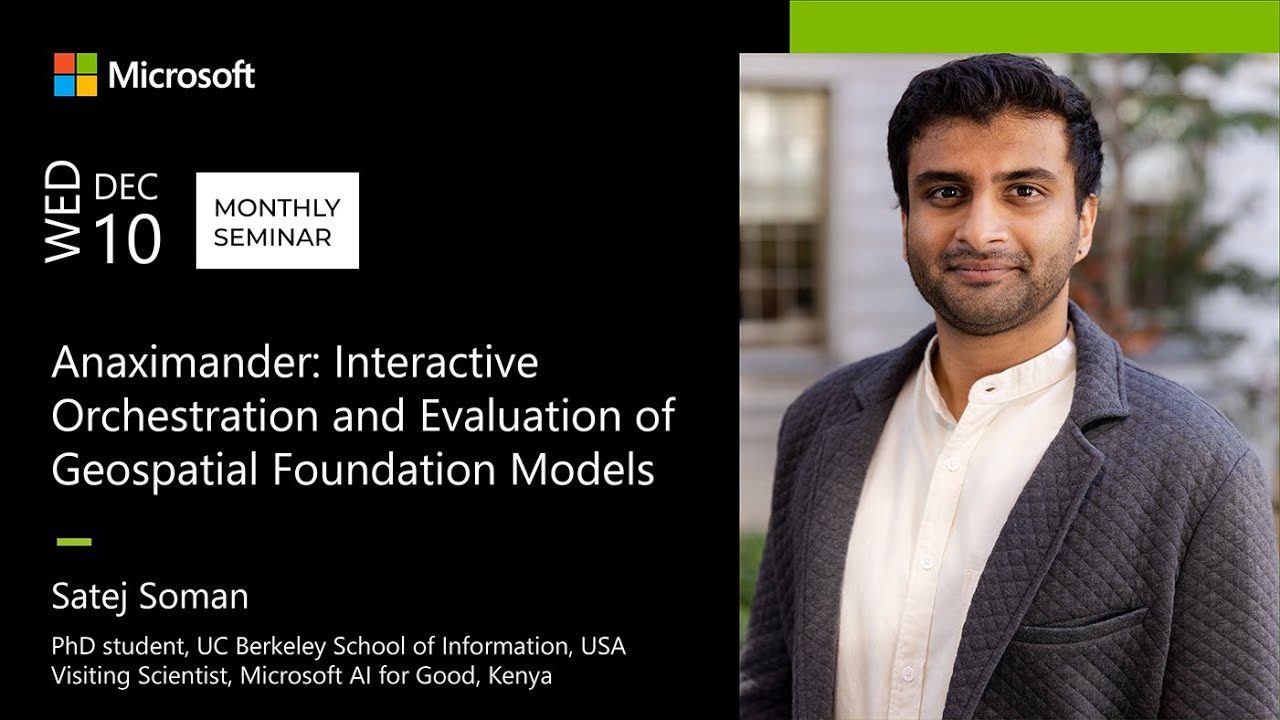
Anaximander: Interactive Orchestration and Evaluation of Geospatial Foundation Models

This talk introduces Anaximander, a system designed to bridge the gap between traditional, GUI-driven Geographic Information System (GIS) workflows and modern, code-heavy machine learning practices. Anaximander integrates geospatial foundation models directly into QGIS, allowing experts to interactively orchestrate, run, and evaluate models for tasks like semantic segmentation and object detection on satellite imagery.

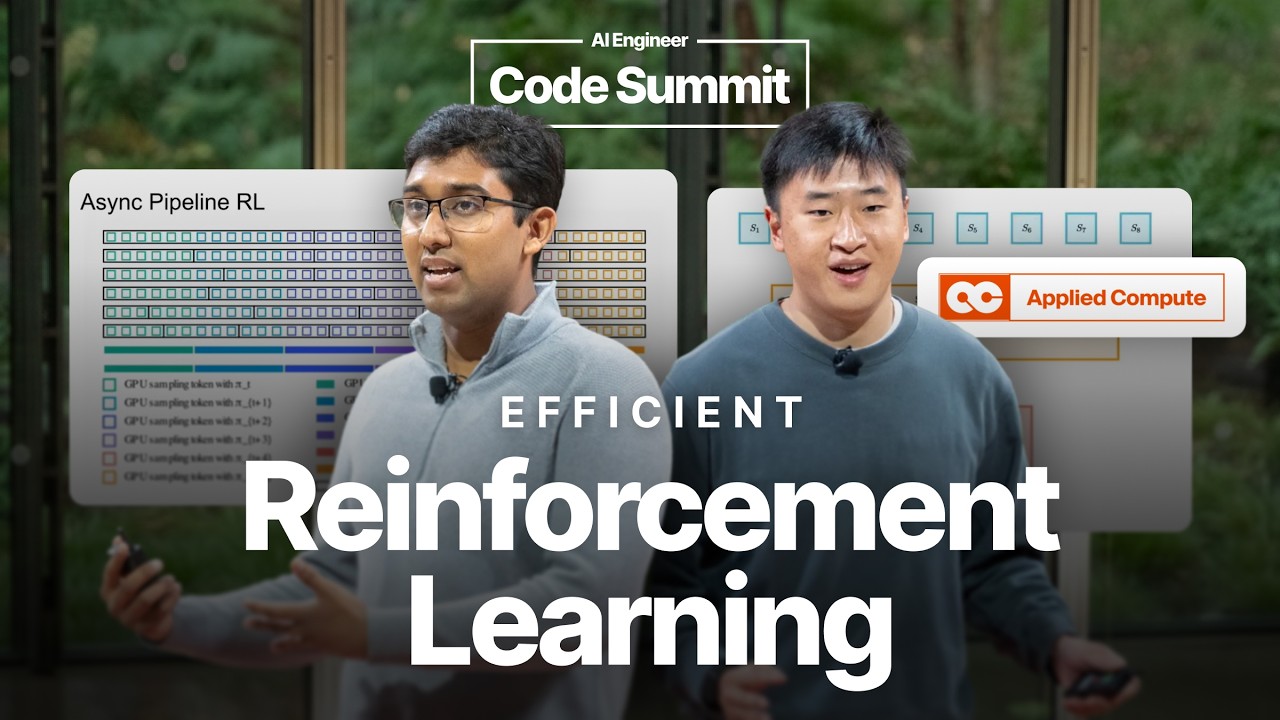
Efficient Reinforcement Learning – Rhythm Garg & Linden Li, Applied Compute

Efficient Reinforcement Learning – Rhythm Garg & Linden Li, Applied Compute

At Applied Compute, efficient Reinforcement Learning is critical for delivering business value. This talk explores the transition from inefficient synchronous RL to a high-throughput asynchronous 'Pipeline RL' system. The core challenge is managing 'staleness'—a side effect of in-flight weight updates that can destabilize training. The speakers detail their first-principles systems model, based on the Roofline model, used to simulate and find the optimal allocation of GPU resources between sampling and training, balancing throughput with algorithmic stability and achieving significant speedups.

Artificial Intelligence

View All
How to Make AI Forget

How to Make AI Forget

Ben Luria, CEO of Hirundo, discusses the critical need for machine unlearning, framing it as a form of "AI neuro-surgery" for enterprise AI. He explains how this technique directly modifies model weights to remove unwanted data and behaviors, addressing core risks that superficial solutions like guardrails cannot solve.

What are State Space Models? Redefining AI & Machine Learning with Data

What are State Space Models? Redefining AI & Machine Learning with Data

State Space Models (SSMs) are emerging as a powerful and efficient alternative to Transformers for handling sequential data. Aaron Baughman explains the core concepts of SSMs, their mathematical foundations, and how architectures like S4 and Mamba address the memory and scalability challenges inherent in Transformers, leading to a new generation of faster, more intelligent hybrid AI models.

AI and the Future of Warfare with US Under Secretary of War Emil Michael

AI and the Future of Warfare with US Under Secretary of War Emil Michael

Emil Michael, the Under Secretary of War for Research and Engineering, details the radical technological transformation of the US military. He discusses the architecture and rapid launch of GenAI.mil, an internal AI platform powered by Gemini that reached over one million users in 30 days. He also outlines critical technology priorities, including scaled hypersonics and autonomous drone swarms, and the urgent need to rebuild the American defense industrial base for a new era of global competition.

Technology

View All
Palo Alto Networks CEO Nikesh Arora on the Virtues of Being an Outsider

Palo Alto Networks CEO Nikesh Arora on the Virtues of Being an Outsider

Nikesh Arora, CEO of Palo Alto Networks, shares his unconventional journey and leadership philosophy. He provides a masterclass in building a multi-platform company through strategic M&A, explains why founders should sometimes ignore customers, and reveals how to lead with conviction while managing imposter syndrome.

Mental models for building products people love ft. Stewart Butterfield

Mental models for building products people love ft. Stewart Butterfield

Stewart Butterfield, co-founder of Slack and Flickr, shares the product frameworks and leadership principles that guided his success. He delves into concepts like "utility curves" for feature investment, the "owner's delusion" in product design, and why focusing on "comprehension" is often more important than reducing friction. He also introduces powerful mental models for organizational effectiveness, such as combating "hyper-realistic work-like activities" and applying Parkinson's Law to team growth.

Intuit CEO Sasan Goodarzi’s Grown-Up CEO Playbook

Intuit CEO Sasan Goodarzi’s Grown-Up CEO Playbook

Intuit CEO Sasan Goodarzi discusses the operational playbook for reinventing a 40-year-old company, from its slow transition to SaaS to its early adoption of AI. He shares insights on winning the SMB market by treating small businesses like consumers, building effective channel partnerships, and developing a platform strategy. Goodarzi also details his leadership philosophy, emphasizing that grit and curiosity are more critical than raw talent.


Recent Post

The ultimate guide to AEO: How to get ChatGPT to recommend your product | Ethan Smith (Graphite)

The ultimate guide to AEO: How to get ChatGPT to recommend your product | Ethan Smith (Graphite)

Ethan Smith, CEO of Graphite, explains Answer Engine Optimization (AEO), the new frontier of getting your product featured in answers from LLMs like ChatGPT. He shares his playbook for ranking in these new systems, revealing why AEO traffic can convert 6x better than traditional search and how even early-stage startups can achieve immediate wins by focusing on landing pages, YouTube videos, and authentic Reddit engagement.

Fully autonomous robots are much closer than you think – Sergey Levine

Fully autonomous robots are much closer than you think – Sergey Levine

Sergey Levine, co-founder of Physical Intelligence, outlines the path to general-purpose robots, predicting a 'self-improvement flywheel' could lead to fully autonomous household robots by 2030. He discusses the architecture of vision-language-action models, the critical role of embodiment in solving the data problem, and how robotics will scale faster than self-driving cars.

Trust at Scale: Security and Governance for Open Source Models // Hudson Buzby // MLOps Podcast #338

Trust at Scale: Security and Governance for Open Source Models // Hudson Buzby // MLOps Podcast #338

Hudson Buzby from JFrog discusses the critical security, governance, and legal challenges enterprises face when adopting open-source AI models. He highlights the risks lurking in repositories like Hugging Face and argues for a centralized, curated AI gateway as the essential framework for enabling safe, scalable, and cost-effective AI development.

The Future of Software Creation with Replit CEO Amjad Masad

The Future of Software Creation with Replit CEO Amjad Masad

Amjad Masad, CEO of Replit, outlines a future where AI agents commoditize traditional software, fundamentally reshaping the economy, the nature of work, and how companies are built. He argues that the focus will shift from building applications to solving problems directly, empowering a new class of 'generalist' employees and 'sovereign individuals'.

Platform Engineering: A Deep Dive Conversation • Russ Miles & Kevlin Henney

Platform Engineering: A Deep Dive Conversation • Russ Miles & Kevlin Henney

In this interview from GOTO Copenhagen 2024, Russ Miles, interviewed by Kevlin Henney, explores a human-centric approach to platform engineering, encapsulated by the phrase "Don't feed the pigeons." He advocates for focusing on desired behavioral changes and empowering creative work over doubling down on existing, suboptimal tools and processes. The discussion delves into using OODA loops, creating a developer "habitat," and the critical role of empathy and storytelling in understanding and improving complex sociotechnical systems.

Why language models hallucinate, revisiting Amodei’s code prediction and AI in the job market

Why language models hallucinate, revisiting Amodei’s code prediction and AI in the job market

Experts discuss an OpenAI paper that reframes hallucinations as a feature driven by training incentives, not just a bug. The panel also revisits Dario Amodei's prediction on AI coding, explores AI's chaotic impact on the job market, and imagines the future of running LLMs on business-card-sized devices.

Stay In The Loop! Subscribe to Our Newsletter.

Get updates straight to your inbox. No spam, just useful content.