Tokenless

Session on Reasoning

Interactive discovery

Explore the topic map

Follow the connections between themes, people, and ideas across the Tokenless archive in an interactive topic modeling map.

Machine Learning

View All
Frontier results, on device - RL Nabors, Arize

Frontier results, on device - RL Nabors, Arize

RL Nabors discusses the significant costs associated with using frontier AI models, covering security, latency, and financial implications. She introduces a framework for right-sizing AI solutions by leveraging smaller, task-specific models and Small Language Models (SLMs). The framework details how to prove task feasibility, establish success criteria with golden datasets, conduct capability evaluations (using tools like Phoenix), and select the most appropriate "Small And Good Enough" (SAGE) model. Nabors further demonstrates how prompt engineering, particularly few-shot prompting, and post-processing can close performance gaps with larger models, while advocating for continuous regression evaluations to maintain performance integrity. The overarching message is to "prototype big, deploy small" to optimize AI deployments.

Research to Reality: Bringing Frontier ML Research to Production - Vaidas Razgaitis, Higharc

Research to Reality: Bringing Frontier ML Research to Production - Vaidas Razgaitis, Higharc

Vaidas Razgaitis, Senior Research Engineer at Higharc, shares three tactical tips to accelerate the transition of novel AI/ML research into production-ready features. He emphasizes addressing the critical handoff challenge between ML researchers and software engineers through structured documentation (Research Prototype Taxonomy Document), a well-organized monorepo utilizing decoupled microservices, and a systematic approach to code decomposition and PR review. These strategies aim to improve legibility, maintainability, and delivery speed for ML-driven products.

Uncertainty-Guided Data Augmentation for Engineers | Deep Dive - Yongmin Kwon

Uncertainty-Guided Data Augmentation for Engineers | Deep Dive - Yongmin Kwon

This session details a data-efficient method for training engineering surrogate models by using uncertainty quantification (UQ) to guide geometric data augmentation. Instead of random deformations, the approach lets the deep ensemble model identify its own knowledge gaps (epistemic uncertainty), then uses Free-Form Deformation (FFD) to generate new shapes specifically in those uncertain regions. This ensures every expensive simulation run yields maximally informative data, significantly improving model accuracy for a fixed computational budget across domains like structural mechanics and aerodynamics.

Artificial Intelligence

View All
Session on Reasoning

Session on Reasoning

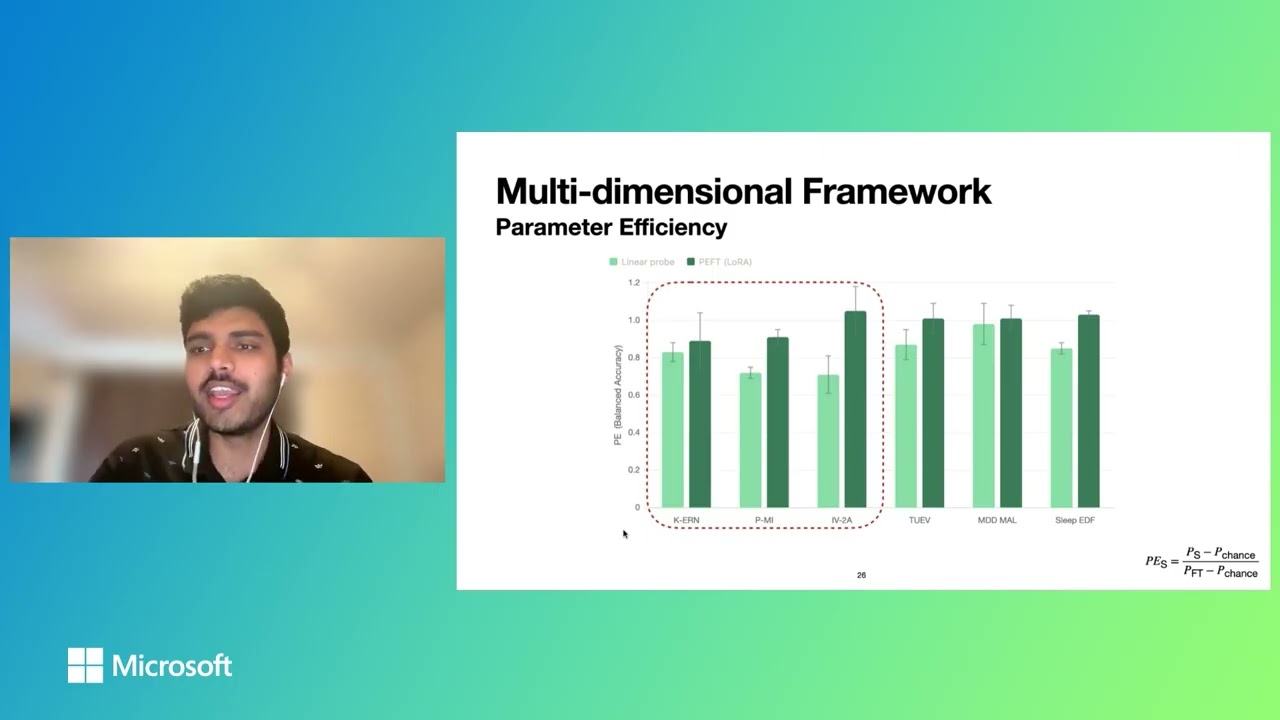
This session features two talks on optimizing and verifying AI reasoning. Hongxiang Fan discusses cross-stack co-design for efficient AI, focusing on Test-Time Scaling (TTS) challenges, optimal verification granularity, and system-level optimizations for edge deployments. Nagarajan Natarajan introduces 'Advancing Verified Reasoning' with the InterVent platform, aiming to ensure AI agents comply with complex policies through formal verification, dynamic steering, and leveraging verification signals for training. Both emphasize addressing the computational and reliability costs of advanced AI.

Multimodal & Embodied Intelligence (Pt 1), Panel on Multimodal AI: Progress, Pitfalls, Possibilities

Multimodal & Embodied Intelligence (Pt 1), Panel on Multimodal AI: Progress, Pitfalls, Possibilities

This session explored Multimodal and Embodied Intelligence, featuring talks on hybrid AI in robotics (classical vs. end-to-end), AI's role in healthcare (focusing on NCDs, deployment, and uncertainty modeling), and fundamental perception challenges in multimodal reasoning (using educational video QA and visual puzzles). A panel discussed the impact of foundation models, the blurred lines between AGI and human-like AI, critical deployment pitfalls (human factors, efficiency, architectural limits), and future directions, emphasizing task-specific models and the redefinition of 'foundation models.'

Grant Sanderson (@3blue1brown) – AI and the future of math

Grant Sanderson (@3blue1brown) – AI and the future of math

Grant Sanderson and Dwarkesh Patel discuss AI's rapid but uneven progress in mathematics, exploring whether AI can achieve true conceptual breakthroughs, the challenge of measuring creativity, and the long-term implications for human understanding and the future roles of mathematicians. They delve into the unique 'grindability' of math for AI training, the potential of formalization, and why AI currently struggles with 'theory of mind' in writing, offering advice for students navigating an AI-transformed world.

Technology

View All
Plenary Talk 3​: Challenges and research opportunities for global hyperscale services

Plenary Talk 3​: Challenges and research opportunities for global hyperscale services

Jim Kleewein's talk outlines the immense challenges and critical research opportunities in building and operating global hyperscale services like Microsoft 365 and Azure. He emphasizes that at this scale, traditional approaches fail, necessitating a "new golden age of applied research" across areas like continuous availability, data management, security, and sustainability. Kleewein also discusses AI's powerful but limited role, stressing the ongoing need for human expertise, and highlights the ethical imperative to prevent failures that can have life-or-death consequences.

Platforms: Build Abstractions, not Illusions • Gregor Hohpe • GOTO 2025

Platforms: Build Abstractions, not Illusions • Gregor Hohpe • GOTO 2025

Gregor Hohpe explains the critical role of platforms in managing the growing cognitive load on developers due to complex distributed systems. He contrasts platforms, driven by "economies of speed" and fostering innovation through diversity, with traditional IT services and oversimplified abstractions that create dangerous illusions. Hohpe emphasizes building platforms that provide intuitive, domain-specific abstractions to solve real business problems, rather than just repackaging existing cloud services.

Full Stack Greenfield Projects : Are they still relevant?

Full Stack Greenfield Projects : Are they still relevant?

Bharat Goenka, co-founder of Tally, discusses the company's unconventional approach to software development through "Full Stack Greenfield" projects. He explains why building every component from scratch, despite being a high-risk strategy, has been crucial for Tally's success in serving the SMB market, fostering extreme customer loyalty, and aspiring to connect 200 million businesses. The talk delves into the historical context, the philosophy of questioning and choosing constraints, and the distinction between product and custom engineering.


Recent Post

How Bots, Deepfakes and AI Agents Are Forcing a New Internet Identity Layer | Alex Blania on a16z

How Bots, Deepfakes and AI Agents Are Forcing a New Internet Identity Layer | Alex Blania on a16z

Alex Blania, cofounder and CEO of Tools for Humanity (Worldcoin), details the critical challenge of proving human uniqueness in the AI era. He explains Worldcoin's iris biometric approach, its sophisticated privacy architecture using Multi-Party Computation and Zero-Knowledge Proofs, and the pervasive impact of AI agents and deepfakes on social media, dating, gaming, and government. Blania also outlines Worldcoin's strategy to scale this proof-of-human network globally, particularly in the US.

Learning API Styles • Lukasz Dynowski & Sam Newman • GOTO 2026

Learning API Styles • Lukasz Dynowski & Sam Newman • GOTO 2026

This GOTO Book Club episode features an in-depth conversation between Sam Newman and Lukasz Dynowski, co-author of "Learning API Styles," exploring the foundational network layer of APIs, various API styles, critical trade-off decisions, and future trends like WebTransport and gRPC. The discussion emphasizes treating APIs as products, understanding consumer context, and the eight key characteristics of a well-designed API, complemented by a cautionary tale on database access.

Large-scale agentic quant research with Weights & Biases

Large-scale agentic quant research with Weights & Biases

Explore how Weights & Biases (W&B) enhances reliability, reproducibility, and explainability in large-scale, agent-driven quantitative research. This video demonstrates two core applications: debugging multi-agent alpha research pipelines with W&B Weave to identify root causes and iterate on forecasts, and automating strategy optimization using W&B Models to tune agent weights and gain insights from performance convergence and parallel coordinate plots.

"We're Not Writing Code by Hand Anymore. That's Over." | Owen Jennings & David Haber - The a16z Show

"We're Not Writing Code by Hand Anymore. That's Over." | Owen Jennings & David Haber - The a16z Show

Owen Jennings, Executive Officer at Block, details the company's radical restructuring (40% workforce reduction) driven by AI's impact on productivity. He explains how Block is now operating with smaller squads, leveraging internal AI tools like Goose and Builder Bot, and shipping AI-native products like Money Bot and Manager Bot to deliver personalized, generative UIs for millions of users, emphasizing a future where unique understanding forms the ultimate business moat.

The Moonshot Podcast S2, Episode 2: Coding The Natural World

The Moonshot Podcast S2, Episode 2: Coding The Natural World

This episode of The Moonshot Podcast delves into the future of biological engineering, showcasing how AI and computational biology are transforming our interaction with living systems. Host Astro Teller first speaks with Brad Zamft of Heritable Agriculture about programming plants for increased yield, pest resistance, and drought resilience. Next, Relly Brandman from project A-Life explains how they're using AI to create a "virtual cell," shifting biomanufacturing from slow trial-and-error to a predictable engineering discipline for producing diverse materials like medicines, fuels, and textiles.

This AI Company Catches Fraud Across the Internet

This AI Company Catches Fraud Across the Internet

Variance, emerging from three years in stealth with a $21 million Series A, is transforming enterprise risk and compliance through purpose-built AI agents. Founded by ex-Apple engineers, the company automates complex tasks like fraud detection, content review, and identity verification for Fortune 500s and platforms such as GoFundMe. They discuss the strategic reasons for stealth, technical challenges of integrating disparate data sources (including UI scraping), the shift from legacy systems to self-healing AI agent architectures, and how their lean, AI-maximalist team detects sophisticated threats like state-sponsored fraud rings.

Stay In The Loop! Subscribe to Our Newsletter.

Get updates straight to your inbox. No spam, just useful content.