Tokenless

Machine Learning

View All
Post-training best-in-class models in 2025

Post-training best-in-class models in 2025

An expert overview of post-training techniques for language models, covering the entire workflow from data generation and curation to advanced algorithms like Supervised Fine-Tuning (SFT), Direct Preference Optimization (DPO), and Reinforcement Learning (RL), along with practical advice on evaluation and iteration.

Anaximander: Interactive Orchestration and Evaluation of Geospatial Foundation Models

Anaximander: Interactive Orchestration and Evaluation of Geospatial Foundation Models

This talk introduces Anaximander, a system designed to bridge the gap between traditional, GUI-driven Geographic Information System (GIS) workflows and modern, code-heavy machine learning practices. Anaximander integrates geospatial foundation models directly into QGIS, allowing experts to interactively orchestrate, run, and evaluate models for tasks like semantic segmentation and object detection on satellite imagery.

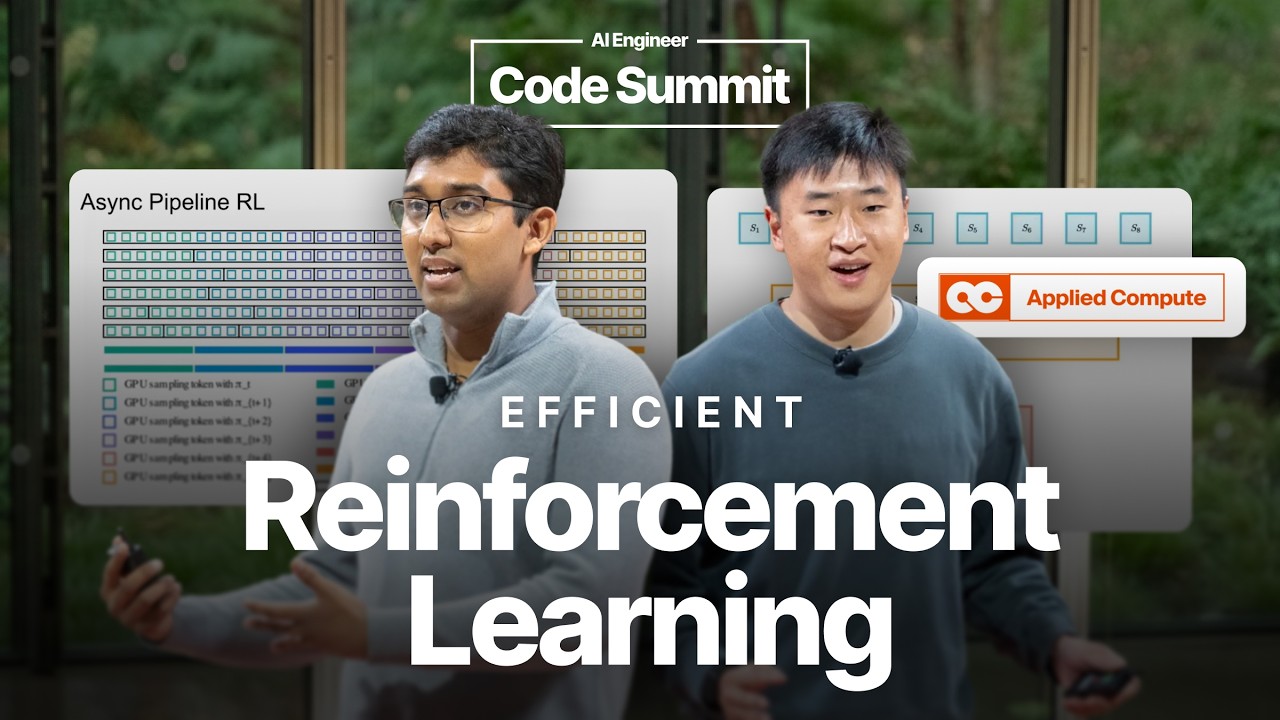
Efficient Reinforcement Learning – Rhythm Garg & Linden Li, Applied Compute

Efficient Reinforcement Learning – Rhythm Garg & Linden Li, Applied Compute

At Applied Compute, efficient Reinforcement Learning is critical for delivering business value. This talk explores the transition from inefficient synchronous RL to a high-throughput asynchronous 'Pipeline RL' system. The core challenge is managing 'staleness'—a side effect of in-flight weight updates that can destabilize training. The speakers detail their first-principles systems model, based on the Roofline model, used to simulate and find the optimal allocation of GPU resources between sampling and training, balancing throughput with algorithmic stability and achieving significant speedups.

Artificial Intelligence

View All
Moonshot Podcast Deep Dive: Emily Ma on Solving Food Waste

Moonshot Podcast Deep Dive: Emily Ma on Solving Food Waste

In a discussion with Astro Teller, Emily Ma from X (formerly Google X) delves into the multifaceted problem of food waste and the moonshot projects developed to tackle it. They explore Project Delta, an initiative that created an "air traffic control" system for surplus food, and Project Chorus, a broader supply chain moonshot designed to give every object a voice through advanced sensors and software.

Ben Horowitz on Investing in AI: AI Bubbles, Economic Impact, and VC Acceleration

Ben Horowitz on Investing in AI: AI Bubbles, Economic Impact, and VC Acceleration

Ben Horowitz of Andreessen Horowitz discusses how AI is reshaping venture capital, detailing the firm's strategy for managing partners, verticalizing teams, and evaluating investments in real-time. He breaks down the current AI cycle, arguing that application design and model orchestration are key, and explains why the current market's growth is driven by real demand, not just hype.

957: How AI Agents Are Automating Enterprise Data Operations, with Ashwin Rajeeva

957: How AI Agents Are Automating Enterprise Data Operations, with Ashwin Rajeeva

Ashwin Rajeeva, cofounder and CTO of Acceldata, details the architecture and philosophy behind their Agentic Data Management (ADM) platform. He explains how the Xlake reasoning engine provides crucial context for AI agents to operate across petabyte-scale enterprise data, enabling capabilities like self-healing data pipelines and automated data quality assurance, while also discussing strategies for leading technical teams in the age of AI.

Technology

View All
Palo Alto Networks CEO Nikesh Arora on the Virtues of Being an Outsider

Palo Alto Networks CEO Nikesh Arora on the Virtues of Being an Outsider

Nikesh Arora, CEO of Palo Alto Networks, shares his unconventional journey and leadership philosophy. He provides a masterclass in building a multi-platform company through strategic M&A, explains why founders should sometimes ignore customers, and reveals how to lead with conviction while managing imposter syndrome.

Mental models for building products people love ft. Stewart Butterfield

Mental models for building products people love ft. Stewart Butterfield

Stewart Butterfield, co-founder of Slack and Flickr, shares the product frameworks and leadership principles that guided his success. He delves into concepts like "utility curves" for feature investment, the "owner's delusion" in product design, and why focusing on "comprehension" is often more important than reducing friction. He also introduces powerful mental models for organizational effectiveness, such as combating "hyper-realistic work-like activities" and applying Parkinson's Law to team growth.

Intuit CEO Sasan Goodarzi’s Grown-Up CEO Playbook

Intuit CEO Sasan Goodarzi’s Grown-Up CEO Playbook

Intuit CEO Sasan Goodarzi discusses the operational playbook for reinventing a 40-year-old company, from its slow transition to SaaS to its early adoption of AI. He shares insights on winning the SMB market by treating small businesses like consumers, building effective channel partnerships, and developing a platform strategy. Goodarzi also details his leadership philosophy, emphasizing that grit and curiosity are more critical than raw talent.


Recent Post

Columbia CS Professor: Why LLMs Can’t Discover New Science

Columbia CS Professor: Why LLMs Can’t Discover New Science

Professor Vishal Misra of Columbia University introduces a formal model for understanding Large Language Models (LLMs) based on information theory. He explains how LLMs reason by navigating "Bayesian manifolds", using concepts like token entropy to explain the mechanics of chain-of-thought, and defines true AGI as the ability to create new manifolds rather than just exploring existing ones.

MCP vs gRPC: How AI Agents & LLMs Connect to Tools & Data

MCP vs gRPC: How AI Agents & LLMs Connect to Tools & Data

A deep dive into how AI agents connect to external tools, comparing the AI-native Model Context Protocol (MCP) with the high-performance gRPC framework. The summary explores their respective architectures, discovery mechanisms, and performance trade-offs, concluding with a vision for their complementary roles in future AI systems.

Deep Dive: Ivy Ross & Isabelle Olsson on the Early Days of Google Glass

Deep Dive: Ivy Ross & Isabelle Olsson on the Early Days of Google Glass

Astro Teller, Ivy Ross, and Isabelle Olsson recount the journey of creating Google Glass. They delve into the human-centered design philosophy, the innovative 'Explorer Program' as a public learning platform, the unexpected social and technical challenges, and the crucial lessons learned about timing and innovation in launching moonshot technologies.

Sparse Activation is the Future of AI (with Adrian Kosowski)

Sparse Activation is the Future of AI (with Adrian Kosowski)

Adrian Kosowski from Pathway explains their groundbreaking research on sparse activation in AI, moving beyond the dense architectures of transformers. Their model, Baby Dragon Hatchling (BDH), mimics the brain's efficiency by activating only a small fraction of its artificial neurons, enabling a new, more scalable, and compositional approach to reasoning that isn't confined by the vector space limitations of current models.

Inside Google's AI turnaround: AI Mode, AI Overviews, and vision for AI-powered search | Robby Stein

Inside Google's AI turnaround: AI Mode, AI Overviews, and vision for AI-powered search | Robby Stein

Robby Stein, VP of Product at Google, shares insights on the development of Google's AI products, including AI Mode and AI Overviews. He discusses the product principles that guided the creation of billion-user products like Instagram Stories, the philosophy of "relentless improvement," and why AI is expanding, not replacing, Google Search.

Nick Lane – Life as we know it is chemically inevitable

Nick Lane – Life as we know it is chemically inevitable

Evolutionary biochemist Nick Lane presents a theory that the origin of life was a chemically inevitable continuation of the geochemistry in deep-sea hydrothermal vents. This framework explains why all life uses proton gradients for energy, the Krebs Cycle, and why simple bacteria dominated for billions of years. The true bottleneck for intelligent life, he argues, is the singular, chance event of endosymbiosis that created the complex eukaryotic cell, a prerequisite for large genomes, multicellularity, and even the evolution of two sexes.

Stay In The Loop! Subscribe to Our Newsletter.

Get updates straight to your inbox. No spam, just useful content.