Computer science

Master Software Architecture: From Simplicity to Complexity • Maciej «MJ» Jedrzejewski • GOTO 2025

Master Software Architecture: From Simplicity to Complexity • Maciej «MJ» Jedrzejewski • GOTO 2025

This presentation by Maciej Jedrzejewski explores the concept of evolutionary software architecture, arguing that architecture is not a static, upfront design but a continuous process. It delves into the cognitive biases that lead to over-engineering, emphasizes the critical role of context, and provides a practical four-step model for evolving systems from simplicity to complexity.
Software Security for Developers • Laur Spilca & Thomas Vitale • GOTO 2026

Software Security for Developers • Laur Spilca & Thomas Vitale • GOTO 2026

Author Laurentiu Spilca discusses his book 'Software Security for Developers', covering why developers avoid security, the dangers of reinventing standards like OAuth 2.0, the growing risks of AI-generated code, and the critical need to understand foundational concepts like encryption, hashing, and PKI.

Towards Safety & Security in C++26 • Daniela Engert • GOTO 2025

Towards Safety & Security in C++26 • Daniela Engert • GOTO 2025

Daniela Engert explores the significant push towards memory safety in C++26, detailing how the language is evolving to address long-standing vulnerabilities. The talk covers the critical distinction between security and functional safety, the nuances of undefined behavior, and introduces powerful new features like Standard Library Hardening and a formal Contracts system to help developers write safer, more reliable code.

Building Planetary-Scale Data Systems with Venice • Felix GV & Olimpiu Pop

Building Planetary-Scale Data Systems with Venice • Felix GV & Olimpiu Pop

Félix GV, architect of LinkedIn's Venice database, explains its unbundled, planetary-scale architecture. He covers their rigorous chaos engineering practices, the trade-offs between consistency and availability in a derived data system, and an experimental integration with DuckDB for advanced analytics and data exploration.

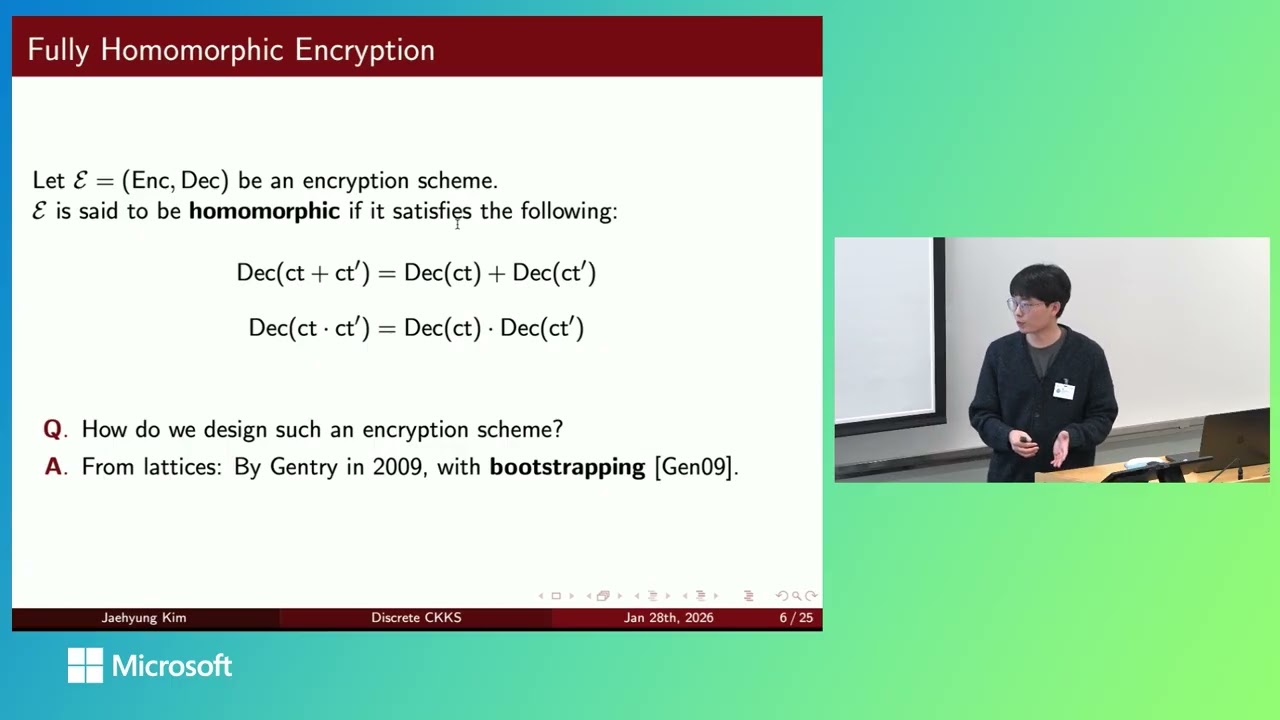
Efficient Homomorphic Integer Computer from CKKS

Efficient Homomorphic Integer Computer from CKKS

This talk introduces Discrete CKKS, a framework that extends the approximate FHE scheme CKKS to support exact integer arithmetic. It achieves this through a hybrid bootstrapping technique that both cleans noise and raises the modulus, enabling a high-throughput, vectorized engine for general-purpose discrete computations on encrypted data.

Hardware Realization and Implementation Security Evaluation of HQC, A NIST PQC Standard

Hardware Realization and Implementation Security Evaluation of HQC, A NIST PQC Standard

This talk by Sanjay Deshpande from Northwestern University explores the critical transition to Post-Quantum Cryptography (PQC) in response to the threat quantum computers pose to current public-key algorithms. It provides a deep dive into the Hamming Quasi-Cyclic (HQC) algorithm, a code-based candidate for NIST standardization. The session focuses on the challenges and innovations in creating efficient and secure hardware implementations of HQC, covering performance optimization for polynomial multiplication and countermeasures against side-channel attacks.