Ai

The Model-Agnostic AI Platform Betting That No Single Lab Will Win

The Model-Agnostic AI Platform Betting That No Single Lab Will Win

Stanislas Polu, co-founder of Dust, shares his journey from Stripe to OpenAI and his motivations for building Dust. He discusses Dust's model-agnostic approach, the challenges of fundraising in an environment dominated by Frontier Labs, the strategic decision to build in France, and critical insights into pricing models and defensibility for AI product companies amidst commoditized intelligence.

AI, Corporate Responsibility & Democratic Legitimacy: Extended Q&A • Joanna Bryson • GOTO 2025

AI, Corporate Responsibility & Democratic Legitimacy: Extended Q&A • Joanna Bryson • GOTO 2025

Joanna Bryson challenges popular AI assumptions, positing current generative AI as powerful tools for cultural knowledge compression, not autonomous intelligences. She emphasizes that AI's capabilities are nearing the human knowledge frontier, requiring focus on human coordination and governance. Bryson critically examines AI's impact on mental health and law, advocating for data-driven regulation and comprehensible systems. She calls for engineering activism, asserting human agency over technological determinism and stressing the importance of transparency and critical thinking in shaping AI's future.

Building an Autonomous Delivery Experience with DoorDash Co-Founders Andy Fang and Stanley Tang

Building an Autonomous Delivery Experience with DoorDash Co-Founders Andy Fang and Stanley Tang

DoorDash co-founders Andy Fang and Stanley Tang discuss how AI and autonomous technology are transforming consumer behavior and delivery logistics. They detail the impact of "Ask DoorDash" on restaurant discovery and grocery orders, and the operational challenges and strategic advantages behind their autonomous delivery robot, Dot. The conversation highlights DoorDash's 'use case first' approach to autonomy, the critical role of data in scaling physical AI, and their surprising prediction that more Dashers, not fewer, will be part of DoorDash's future multimodal delivery strategy.

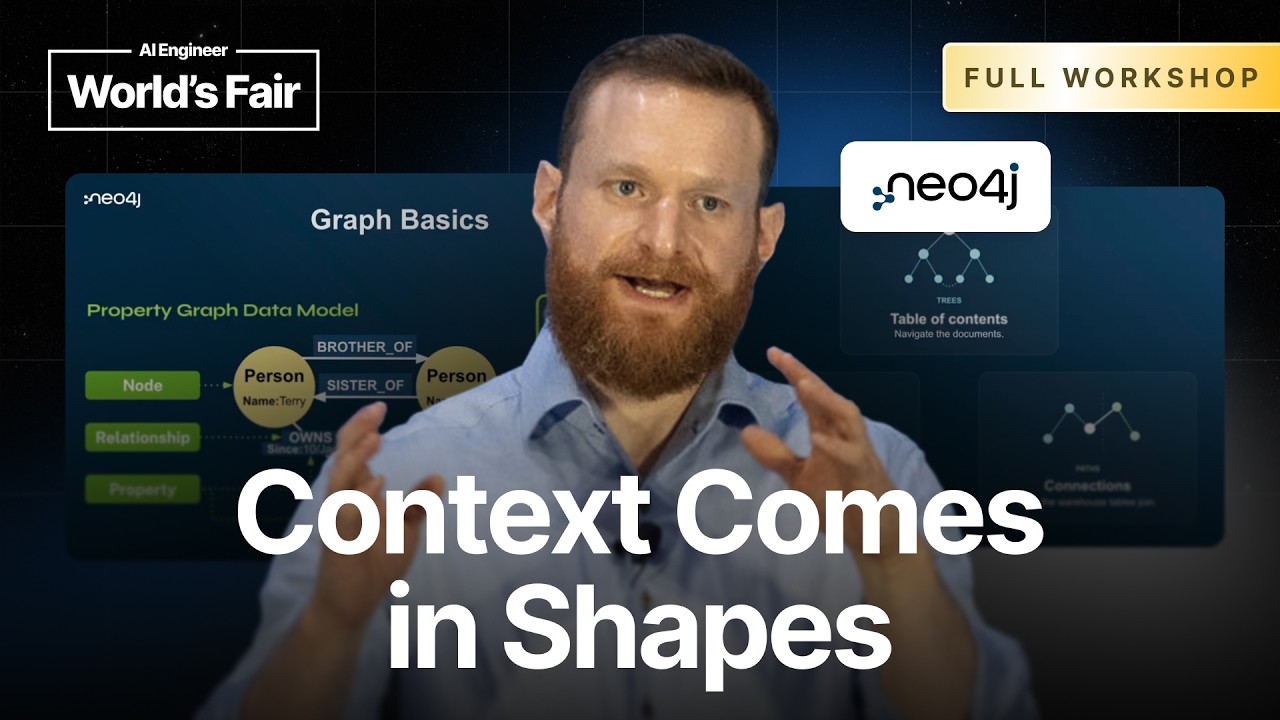
AI on Your Lakehouse: Context Comes in Shapes, Not Queries — Zach Blumenfeld, Neo4j

AI on Your Lakehouse: Context Comes in Shapes, Not Queries — Zach Blumenfeld, Neo4j

AI agents often struggle with context in lakehouses, leading to confident but incorrect answers. This workshop by Zach Blumenfeld introduces three Neo4j graph shapes built on lakehouse data—Connections (semantic layer), Trees (document outlines), and Communities (themes)—to provide essential context, enabling agents to accurately navigate structured and unstructured data, answer complex estate-level questions, and overcome limitations of traditional Text2SQL and vector search.

How Supabase Became One Of The Fastest Growing DevTool Companies In The World

How Supabase Became One Of The Fastest Growing DevTool Companies In The World

Supabase CEO Paul Copplestone details how a frustrating Firebase migration sparked an open-source side project that grew into a decacorn. He explains the strategic choice of PostgreSQL and open source, the evolution of developer experience to achieve 5-second time-to-value, and the transformative impact of AI agents, which now launch millions of Supabase databases monthly. The conversation also covers the challenges and advantages of a fully distributed workforce and the future bet on 'self-driving databases' to address the complex 'operate' stage of AI-driven development.

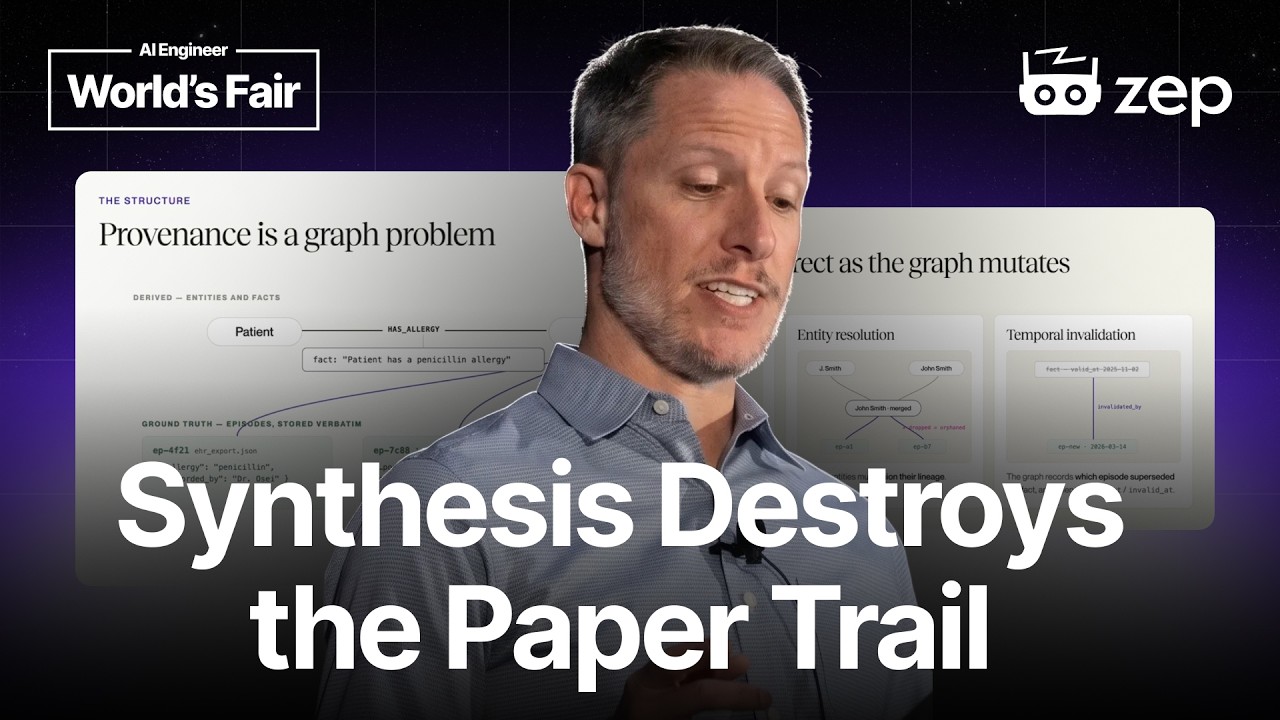
Citation Needed: Provenance for LLM-Built Knowledge Graphs — Daniel Chalef, Zep AI

Citation Needed: Provenance for LLM-Built Knowledge Graphs — Daniel Chalef, Zep AI

Daniel Chalef discusses how LLM synthesis destroys data provenance, making it difficult to trace information back to its sources. He introduces Graphiti, an open-source temporal graph framework, and Zep, an agent memory infrastructure built upon it. This system models provenance as a graph, treating sources as 'episodes' and derived facts as interconnected nodes and edges. This approach enables robust lineage tracing, handles entity merges and fact invalidation through temporal mechanisms, facilitates metadata-driven trust evaluation, and allows for compliant data deletion (e.g., GDPR) based on source support. The benefits include enhanced compliance, improved data veracity, and debuggable AI agents, addressing a critical engineering challenge in LLM applications.