Ai

Reid Hoffman on AI, Consciousness, and the Future of Humanity

Reid Hoffman on AI, Consciousness, and the Future of Humanity

Reid Hoffman explores the future of AI, moving beyond obvious productivity applications to tackle grand challenges in science and industry. He discusses the current limitations of LLMs in reasoning, the distinction between augmenting and replacing human experts, the philosophical questions of consciousness, and the enduring power of human connection in the age of AI.

How to measure AI developer productivity in 2025 | Nicole Forsgren

How to measure AI developer productivity in 2025 | Nicole Forsgren

Nicole Forsgren, creator of the DORA and SPACE frameworks, explains why traditional productivity metrics are failing in the age of AI. She details how AI impacts developer flow state, shifts the focus from writing to reviewing code, and provides a new framework for measuring and improving Developer Experience (DevEx) by aligning engineering efforts with strategic business goals.

Why AI Needs Culture (Not Just Data) - Prolific [Sponsored]

Why AI Needs Culture (Not Just Data) - Prolific [Sponsored]

Sara Saab and Enzo Blindow from Prolific discuss the critical, and growing, need for high-quality human evaluation in the age of non-deterministic AI. They explore the limitations of current benchmarks, the dangers of agentic misalignment as revealed by Anthropic's research, and how Prolific is building a "science of evals" by treating human feedback as a robust infrastructure layer.

Distant conversational speech recognition: Challenges and Opportunities

Distant conversational speech recognition: Challenges and Opportunities

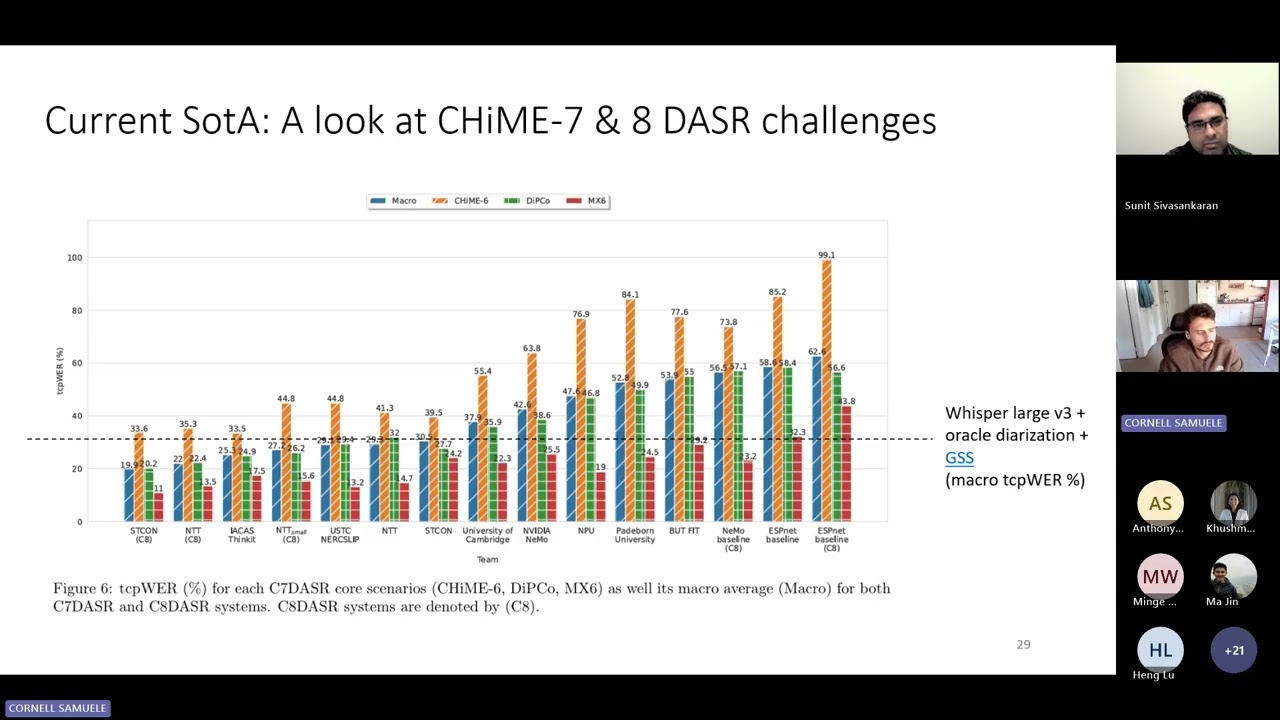
Dr. Samuele Cornell from Carnegie Mellon University discusses the persistent challenges in distant automatic speech recognition (DASR) for spontaneous, multi-party conversations. He explains why state-of-the-art systems falter in real-world scenarios and presents recent advancements through three key efforts: (1) insights from the CHiME-7/8 DASR challenges, which benchmark robust meeting transcription; (2) progress towards unified end-to-end models that jointly handle diarization and recognition; and (3) novel techniques for generating realistic, large-scale training data using a combination of large language models and multi-speaker text-to-speech systems.

IronDict: Transparent Dictionaries from Polynomial Commitments

IronDict: Transparent Dictionaries from Polynomial Commitments

Hossein Hafezi from NYU presents IronDict, a novel transparent dictionary construction using polynomial commitment schemes. IronDict addresses the major limitations of existing Merkle tree-based systems, such as high auditing costs and imperfect privacy. By modeling the dictionary with polynomials and leveraging the algebraic properties of the KZH commitment scheme, IronDict achieves perfect privacy and dramatically reduces auditing overhead, making it feasible for end-users to verify the system's integrity on consumer devices.

Efficient Secure Aggregation for Federated Learning

Efficient Secure Aggregation for Federated Learning

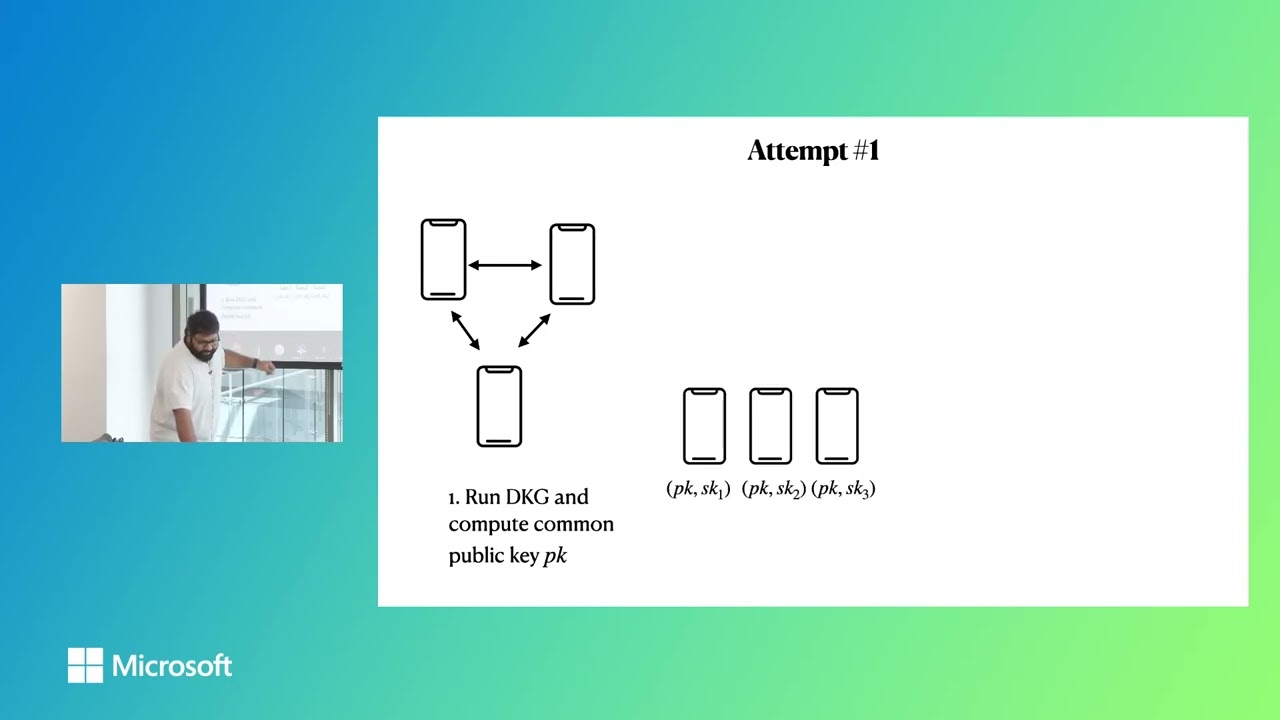
Varun Madathil from Yale University presents Tacita, a novel, single-server protocol for secure aggregation in Federated Learning (FL). Tacita is designed to address the unique constraints of the FL environment, such as client dropouts and the absence of client-to-client communication. The protocol achieves one-shot execution with constant-size communication and robustness against dropouts by introducing two new cryptographic primitives: succinct multi-key linearly homomorphic threshold signatures (MKLHTS) and a homomorphic variant of Silent Threshold Encryption.