System design

Designing safe digital systems for the humanitarian sector

Designing safe digital systems for the humanitarian sector

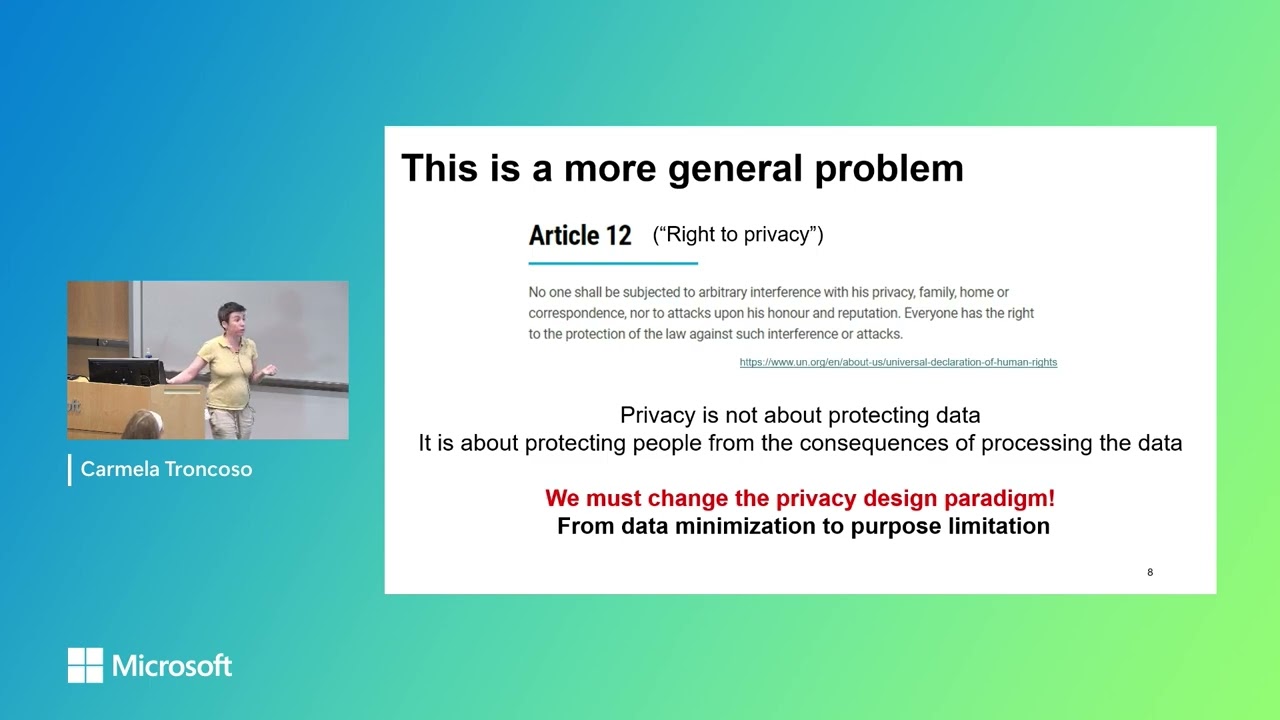
Carmela Troncoso from EPFL discusses her collaboration with the International Committee of the Red Cross (ICRC) to digitalize humanitarian aid distribution. She advocates for a paradigm shift from data minimization to "purpose limitation," designing systems that are structurally incapable of being misused, even if the data is accessed. The talk details a practical, low-cost, and connectivity-resilient system built on this principle, using smart cards and cryptographic techniques to protect vulnerable aid recipients while meeting the operational needs of the ICRC.

How to Build Execution Layers That Don’t Burn Out // Tanmay Tiwari // Agents in Production 2025

How to Build Execution Layers That Don’t Burn Out // Tanmay Tiwari // Agents in Production 2025

A talk on designing a dependable AI execution layer that handles thousands of operations without constant supervision. The system is built to be precise, responsible, and action-oriented, avoiding common LLM pitfalls like burnout, memory bloat, and overthinking.

Why SW Architecture is Mostly Communication • David Whitney, Ian Cooper & Hannes Lowette • GOTO 2025

Why SW Architecture is Mostly Communication • David Whitney, Ian Cooper & Hannes Lowette • GOTO 2025

Three experienced software engineers—Ian Cooper, David Whitney, and Hannes Lowette—deconstruct the evolution of software architecture from a top-down, "ivory tower" practice to a modern, collaborative discipline. They explore the dynamics between emergent and intentional design, the importance of sustainable development over "slash-and-burn" cycles, and how architectural strategies must adapt to organizational scale. The conversation emphasizes that the architect's primary role has shifted to coaching, fostering a shared language, and managing trade-offs, concluding that all significant architectural challenges are ultimately people problems rooted in communication, empathy, and culture.

Predictability Beats Accuracy in Enterprise AI

Predictability Beats Accuracy in Enterprise AI

Anant Bhardwaj, CEO of Instabase, presents a pragmatic guide for building enterprise AI. He argues that AI agents are best used during the 'design-time' to create predictable workflows, rather than for autonomous 'runtime' operations. Bhardwaj also debunks the hype around RAG, highlighting its dependency on data quality, and explains why trust in AI systems stems from predictability, not just accuracy.

Too much lock-in for too little gain: agent frameworks are a dead-end // Valliappa Lakshmanan

Too much lock-in for too little gain: agent frameworks are a dead-end // Valliappa Lakshmanan

Lak Lakshmanan presents a robust architecture for building production-quality, framework-agnostic agentic systems. He advocates for using simple, composable GenAI patterns, off-the-shelf tools for governance, and a strong emphasis on a human-in-the-loop design to create continuously learning systems that avoid vendor lock-in.

Building an Agentic Platform — Ben Kus, CTO Box

Building an Agentic Platform — Ben Kus, CTO Box

Ben Kus, CTO of Box, outlines the technical evolution of their AI platform, detailing the transition from a promising but fragile LLM-based metadata extraction system to a robust, scalable agentic architecture. He explains why this shift was necessary to handle enterprise-level complexity and the key lessons learned.