Real time ai

Real-Time Voice Agents in Production

Real-Time Voice Agents in Production

Panos Stravopodis, CTO of Elyos AI, shares the infrastructure and orchestration challenges of building production-ready voice AI agents. He details the four pillars for success—latency, consistency, context, and recovery—and provides engineering patterns for error handling, context management, and achieving conversational coherence in real-time systems.
Tavus: The AI Human Platform

Tavus: The AI Human Platform

Founders Hassaan Raza and Quinn Favret detail Tavus's evolution from a personalized video tool to an AI research lab building real-time, agentic AI humans. They explore the foundational models for perception and rendering, the launch of Tavus PALs, and their vision for AI humans as the next major computing interface.

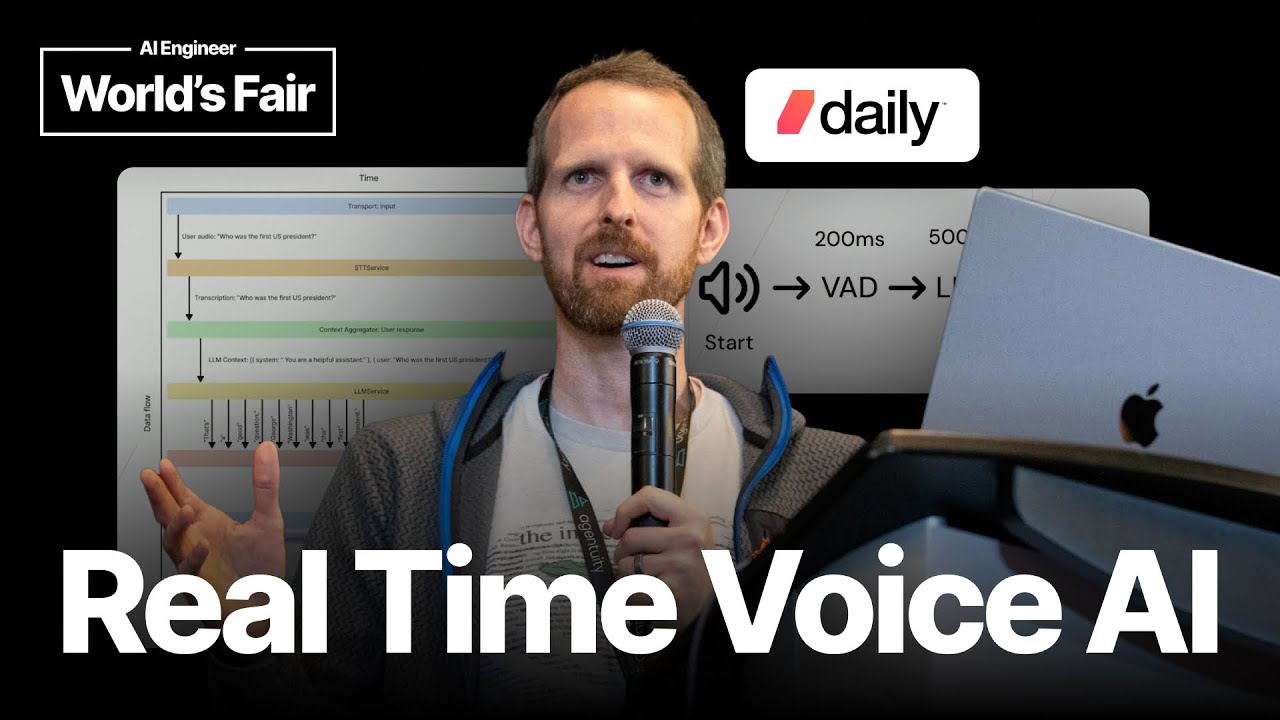
Full Workshop: Realtime Voice AI — Mark Backman, Daily

Full Workshop: Realtime Voice AI — Mark Backman, Daily

An in-depth look at building real-time, production-grade voice AI agents using the open-source Pipecat framework. This summary covers the core concepts of voice AI pipelines, the shift to speech-to-speech models like Gemini Live, and advanced techniques for managing latency, context, and turn-taking.

Flipping the Inference Stack — Robert Wachen, Etched

Flipping the Inference Stack — Robert Wachen, Etched

The current AI inference stack, reliant on general-purpose GPUs, is economically and technically unsustainable for real-time AI at scale. AI hardware expert Robert Wachen argues that the future is specialized hardware, like Transformer-specific ASICs, which can unlock currently bottlenecked applications such as real-time video, code generation, and large-scale enterprise deployments by solving critical latency and cost-per-user challenges.

Pipecat Cloud: Enterprise Voice Agents Built On Open Source - Kwindla Hultman Kramer, Daily

Pipecat Cloud: Enterprise Voice Agents Built On Open Source - Kwindla Hultman Kramer, Daily

A deep dive into the challenges of building production-grade, low-latency voice AI agents, and how the open-source, vendor-neutral framework Pipecat provides a comprehensive solution for development, deployment, and scaling. Learn about voice AI architecture, the trade-offs between speech-to-speech and text-based models, and practical deployment strategies.

Your realtime AI is ngmi — Sean DuBois (OpenAI), Kwindla Kramer (Daily)

Your realtime AI is ngmi — Sean DuBois (OpenAI), Kwindla Kramer (Daily)

Sean DuBois (OpenAI, Pion) and Kwindla Hultman Kramer (Daily, Pipecat) argue that to build successful real-time AI applications, developers must start from the network layer up, prioritizing WebRTC over WebSockets to manage latency effectively and enable advanced features like interruption and state management.