Lang graph

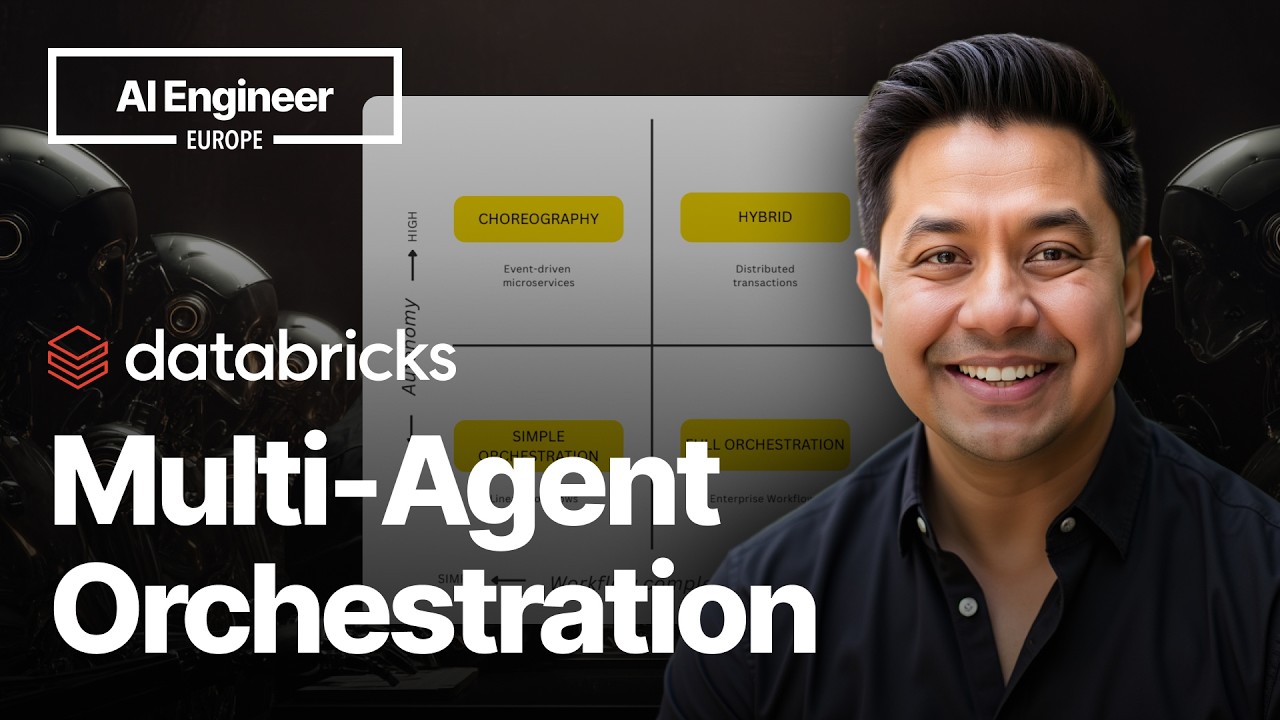
From Chaos to Choreography: Multi-Agent Orchestration Patterns That Actually Work — Sandipan Bhaumik

From Chaos to Choreography: Multi-Agent Orchestration Patterns That Actually Work — Sandipan Bhaumik

Sandipan Bhaumik from Databricks explains that scaling from one to many AI agents is a distributed systems problem, not an AI one. He details common architectural anti-patterns like shared mutable state that cause race conditions and silent failures. The talk provides a practical framework based on distributed systems engineering, covering crucial patterns like choreography vs. orchestration, immutable state management with versioning, data contracts, and failure recovery using circuit breakers and compensation (Saga) patterns. Bhaumik illustrates how to build a robust, production-grade multi-agent architecture using tools like Databricks, LangGraph, and MLflow.

Open vs Closed Source Agent Infra?

Open vs Closed Source Agent Infra?

This panel delves into the strategic implementation of open-source, community-driven agentic stacks, balancing the benefits of open-source frameworks and models for rapid iteration, cost-efficiency, and compliance against the complexities of abstraction and debugging in production environments. Experts from NVIDIA, Stacklok, and Prosus discuss when to adopt open source, challenges in framework choice, the critical need for robust observability, and the role of no-code solutions for diverse user groups, emphasizing the importance of aligning tooling decisions with specific use cases and organizational needs.

Building an Orchestration Layer for Agentic Commerce at Loblaws

Building an Orchestration Layer for Agentic Commerce at Loblaws

Mefta Sadat from Loblaw Digital discusses Alfred, an agentic orchestration layer designed to run AI shopping agents reliably in production. He covers the architecture built with LangGraph and GCP, the role of the Model Context Protocol (MCP) in simplifying API interaction, and practical MLOps strategies for observability, cost management, and ensuring reliability.

Agentic Al in SW Development: Evolving Patterns & Protocols • Bhuvaneswari  Subramani • GOTO 2025

Agentic Al in SW Development: Evolving Patterns & Protocols • Bhuvaneswari Subramani • GOTO 2025

Bhuvaneswari Subramani details the "Agentic Shift" in AI by presenting an evolutionary journey through seven foundational system design patterns. The talk progresses from simple conversational clients to sophisticated, multi-agent systems, covering key patterns like Retrieval-Augmented Generation (RAG), Self-Correcting RAG, and the Model Context Protocol (MCP), explaining how each pattern adds new layers of context, action, and autonomy.

Shipping AI That Works: An Evaluation Framework for PMs – Aman Khan, Arize

Shipping AI That Works: An Evaluation Framework for PMs – Aman Khan, Arize

This talk provides a practical framework for product managers to move beyond simple "vibe checks" to implement rigorous, data-driven evaluation for LLM-powered products. Using a live demo of a multi-agent AI trip planner, the speaker breaks down essential methodologies, including human feedback, code-based checks, and LLM-as-a-judge systems, and demonstrates how to iterate on both prompts and the evals themselves to ensure consistent quality and build user trust.

Why You Should Care About Observability in LLM Workflows

Why You Should Care About Observability in LLM Workflows

An inside look at AlwaysCool.ai's journey from simple GPT wrappers to a production-ready agentic infrastructure. This talk covers the evolution from synchronous tools to asynchronous, multi-step flows orchestrated by LangGraph, the critical role of OpenTelemetry for compliance and observability, and the architectural patterns of using FastAPI to serve centralized AI agents.