Context engineering

Before Building AI Agents Watch This (Deep Agent Expertise)

Before Building AI Agents Watch This (Deep Agent Expertise)

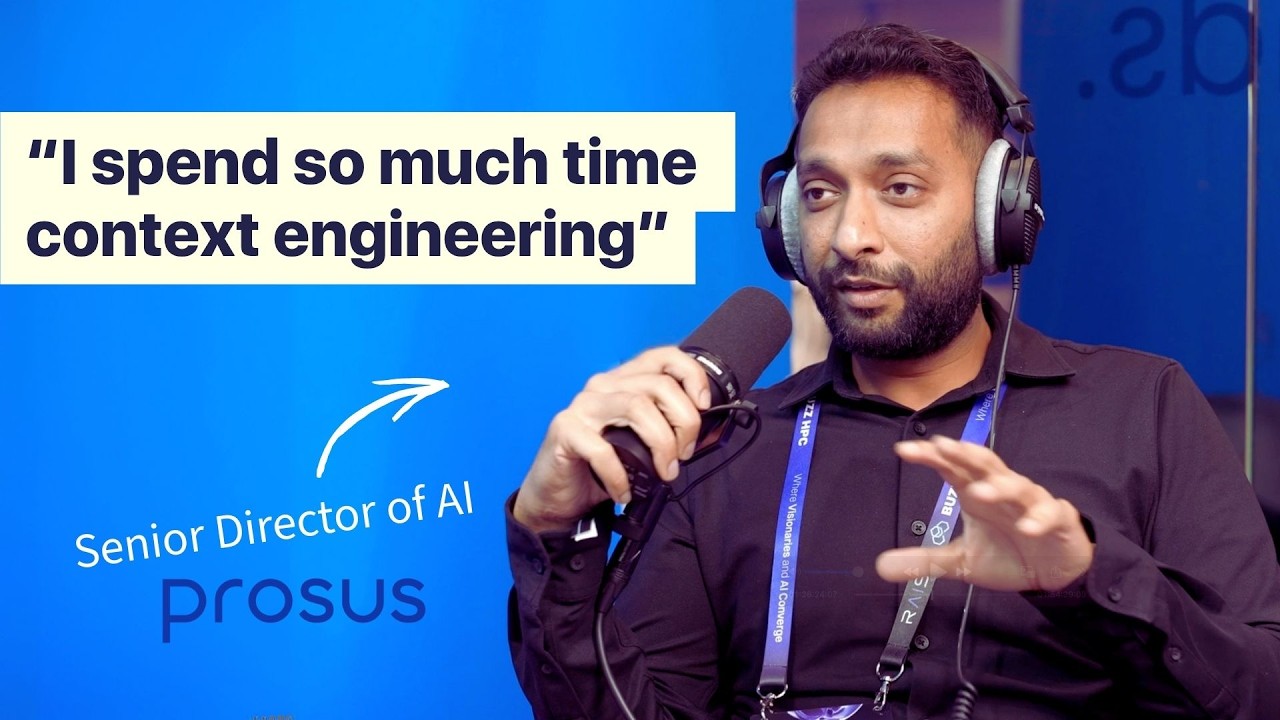
Nishikant Dhanuka from Prosus Group shares practical lessons on building effective AI agents for e-commerce and productivity. He covers why context engineering is more crucial than prompt tweaking, how to build a modern search pipeline, the failures of pure-chat interfaces, and why a robust evaluation framework is the real competitive advantage.

Advanced Context Engineering for Agents

Advanced Context Engineering for Agents

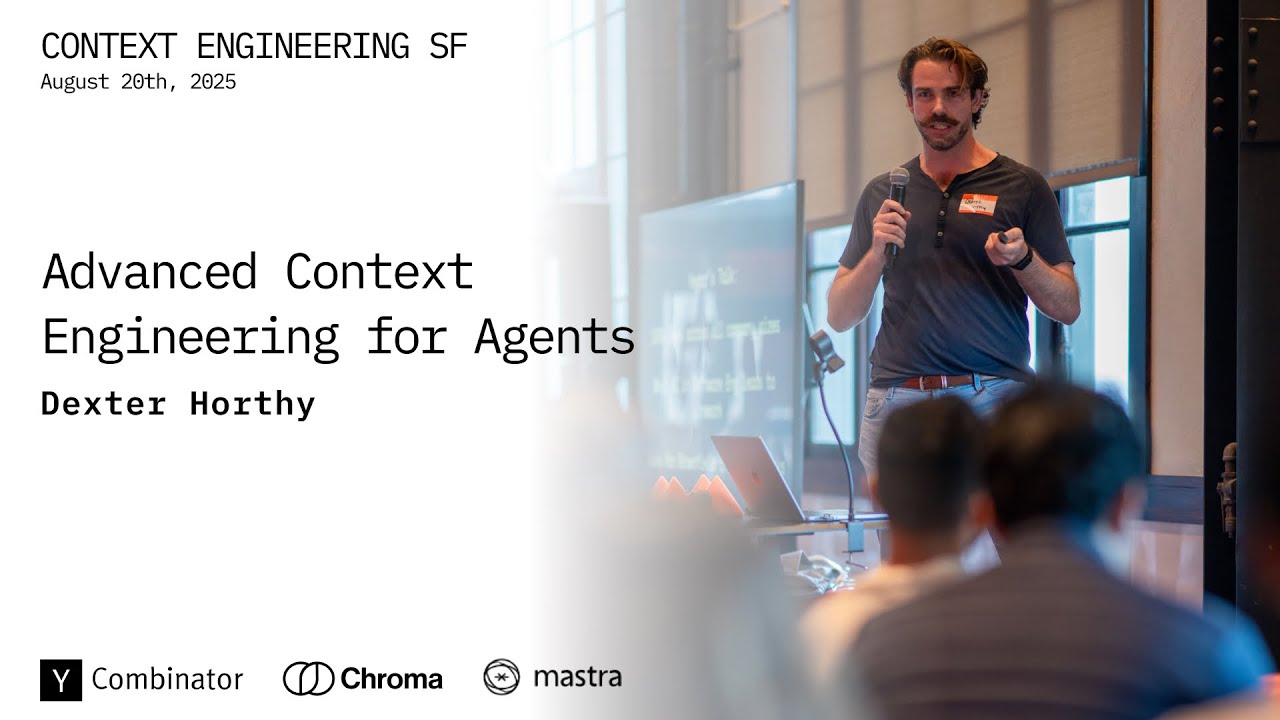
Dexter Horthy of Human Layer explains why naive AI coding agents fail in complex software projects and introduces 'Advanced Context Engineering.' He details a spec-first, three-phase workflow (Research, Plan, Implement) designed to manage context intentionally, keeping utilization below 40% to maximize model performance. This approach uses subagents and frequent compaction to turn AI from a prototyping tool into a production-ready system for large, brownfield codebases.

Conext Engineering for Engineers

Conext Engineering for Engineers

Jeff Huber of Chroma argues that building reliable AI systems hinges on 'Context Engineering'—the deliberate curation of information within the context window. He challenges the efficacy of long-context models, presenting a 'Gather and Glean' framework to maximize recall and precision, and discusses specific challenges and techniques for AI agents, such as intelligent compaction.

Context Engineering: Lessons Learned from Scaling CoCounsel

Context Engineering: Lessons Learned from Scaling CoCounsel

Jake Heller, founder of Casetext, shares a pragmatic framework for turning powerful large language models like GPT-4 into reliable, professional-grade products. He details a rigorous, evaluation-driven approach to prompt and context engineering, emphasizing iterative testing, the critical role of high-quality context, and advanced techniques like reinforcement fine-tuning and strategic model selection.

Five hard earned lessons about Evals — Ankur Goyal, Braintrust

Five hard earned lessons about Evals — Ankur Goyal, Braintrust

Building successful AI applications requires a sophisticated engineering approach that goes beyond prompt engineering. This involves creating intentionally engineered evaluations (evals) that reflect user feedback, focusing on "context engineering" to optimize tool definitions and outputs, and maintaining a flexible, model-agnostic architecture to adapt to the rapidly evolving AI landscape.

12-factor Agents - Patterns of reliable LLM applications // Dexter Horthy

12-factor Agents - Patterns of reliable LLM applications // Dexter Horthy

Drawing from conversations with top AI builders, Dex argues that production-grade AI agents are not magical loops but well-architected software. This talk introduces "12-Factor Agents," a methodology centered on "Context Engineering" to build reliable, high-performance LLM-powered applications by applying rigorous software engineering principles.