Ai agents

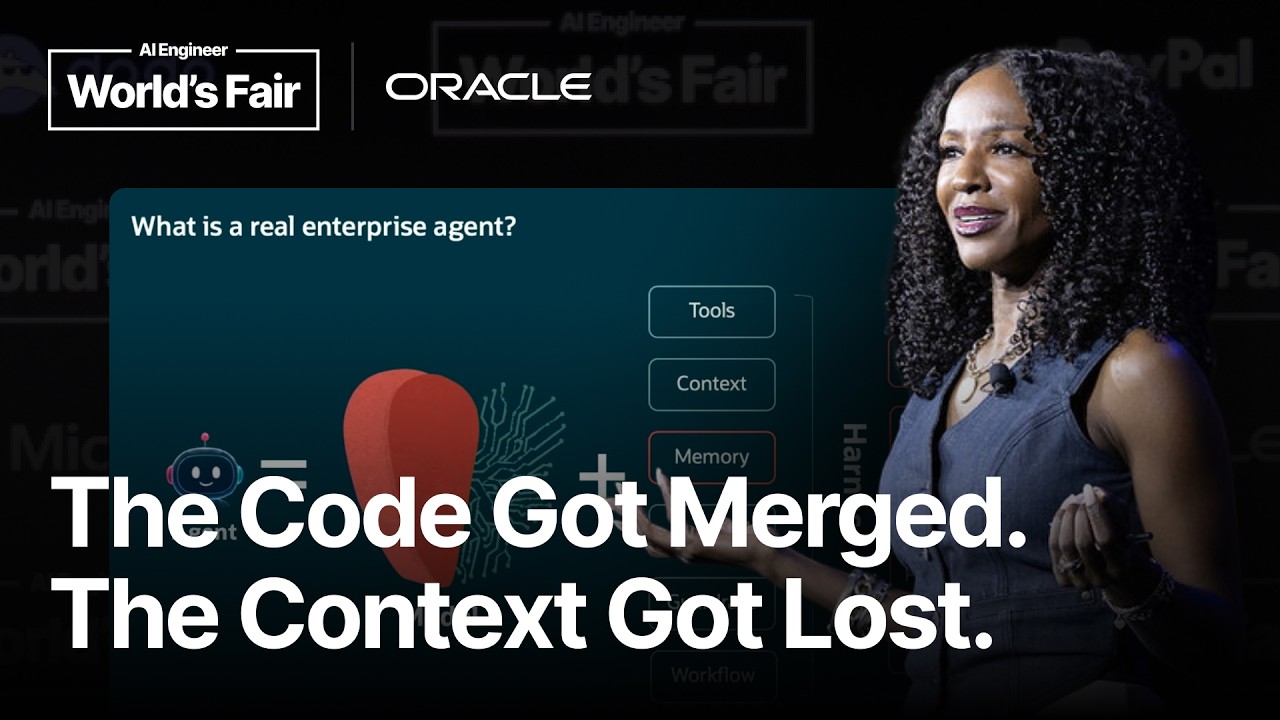
WTF Is the Context Layer? The Missing Infrastructure for Production Agents — Prukalpa Sankar

WTF Is the Context Layer? The Missing Infrastructure for Production Agents — Prukalpa Sankar

Prukalpa Sankar argues that while AI models are increasingly intelligent, their practical business utility is limited by a lack of contextual intelligence. She proposes a "context layer" as a crucial solution, akin to a "GitHub for context," to centralize and manage business knowledge, expertise, and norms. This system aims to provide AI agents with the shared, versioned, and continuously learning context necessary to overcome the challenges of isolated systems and context sprawl, ultimately differentiating companies in an AI-driven world.

Don't Build Agents You Can't Answer For — Addy Osmani

Don't Build Agents You Can't Answer For — Addy Osmani

Addy Osmani discusses the evolving role of software engineers in the age of AI agents, emphasizing a shift from code production to human judgment, accountability, and system ownership. He highlights new challenges like cognitive debt and the "orchestration tax," proposing that the modern engineer's value lies in "answerability," taste, and discerning which paths warrant human investment and responsibility.

5 More AI Myths & The Truth Behind Them: ML, Context, Agents & More

5 More AI Myths & The Truth Behind Them: ML, Context, Agents & More

Martin Keen debunks five common AI myths, covering topics from reduced AI hallucinations and the misinterpretation of AI's "thinking" process, to the rising costs of AI inference, the limitations of large context windows, and the current challenges to fully autonomous AI agents.

Anthropic's Katelyn Lesse & Angela Jiang: Building an Ecosystem, not a Walled Garden

Anthropic's Katelyn Lesse & Angela Jiang: Building an Ecosystem, not a Walled Garden

Katelyn Lesse and Angela Jiang, leaders of Anthropic's developer platform, outline their strategy built on a "three-layer cake": knowledge, execution, and coordination. They emphasize moving towards advanced "strategies" or meta-harnesses that assign distinct jobs to tokens, fostering a robust and open AI ecosystem. The discussion covers empowering builders, setting industry standards, and Anthropic's nuanced approach to an open platform versus a walled garden, focusing on architectural soundness over infrastructure ownership.

From fork() to Fleet: Designing an Agent Sandbox Cloud — Abhishek Bhardwaj, OpenAI

From fork() to Fleet: Designing an Agent Sandbox Cloud — Abhishek Bhardwaj, OpenAI

This talk by Abhishek Bhardwaj from OpenAI details the architectural considerations for building secure and scalable AI agent sandboxes in the cloud. It explores runtime isolation technologies (from basic process execution to containers, GVisor, and microVMs), emphasizing the superior security of hardware-virtualized microVMs. The speaker then highlights the critical need for persistent storage, outlining explicit (copy-on-write snapshots) and always-on (tiered block storage) solutions as the next major unlock for agent capabilities. Finally, it touches on orchestration challenges for fleet-level management, including low-latency sandbox creation and snapshot-driven scheduling.

RLM: Recursive Language Models for Large Codebases - Shashi, Superagentic AI

RLM: Recursive Language Models for Large Codebases - Shashi, Superagentic AI

This talk introduces Recursive Language Models (RLM) as a solution for coding agents struggling with large codebases. RLM externalizes context management into a programmable REPL, allowing the model to write code, inspect the repository, and recursively delegate sub-questions via `llm_query` to curate relevant context. The speaker demonstrates `RLM Code`, an independent implementation, showcasing its operational loop, observability features, and practical applications for AI engineers dealing with complex software projects.