Posts

Beyond Sonic Pi: Tau5 & the Art of Coding with AI • Sam Aaron • GOTO 2025

Beyond Sonic Pi: Tau5 & the Art of Coding with AI • Sam Aaron • GOTO 2025

Sam Aaron, creator of Sonic Pi, discusses the journey from teaching children to code with music to building the next generation of live coding environments. He details the limitations of Sonic Pi (security, deployment) that led to Tau5, a new system built on Elixir and the BEAM. Tau5 is designed to be web-based, secure via a sandboxed Lua environment, and collaborative. A key focus is the integration of AI as a creative partner, using sophisticated tooling to allow AI agents to safely improvise and interact with the system.
What are we scaling?

What are we scaling?

A critical analysis of AI progress, arguing that short AGI timelines are unlikely given the current reliance on pre-baking skills via reinforcement learning. The author contends that true AGI requires on-the-job, continual learning—a capability current models lack. The modest economic impact of AI is presented not as a diffusion lag but as direct evidence of this capability gap. The future of AI will be a gradual, competitive race to solve continual learning, not a sudden takeoff.

Developer Experience in the Age of AI Coding Agents – Max Kanat Alexander, Capitol One

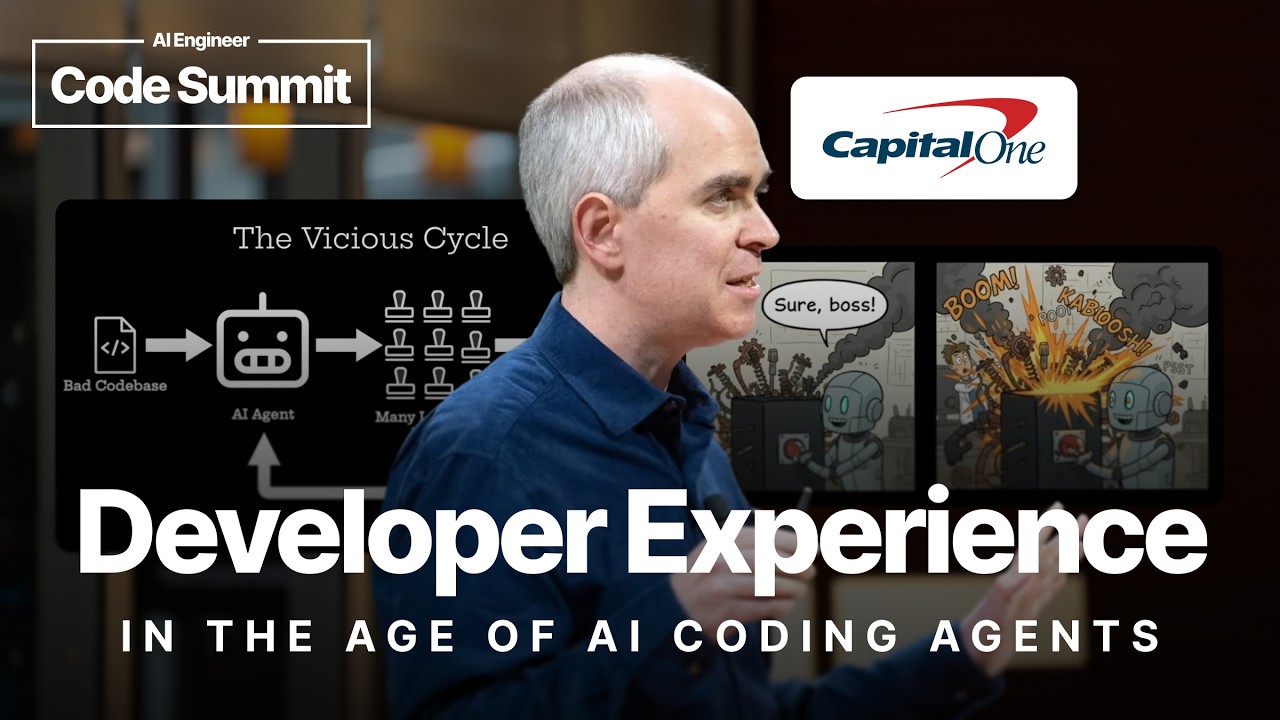
Developer Experience in the Age of AI Coding Agents – Max Kanat Alexander, Capitol One

Max Kanat-Alexander explores the rapid changes in software engineering driven by AI and identifies 'no-regrets investments' that will benefit development teams regardless of the future. He argues that by focusing on foundational developer experience principles—such as standardizing tools, improving validation, structuring code for testability, and refining the code review process—organizations can create a virtuous cycle of productivity for both human developers and their AI agent counterparts.

Continual System Prompt Learning for Code Agents – Aparna Dhinakaran, Arize

Continual System Prompt Learning for Code Agents – Aparna Dhinakaran, Arize

The talk by Aparna Dhinakaran introduces "system prompt learning" as an efficient alternative to traditional Reinforcement Learning for improving large language model-based coding agents. By leveraging LLM-as-a-judge evaluations to generate English feedback and explanations for code failures, agents can automatically refine their system prompts and rules. This method, demonstrated on Claude and Klein, significantly boosts performance on benchmarks like SWEBench with minimal data, highlighting the critical role of high-quality evaluation prompts.

Making Codebases Agent Ready – Eno Reyes, Factory AI

Making Codebases Agent Ready – Eno Reyes, Factory AI

The effectiveness of AI coding agents is not limited by model quality, but by "Agent Readiness"—the state of your development environment. This talk explains why agents fail on codebases with flaky tests, low validation, and tribal knowledge. It introduces a framework for improving your environment's readiness through rigorous verification, automated validation, and a shift to specification-driven development, arguing this is the key to unlocking 5-7x productivity gains and enabling true software engineering autonomy.

AI Agents in 2026 | 3 Predictions For What’s To Come (a16z Big Ideas)

AI Agents in 2026 | 3 Predictions For What’s To Come (a16z Big Ideas)

This episode explores three major shifts shaping the future of AI products. The discussion moves from the 'death of the prompt box' towards proactive AI that acts like a top-tier employee, to a new design paradigm of 'machine legibility' where we create for agents instead of humans. Finally, it covers the practical, real-world deployment of AI voice agents in enterprise sectors like healthcare and finance, signaling a move from AI as something you ask to something that does.