Tokenless

Machine Learning

View All
Post-training best-in-class models in 2025

Post-training best-in-class models in 2025

An expert overview of post-training techniques for language models, covering the entire workflow from data generation and curation to advanced algorithms like Supervised Fine-Tuning (SFT), Direct Preference Optimization (DPO), and Reinforcement Learning (RL), along with practical advice on evaluation and iteration.
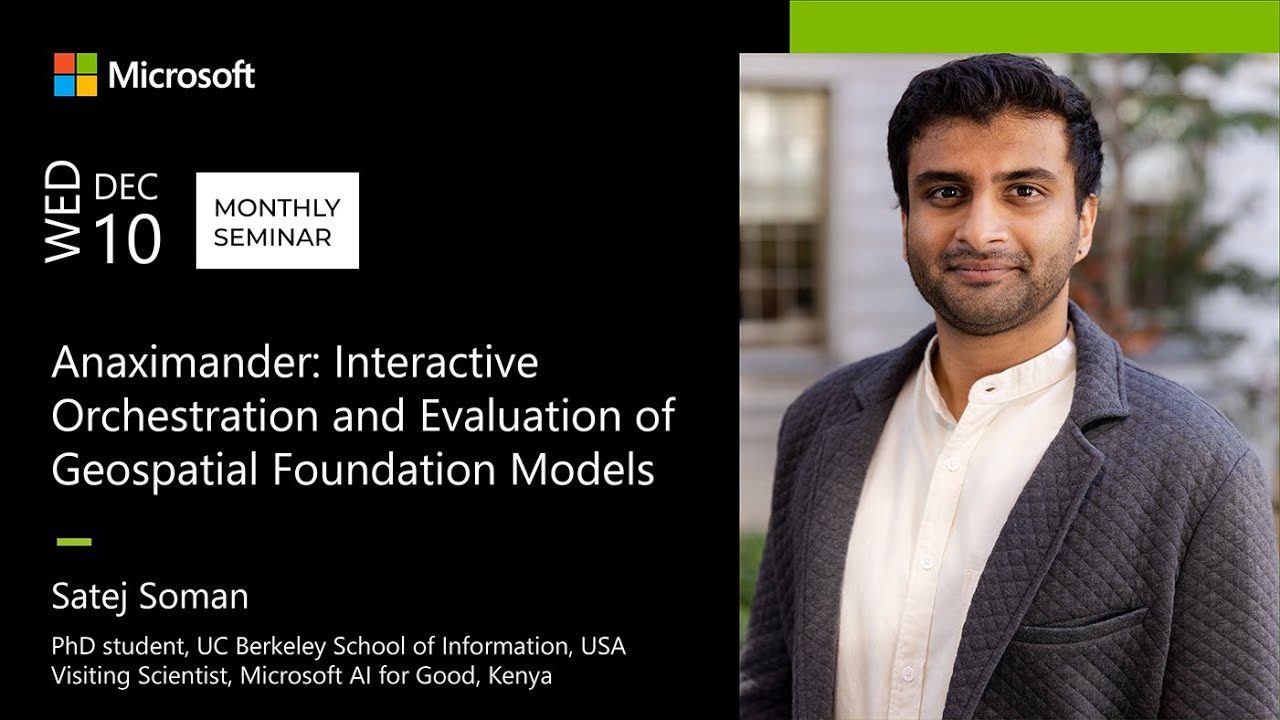
Anaximander: Interactive Orchestration and Evaluation of Geospatial Foundation Models

Anaximander: Interactive Orchestration and Evaluation of Geospatial Foundation Models

This talk introduces Anaximander, a system designed to bridge the gap between traditional, GUI-driven Geographic Information System (GIS) workflows and modern, code-heavy machine learning practices. Anaximander integrates geospatial foundation models directly into QGIS, allowing experts to interactively orchestrate, run, and evaluate models for tasks like semantic segmentation and object detection on satellite imagery.

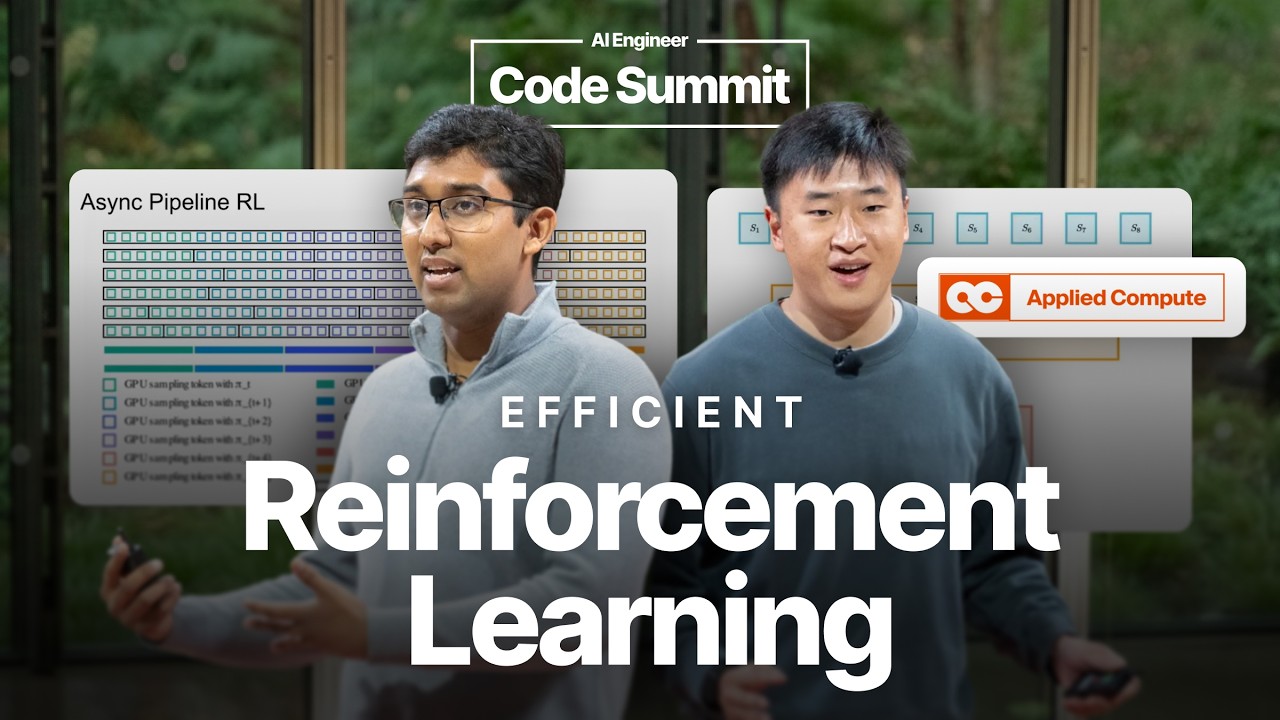
Efficient Reinforcement Learning – Rhythm Garg & Linden Li, Applied Compute

Efficient Reinforcement Learning – Rhythm Garg & Linden Li, Applied Compute

At Applied Compute, efficient Reinforcement Learning is critical for delivering business value. This talk explores the transition from inefficient synchronous RL to a high-throughput asynchronous 'Pipeline RL' system. The core challenge is managing 'staleness'—a side effect of in-flight weight updates that can destabilize training. The speakers detail their first-principles systems model, based on the Roofline model, used to simulate and find the optimal allocation of GPU resources between sampling and training, balancing throughput with algorithmic stability and achieving significant speedups.

Artificial Intelligence

View All
Lessons from Building Open Source Libraries

Lessons from Building Open Source Libraries

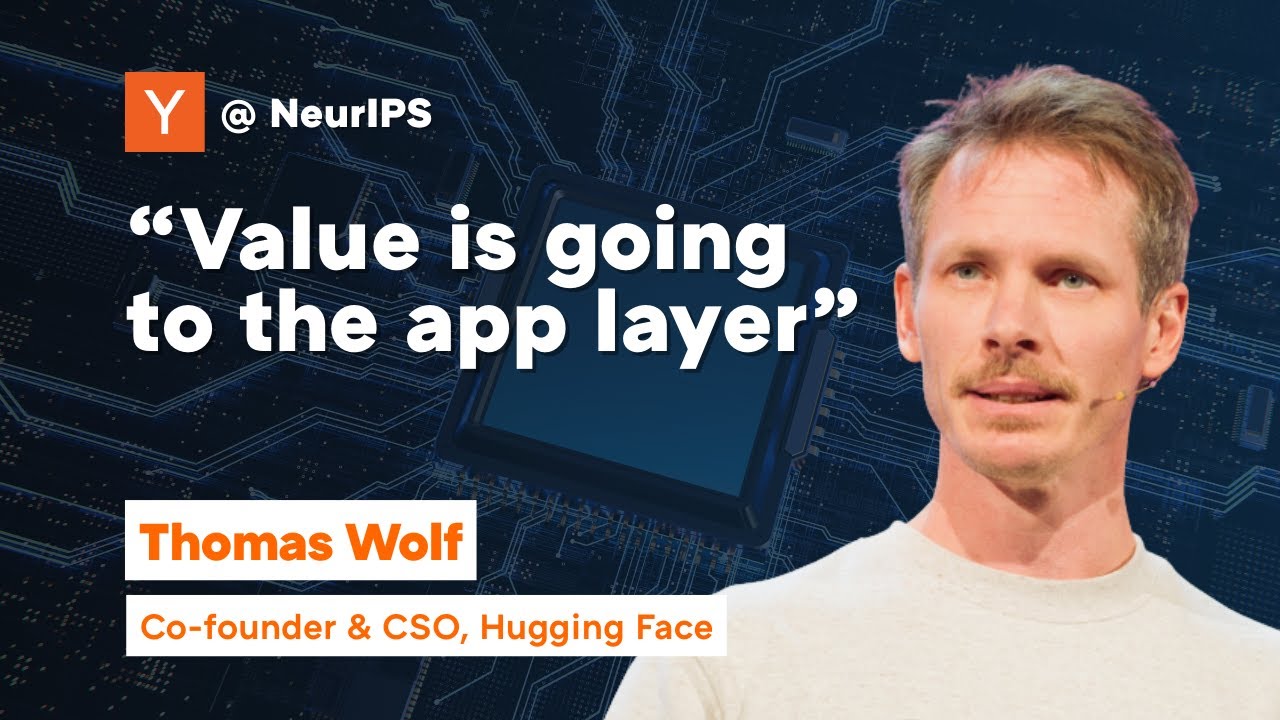
Thomas Wolf, co-founder of Hugging Face, discusses his journey from physics to AI, the power of open-source models to accelerate innovation, the practical challenges of productionalizing AI demos, and why the biggest opportunities for founders now lie in the application layer on top of powerful foundation models.

Modernizing Manufacturing: AI + Robots + Humans | Daren Fields | Founder & CEO | Virtual Select | 4K

Modernizing Manufacturing: AI + Robots + Humans | Daren Fields | Founder & CEO | Virtual Select | 4K

Daren Fields, Co-Founder & CEO of Virtual Select, discusses the future of manufacturing, emphasizing the role of AI as a tool for human augmentation, not replacement. He explores how to modernize manufacturing by combining a carbon-based workforce with silicon-based systems to prevent defects, reduce costs, and de-risk execution.

Claude Cowork analysis & Apple picks Gemini

Claude Cowork analysis & Apple picks Gemini

The panel discusses Anthropic's Claude Cowork and the challenge of user trust in AI agents for everyday tasks. They then analyze the Apple-Google partnership to integrate Gemini into Siri, debating its implications for edge AI, privacy, and hardware limitations. Finally, they explore Linus Torvalds' use of AI for "vibe coding," considering its impact on hobbyist programming and entrepreneurship versus the current limitations in producing production-ready software.

Technology

View All
Palo Alto Networks CEO Nikesh Arora on the Virtues of Being an Outsider

Palo Alto Networks CEO Nikesh Arora on the Virtues of Being an Outsider

Nikesh Arora, CEO of Palo Alto Networks, shares his unconventional journey and leadership philosophy. He provides a masterclass in building a multi-platform company through strategic M&A, explains why founders should sometimes ignore customers, and reveals how to lead with conviction while managing imposter syndrome.

Mental models for building products people love ft. Stewart Butterfield

Mental models for building products people love ft. Stewart Butterfield

Stewart Butterfield, co-founder of Slack and Flickr, shares the product frameworks and leadership principles that guided his success. He delves into concepts like "utility curves" for feature investment, the "owner's delusion" in product design, and why focusing on "comprehension" is often more important than reducing friction. He also introduces powerful mental models for organizational effectiveness, such as combating "hyper-realistic work-like activities" and applying Parkinson's Law to team growth.

Intuit CEO Sasan Goodarzi’s Grown-Up CEO Playbook

Intuit CEO Sasan Goodarzi’s Grown-Up CEO Playbook

Intuit CEO Sasan Goodarzi discusses the operational playbook for reinventing a 40-year-old company, from its slow transition to SaaS to its early adoption of AI. He shares insights on winning the SMB market by treating small businesses like consumers, building effective channel partnerships, and developing a platform strategy. Goodarzi also details his leadership philosophy, emphasizing that grit and curiosity are more critical than raw talent.


Recent Post

Combinators Revisited • Edward Kmett • YOW! 2018

Combinators Revisited • Edward Kmett • YOW! 2018

Edward Kmett revisits the historical approach of compiling lambda calculus to a fixed set of combinators, arguing for its renewed relevance. He contrasts it with modern super-combinator techniques (like GHC's G-machine), highlighting the latter's vulnerability to Spectre attacks. Kmett proposes that a combinator-based evaluation model, combined with SPMD on SIMD execution, offers a secure, highly-parallel alternative that could rival the performance of current systems while providing a unified foundation for advanced compiler features.

AI Agents for Cybersecurity: Enhancing Automation & Threat Detection

AI Agents for Cybersecurity: Enhancing Automation & Threat Detection

An exploration of how LLM-powered AI agents are transforming cybersecurity by moving beyond traditional static rules to provide dynamic, adaptive security operations. The summary covers key applications in threat detection and incident response, while also addressing critical risks like hallucinations and adversarial manipulation, emphasizing a "human-in-the-loop" approach.

#define AI Engineer - Greg Brockman, OpenAI (ft. Jensen Huang, NVIDIA)

#define AI Engineer - Greg Brockman, OpenAI (ft. Jensen Huang, NVIDIA)

Greg Brockman discusses his journey from a math enthusiast to a programmer, his early days scaling Stripe, and the core philosophies that drive OpenAI. He covers the critical partnership between research and engineering, the future of coding with agentic systems, and the immense infrastructure and algorithmic challenges on the path to AGI.

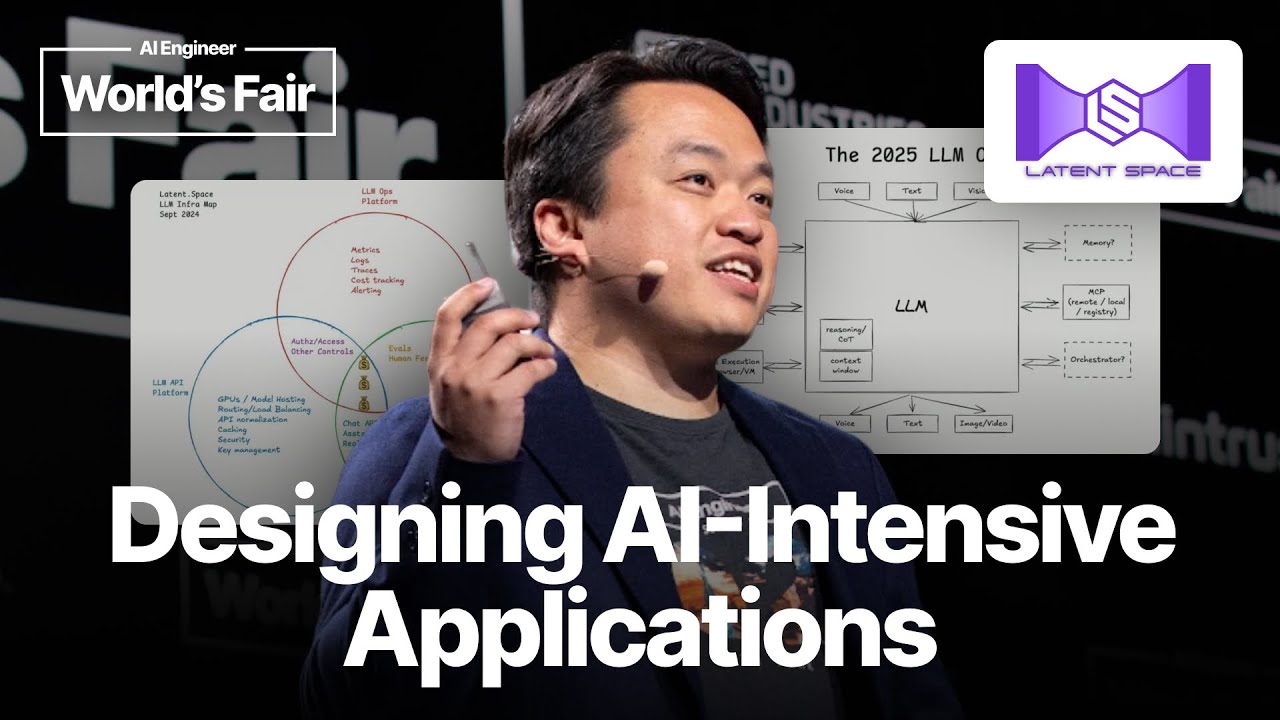
Designing AI-Intensive Applications - swyx

Designing AI-Intensive Applications - swyx

The field of AI Engineering is evolving from simple 1:1 applications to complex, AI-intensive systems with high LLM-call ratios. This talk explores the search for a 'Standard Model' for AI engineering, analogous to MVC or ETL in traditional software, proposing several candidates including LLM OS, LLM SDLC, and a new SPADE (Sync, Plan, Analyze, Deliver, Evaluate) model for building robust applications.

The Truth About LLM Training

The Truth About LLM Training

Paul van der Boor and Zulkuf Genc from Prosus discuss the practical realities of deploying AI agents in production. They cover their in-house evaluation framework, strategies for navigating the GPU market, the importance of fine-tuning over building from scratch, and how they use AI to analyze usage patterns in a privacy-preserving manner.

OpenAI dropped GPT-5, is AGI here?

OpenAI dropped GPT-5, is AGI here?

In this analysis, experts Bryan Casey, Mihai Criveti, and Chris Hay dissect the OpenAI GPT-5 release, comparing its capabilities against Anthropic's Claude Opus 4.1. While GPT-5 introduces significant improvements in accessibility, agentic capabilities, and reliability, the consensus is that it does not yet dethrone Claude as the daily driver for developers due to key differences in user experience and workflow management.

Stay In The Loop! Subscribe to Our Newsletter.

Get updates straight to your inbox. No spam, just useful content.