Ai

The State of Frontier Post-Training Recipes | Conversation with Finbarr Timbers

The State of Frontier Post-Training Recipes | Conversation with Finbarr Timbers

This discussion with Finbarr Timbers reviews the evolution of frontier post-training recipes, highlighting the shift from simpler SFT-DPO-RL to complex multi-teacher on-policy distillation (MOPD). It covers the organizational challenges of building models like Olmo, the rise of synthetic data and reasoning-focused RL in DeepSeek, and the complexities of integrating expert teachers, while also exploring open questions on environments, specialized APIs, and career strategies in the rapidly changing AI landscape.
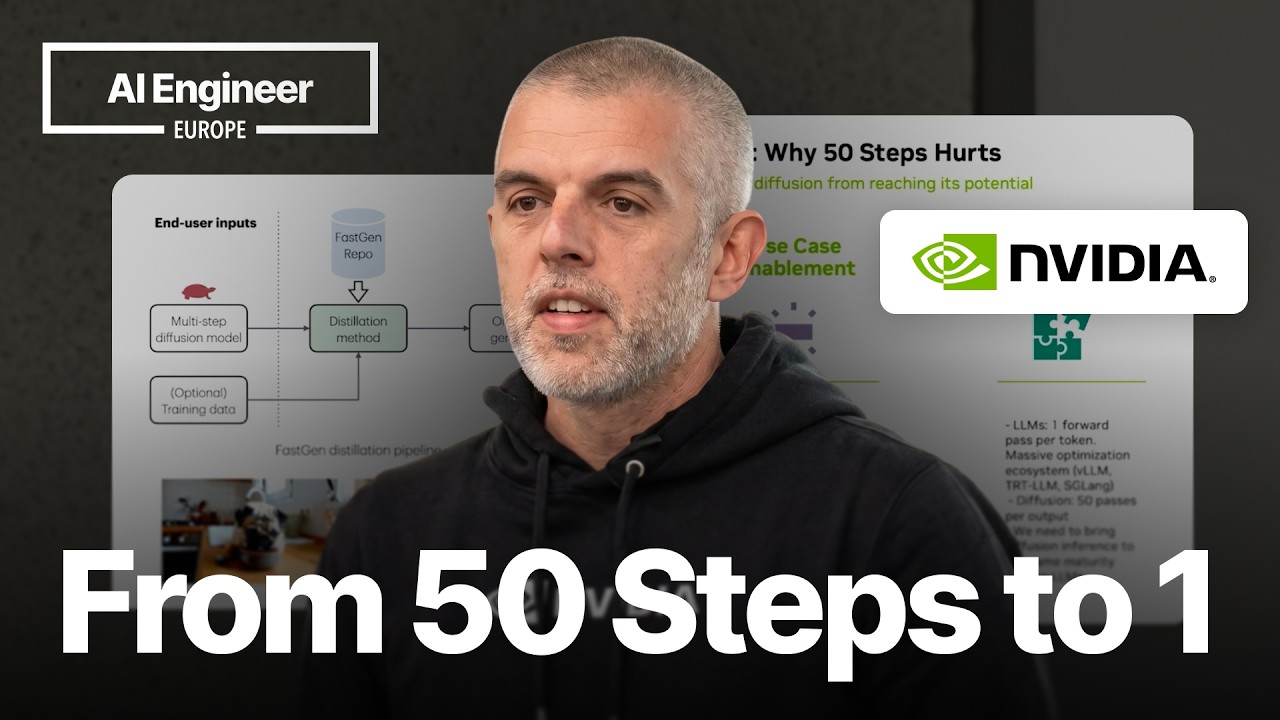
You Might Not Need 50 Diffusion Steps — Ziv Ilan, Nvidia

You Might Not Need 50 Diffusion Steps — Ziv Ilan, Nvidia

Ziv Ilan from NVIDIA details how latency in video diffusion models can be drastically reduced to achieve real-time generation. He presents a layered approach combining dynamic quantization for memory and speed, chunk-based caching to skip redundant denoising computations, and, most critically, step distillation—training models to achieve high-quality output in significantly fewer steps. These techniques, packaged in the open-source FastGen repository, offer additive performance gains, enabling real-time video on a single Blackwell B200 GPU.

Simulating Humans at Scale: Simile's Joon Sung Park

Simulating Humans at Scale: Simile's Joon Sung Park

Joon Sung Park, founder and CEO of Simile and creator of Stanford's "Smallville" generative agents study, explains how Simile is building the "GPU of intelligence" to simulate human society, diverging from frontier models that act as the "CPU of intelligence." He details Simile's approach of grounding simulations with real human behavioral data, its diverse corporate applications, and its long-term vision to create a "CERN of human society" to solve fundamental societal challenges.

Context Engineering for Coding Agents

Context Engineering for Coding Agents

A deep dive into advanced engineering techniques for coding agents, focusing on effective context management in LLMs like Claude. The talk introduces a practical framework using a brain-inspired analogy, proposing a Markdown-based 'wiki' as a long-term memory system to augment the agent's limited context window. This approach is demonstrated through a real-world challenge of extracting structured data from technical drawings.

Stop Making Models Bigger, Make Them Behave — Kobie Crawdord, Snorkel

Stop Making Models Bigger, Make Them Behave — Kobie Crawdord, Snorkel

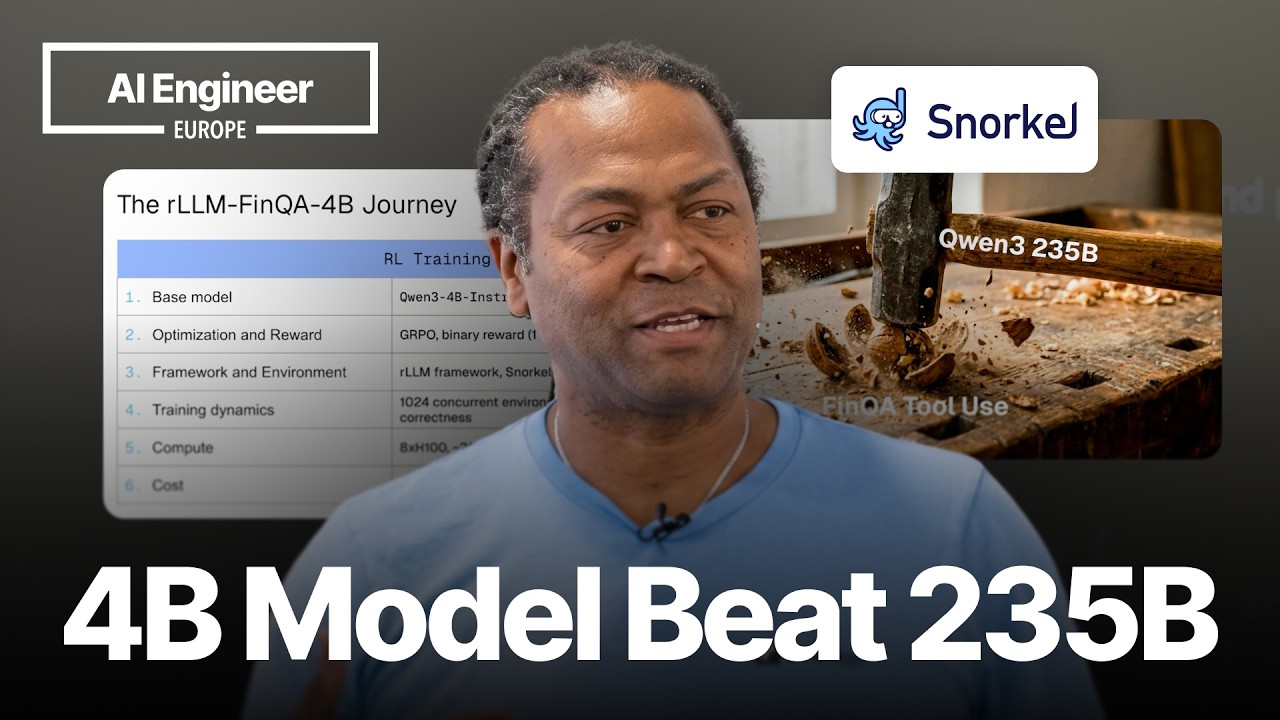
Snorkel.ai's research demonstrates how a 4-billion-parameter model, fine-tuned with Reinforcement Learning for under $500, significantly outperformed a 235-billion-parameter model on financial analysis tool-use tasks. The key was cultivating 'tool discipline' and error correction capabilities, rather than relying on sheer model size or deeper reasoning. Single-table training generalized effectively to harder multi-table problems, emphasizing the importance of targeted behavioral fixes identified through detailed evaluation rubrics.

Sovereign Escape Velocity: Ownership w Open Models — Gus Martins, & Ian Ballantyne, Google DeepMind

Sovereign Escape Velocity: Ownership w Open Models — Gus Martins, & Ian Ballantyne, Google DeepMind

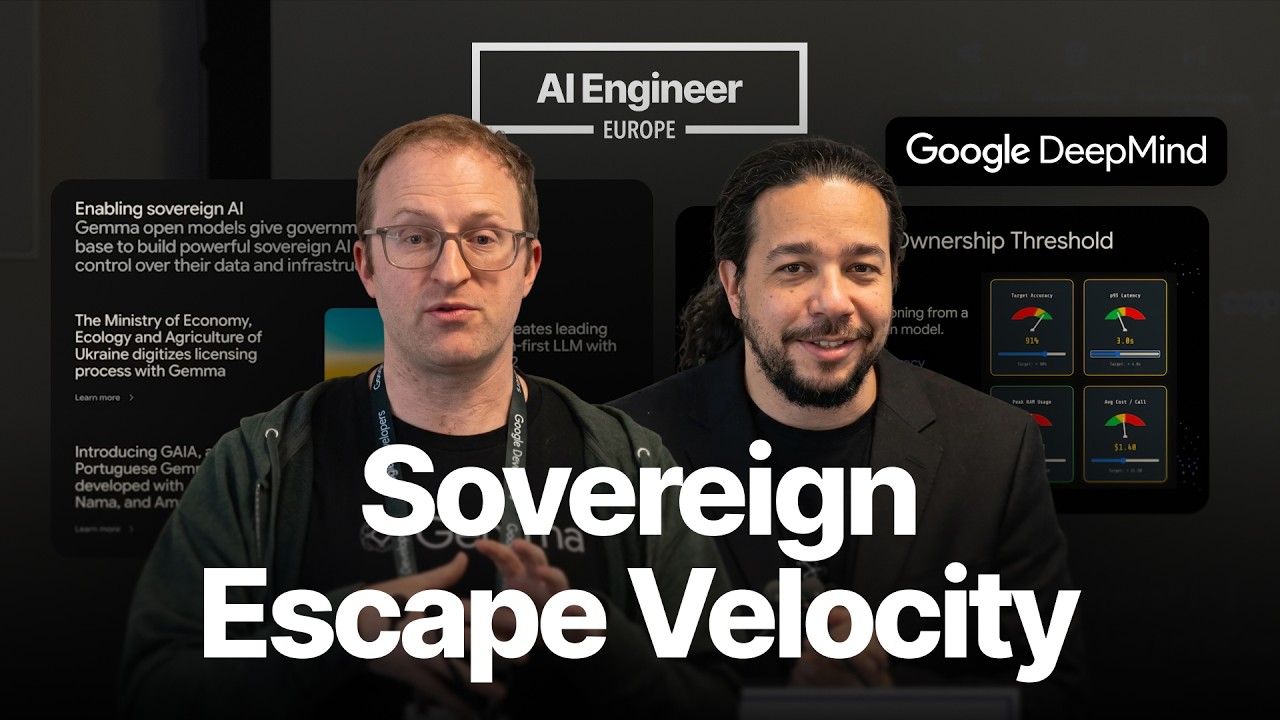
Google DeepMind's Ian Ballantyne and Gus Martins introduce Gemma 4, a family of open models delivering state-of-the-art performance with remarkable size efficiency. They discuss how models like the 31B variant outperform competitors 2-20x its size while running on a single GPU, the shift to an Apache 2.0 license to foster sovereignty and adoption, and the new economics of running powerful agentic workloads on hardware ranging from a Pixel phone to a single enterprise GPU.